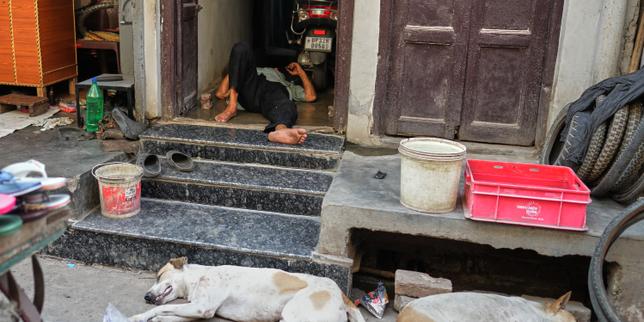
The air does not move. It weighs.
In southern India, when the mercury climbs past 40 degrees Celsius, the atmosphere ceases to be an invisible gas and becomes a physical opponent. It presses against your chest. It fills your lungs with something that feels less like oxygen and more like liquid lead. You can see the heat rising off the asphalt in violent, shivering waves, distorting the horizon until the concrete world looks like it is melting into the sky. You might also find this related article insightful: Why the US Iran Sixty Day Ceasefire Proposal Is a Dangerous Illusion.
Most people experience this kind of heat as an inconvenience. They adjust the dial on an air conditioner. They order an iced drink. They stay inside.
But for millions, shelter is a luxury they cannot afford. For them, the sun is not a weather report. It is a workplace hazard. It is a predator. As reported in detailed coverage by USA Today, the effects are worth noting.
Recent dispatches from the southern states of India report a grim, clinical statistic: at least 16 dead. It is a number that appears in brief, easily ignored news crawls. It is a cold metric meant to summarize a tragedy. But statistics are inherently dishonest because they flatten the agonizing reality of human suffering into a neat rows of digits. They strip away the noise, the smell of sweat, and the sudden, terrifying realization that your body is failing you.
To understand those 16 deaths, you have to look past the spreadsheets. You have to understand what happens when a human being is cooked from the inside out.
The Boiling Point of Labor
Consider an ordinary morning in Hyderabad or Chennai. Long before the sun cuts through the smog, the city is already humming.
Ramesh is a hypothetical composite of the construction workers who line the roadsides of Telangana, but his reality is shared by thousands. He is forty-two years old, though the sun has carved deep, permanent canyons into the corners of his eyes, making him look sixty. He earns a daily wage. In the brutal economy of manual labor, if Ramesh does not work today, his family does not eat tomorrow. The math is that simple. The math is unrelenting.
By ten in the morning, the temperature is already breaching 38 degrees. Ramesh is on a scaffold, hauling bags of cement that weigh fifty kilograms each.
The human body is an exquisite machine designed to cool itself through evaporation. When the internal thermostat in the hypothalamus detects rising temperatures, it signals the heart to pump more blood to the skin, dilating vessels to release heat. Sweat glands open. The moisture evaporates, pulling the heat away. It is a beautiful, delicate equilibrium.
But that equilibrium requires a cooperative environment. When the humidity is high, sweat cannot evaporate; it merely pools on the skin, useless. When the surrounding air is hotter than the body itself, radiation reverses. Instead of the body shedding heat into the world, the world forces its heat into the body.
Ramesh keeps working. He has to. He drinks water from a plastic jerrycan that has been sitting in the sun, the liquid lukewarm and tasting of chemical polyethylene. His heart rate climbs. To dump heat at the skin, his heart must beat faster and harder. It is running a marathon while he is standing still.
Then comes the tipping point.
The Anatomy of Heatstroke
It begins with a profound, disorienting fatigue. Your muscles ache, starved of blood because every available drop is being diverted to your skin in a desperate attempt to cool down. You feel dizzy. The world tilts.
Then, paradoxically, you stop sweating.
This is the most dangerous moment. The body’s cooling system has suffered a catastrophic failure. It has run out of fluids, or the mechanism has simply broken under the strain. The internal temperature skyrockets, blowing past 40 degrees, then 41, then 42.
This is not a fever. A fever is a controlled defense mechanism orchestrated by the body to fight infection. This is hyperthermia. This is the thermal destruction of living tissue.
At these temperatures, the proteins that make up your cellular structure begin to denature. They uncoil and clump together, much like the white of an egg turning opaque and solid in a frying pan. The blood-brain barrier breaks down. Toxins from the gut leak into the bloodstream. The body enters a state of systemic inflammation, a cascading failure where the kidneys shut down, the liver coagulates, and the heart finally gives way under an impossible workload.
When the news reports that someone died of "heat-related illness," this is what they mean. They mean a human being endured a slow, internal breakdown until their vital organs simply quit.
The sixteen people who died in southern India over the past weeks were not abstract data points. They were election officials standing for hours in unventilated polling stations during the massive national elections. They were agricultural laborers harvesting crops under an unforgiving noon sky. They were street vendors who could not abandon their carts because their survival depended on selling a few rupees' worth of fruit before it rotted in the sun.
The Illusion of the Threshold
There is a common misconception that people living in tropical climates are somehow immune to this. We tell ourselves a comforting lie: They are used to it.
We look at historical weather patterns and assume that because India has always known hot summers, its people possess a cultural or biological shield against the heat. This is a dangerous delusion.
Human physiology has hard, evolutionary boundaries. No amount of cultural resilience can alter the temperature at which human enzymes begin to unravel. What has changed is not the human body, but the nature of the heat itself.
The summers of the past were punctuated by relief. Evenings brought a cool breeze; the nights allowed the concrete and stone of the cities to shed their stored energy, resetting the baseline for the following day. That baseline is gone.
Urban centers have transformed into massive thermal sponges. Concrete buildings, asphalt roads, and millions of air conditioning units pumping hot air into the streets create what meteorologists call the urban heat island effect. The city becomes a trap. The temperature does not drop at night. The body never gets a chance to recover. It enters the second, third, and fourth days of a heatwave already exhausted, its cardiac reserves depleted.
The uncertainty of this crisis is what makes it so terrifying. When a cyclone hits, there is a visible enemy. There are howling winds, shattered windows, and rising floods. You can photograph a cyclone. You can point a camera at a destroyed village and understand the scope of the disaster instantly.
Heat is invisible. It leaves no rubble. It does not smash structures. It kills quietly, behind closed doors, in small concrete rooms with tin roofs that act as ovens, or on the shoulder of a dusty road where a laborer sits down to rest and never gets back up. It is a ghost disaster.
The Global Thermostat
The tragedy unfolding in places like Kerala, Tamil Nadu, and Andhra Pradesh is not an isolated local event. It is a preview.
The global climate conversation often focuses on abstract metrics—one and a half degrees of warming, carbon parts per million, targets for the year 2050. These phrases are bloodless. They belong in conference rooms in Geneva and Copenhagen, spoken by people in tailored suits who return to air-conditioned hotels.
The true cost of those numbers is paid in the red dirt of southern India.
Every fraction of a degree added to the global average does not mean a uniform, gentle warming. It means extreme events become more frequent, more intense, and infinitely more lethal. It means the boundary of what is survivable for an outdoor worker is shrinking every single year.
Consider the concept of the wet-bulb temperature. It is a measurement that combines dry air temperature with humidity. It represents the absolute physical limit of human survival. If the wet-bulb temperature reaches 35 degrees Celsius, a healthy human being, sitting in the shade with unlimited water, will die within six hours. The air is simply too thick with moisture and heat for the body to shed its internal warmth.
We are flirting with that limit now. Not in some distant, dystopian future, but right now, in the present tense.
The sun finally dips below the horizon in a haze of purple and orange dust. The sky looks bruised.
In the neighborhoods where the houses are made of brick and tin, the walls are radiating the heat they drank in all day. Inside, the air is stagnant and thick. People lie on thin mats on the floor, moving as little as possible, waiting for a breeze that will not come.
Tomorrow, the sun will rise again. It will climb into a sky that offers no clouds, no mercy, and no cover. The laborers will walk back out to the fields and the construction sites. The vendors will push their carts back into the streets. They will do this because they have no other choice.
The sixteen lives lost in the south of India are a warning written in sweat and grief. They are a reminder that the environment is not something separate from us—not a landscape to be observed or a resource to be managed. We are trapped inside it. And right now, the room is getting smaller.
A woman sits on a stone step, wiping the forehead of her sleeping child with a damp rag. She wrings the cloth out, her movements slow, heavy, and exhausted. The water drips onto the dry earth and disappears instantly, leaving nothing but a dark stain that dries in seconds.


