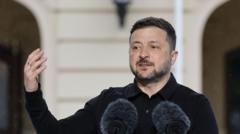
The olive-drab cotton of Volododymyr Zelensky’s sweatshirt does not belong in the State Dining Room of 10 Downing Street. It is a deliberate, jarring choice. Against the backdrop of seventeenth-century oak paneling, gilded frames housing portraits of long-dead British prime ministers, and the immaculate, bespoke tailoring of Western Europe’s political elite, that faded green fabric screams. It smells of underground bunkers, diesel exhaust, and the damp chill of frontline trenches near Kharkiv.
When the Ukrainian president stepped out of a silver convoy onto the damp London pavement, the British drizzle didn’t seem to touch him. He moved with the hurried, heavy gait of a man who measures time not in political terms or election cycles, but in the flight time of ballistic missiles.
This was not a standard diplomatic visit. It was a confrontation between two entirely different realities.
On one side of the mahogany table sat the European leaders, men and women whose greatest daily anxieties involve inflation indices, coalition mathematics, and the shifting moods of suburban voters. On the other side sat a former comedian who now carries the survival of a nation on his hunched shoulders. The air inside the room was thick with the scent of expensive coffee and unspoken desperation.
The Geography of Exhaustion
To understand what happened behind those closed doors, you have to look past the sterile press releases detailing "regional security cooperation" and "strategic defense frameworks." You have to look at the eyes.
Zelensky has aged a decade in four years. The lines around his eyes are deep enough to catch the dim London light, mapping out a geography of sleepless nights and impossible decisions. When he shakes hands with the British Prime Minister, the contrast is stark. The British host is crisp, polished, and operating within the predictable theater of Western democracy. Zelensky looks like he has just emerged from the earth.
Consider the sheer psychological distortion of this journey. A few hours prior, he was in a country where air raid sirens are a daily metronome, where parents routinely check the structural integrity of their children’s school basements. Now, he is handed a porcelain teacup in a room where the biggest immediate threat is a breach of protocol.
The European leaders gathered around him are facing their own quiet crisis. The initial wave of public euphoria that greeted Ukrainian resistance has settled into a grinding, bureaucratic fatigue. Western publics are distracted by the cost of living, by domestic scandals, by the comforting luxury of looking away. The leaders know this. They look at Zelensky and see a mirror reflecting their own broken promises and delayed shipments.
Every handshake in that room carries an invisible price tag. When a European premier smiles for the cameras alongside the Ukrainian leader, they are calculating the political cost back home. How many artillery shells can they send before their own defense ministries sound the alarm? How much financial aid can they authorize before the opposition accuses them of neglecting their own citizens?
The Calculus of the Unseen
Behind the public declarations of unwavering support lies a cold, mathematical friction. Ukraine requires blood and iron; Europe operates on consensus and committee.
Imagine a logistics officer in a supply depot somewhere in eastern Poland. Let’s call him Stefan. Stefan doesn’t read the high-minded communiqués issued from Downing Street. His reality is measured in wooden crates and shipping manifests. Every day, he watches the arrival of mismatched equipment from a dozen different nations. British missiles, German air defense systems, American personnel carriers. It is a logistical nightmare, a tower of Babel built from steel and gunpowder.
Stefan’s job is to make sure these disparate systems speak the same language, use the same caliber of ammunition, and arrive at the front before the next Russian offensive begins. When Western leaders delay a decision on long-range weapons by three months to debate the escalatory risks, Stefan sees the direct consequence: fewer crates on his trucks, more casualties in the field hospitals.
This is the hidden friction that Zelensky brought to London. He did not come to beg for charity. He came to demand a synchronization of realities.
During the plenary session, the European leaders spoke of long-term integration, of five-year economic reconstruction plans, of the complex legal mechanisms required to seize frozen Russian assets. Zelensky listened, his fingers tapping a restless rhythm against his knee. To a man whose country could face a catastrophic breakthrough next week, a five-year plan sounds like dark comedy.
The conversation shifted to air defense. This is where the abstract concept of sovereignty becomes agonizingly concrete. Every Patriot missile battery or Iris-T system parked in a European warehouse is a statistical calculation of safety for a Western city that is not currently under bombardment. To Zelensky, that same battery is the difference between a functioning power grid in Kyiv and a winter spent in freezing darkness.
The debate in Downing Street wasn’t truly about budgets or stockpiles. It was an argument about the definition of time itself.
The Ghost at the Banquet
There was an invisible guest at the Downing Street table, one whose presence dictated every seating arrangement and modulated every tone of voice. The shadow of Washington loomed large over the European summit.
European strategic autonomy has long been a talking point in Brussels and Paris, a comfortable intellectual exercise for peacetime. The war in Ukraine has exposed it as a fragile myth. Without American intelligence, American logistics, and American financial muscle, the European defense apparatus is a engine without fuel.
The leaders gathered in London are acutely aware that the political wind across the Atlantic is shifting. The certainty of American backing is no longer absolute. This realization introduces a frantic, almost panicked energy to the European consultations. If the American umbrella folds, Europe is left exposed on a cold, rain-slicked porch.
Zelensky understands this vulnerability better than anyone. His address to the European leaders was a masterclass in psychological pressure. He did not appeal merely to their altruism; he targeted their self-preservation.
He reminded them of the map. He reminded them that the distance between the frontline trenches in the Donbas and the comfortable cafes of Berlin or Warsaw is measured not in continents, but in a few days' drive. If Ukraine falls, the border of an aggressive, mobilized empire moves directly to the edge of the European Union. The cost of supporting Ukraine now, he implied, is a fraction of the price Europe will pay if it has to defend its own soil later.
The argument is logical, even unassailable. Yet, the human mind is hardwired to reject catastrophic futures until they arrive on the doorstep. The European leaders nod, they agree, they pledge further millions. But their actions still possess the leisurely cadence of a continent that has forgotten the smell of total war.
The Cold Reality of the Red Carpet
As the afternoon light faded into the gray London evening, the leaders emerged for the family photo. They stood on the steps of Number 10, a semi-circle of dark wool coats and silk ties, with the man in the green sweatshirt positioned dead center.
The cameras clicked in an frantic chorus. The images would be broadcast across the globe within minutes, framed as a powerful demonstration of Western unity and resolve.
But watch the video footage closely. Look at the moment the cameras stop flashing and the leaders begin to turn back inside. The smiles vanish instantly. The professional warmth evaporates, replaced by the grim, exhausted expressions of people who know they are caught in a trap of their own making.
Europe cannot afford to let Ukraine lose, but it has not yet found the collective will to ensure it wins.
Zelensky walked back to his vehicle alone, his security detail moving with practiced, aggressive efficiency around him. He did not look back at the historic building or wave to the small crowd gathered at the gates. His mind was already back in the airspace over the Black Sea, calculating the flight path of the next drone swarm, wondering if the promises made in that gilded room would manifest as steel on the ground before the night was through.
The silver doors closed, the convoy pulled away into the London traffic, and the British rain continued to fall, washing away the tire tracks on the asphalt as if no one had ever been there.