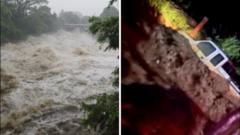
The rain over Hawaii did not fall; it drifted sideways, heavy and grey like wet wool, driven by winds that screamed down the volcanic slopes of Mauna Kea.
When Hurricane Lala tracked just thirty-five miles south of the Big Island, it carried with it an old and terrifying misconception. People think a storm needs to make landfall to destroy a place. They look for the direct bullseye on a map, forgetting that the atmospheric machinery of a hurricane operates on a scale far larger than a coastline. Lala did not need to step ashore to break things. It simply grazed the island's southern flank, exhaled three feet of rain into the high elevations, and left a trail of fractured geography in its wake.
Consider what happened in the Kaʻū District.
Before the storm, towns like Pāhala and Nāʻālehu were quiet communities stitched together by narrow highways and old bridges that crossed deep gulches. By Sunday morning, those bridges had vanished, swept away by brown torrents of water and thick volcanic mud. Over one hundred homes on the Big Island were unmoored from their footings, lifted by floodwaters, and carried away as if they were made of balsa wood.
Imagine standing in your kitchen, watching the floorboards groan upward as water presses through the gaps. Imagine the realization that the road outside, the only concrete artery connecting your family to the nearest hospital, has dissolved into a churning gap of air and debris.
That was the reality for Pāhala, completely cut off when chunks of Highway 11 collapsed overnight. The town’s critical access hospital sat isolated behind miles of impassable mudslides and broken asphalt. Emergency crews attempting aerial surveys on Sunday morning looked down not at neighborhoods, but at isolated islands of rooftops surrounded by brown lakes.
The math of the aftermath is staggering, yet fundamentally inadequate at capturing the human cost. Governor Josh Green estimated statewide damages in the hundreds of millions of dollars. More than two hundred thousand customers lost power across the islands, leaving nearly seventy percent of the Big Island sitting in absolute darkness. Three major hospitals were forced to switch over to emergency backup generators just to keep respirators and surgical suites humming.
Yet numbers do not bleed. They do not smell like rotting vegetation and spoiled food in a powerless refrigerator.
In Nāʻālehu, the historic Punaluʻu Bake Shop—a landmark known to every traveler and a vital local employer—was filled with three feet of mud. Zachary Kennedy, managing the site, looked at a commercial kitchen turned into a settling pond and called it what it was: a different level of devastation. Not a minor inconvenience, but a structural fracture in the daily rhythm of survival.
Down on Oahu, the Honolulu Fire Department answered more than six hundred emergency calls in a matter of hours. Trees crashed through roofs. Power lines whipped through the air like live serpents. In the South Point area, a fatal car crash left investigators questioning whether the wet, blinding roads claimed yet another life, a grim reminder that danger often lingers long after the wind dies down.
The meteorologists have a term for it. They talk about El Niño patterns, warm sea surface temperatures, and the atmospheric energy that supercharges Pacific storms. They point out that Hawaii was overdue for this kind of severe brush, noting that memories of past floods and fires are still fresh in the public consciousness.
But the science misses the texture of the experience.
True disaster recovery is not just about pouring new concrete or stringing copper wire across utility poles. It is the slow, grinding realization that the landscape has changed permanently. The riverbeds have widened. The slopes have shifted. The familiar turnoff is gone.
As the sun finally broke through the retreating clouds on Monday morning, revealing the bruised green peaks of the islands, the real work began. Chainsaws whirred to life against fallen eucalyptus trees. Heavy machinery ground into the mud of the southern tip. People walked out onto their porches, swept the debris from their doorsteps, and looked out at a horizon that had shifted overnight.