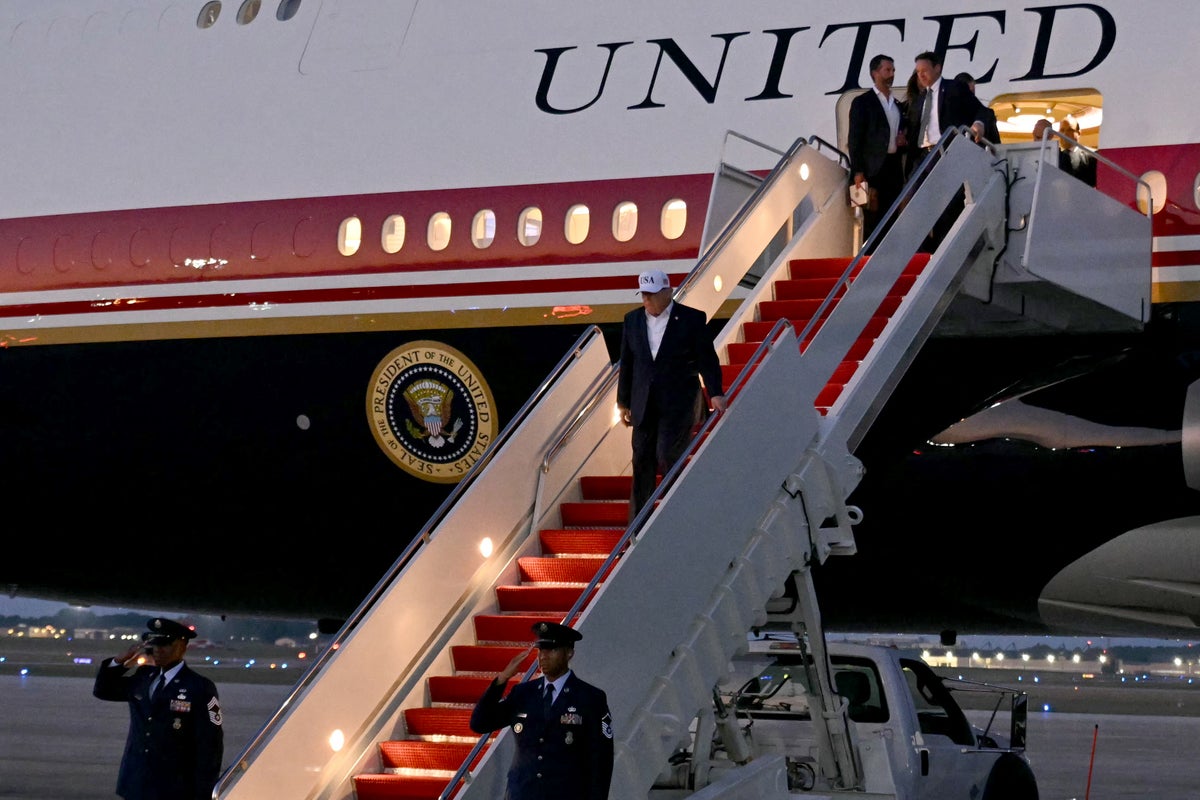
The media outrage machine is operating at full capacity over Donald Trump’s Qatari-gifted Boeing 747-8 being pulled for maintenance less than a month after hitting the tarmac. Critics call it a logistical disaster. Headlines frame it as an embarrassing miscalculation or a glaring oversight.
They are missing the entire point of high-level government defense logistics. Discover more on a similar topic: this related article.
Pulling a foreign-sourced VIP transport aircraft out of rotation weeks into service isn't a failure. It is standard operating procedure executed correctly. The media wants you to believe this is a scandal of planning. In reality, it is a textbook example of how zero-trust supply chain security operates when the stakes involve the head of state.
The Naive Fantasy of "Plug-and-Play" VIP Aviation
Mainstream commentary assumes an aircraft gifted by a foreign state—even a close ally—can simply be handed over, given a quick coat of paint, and flown indefinitely. That assumption is criminally naive. More reporting by BBC News explores comparable perspectives on the subject.
When a presidential or head-of-state transport option changes hands, every foot of wiring, every sensor, every piece of avionics, and every square inch of composite material must be assumed compromised until proven otherwise.
I have watched organizations throw tens of millions of dollars at hardware security audits only to discover they missed a passive listening node embedded inside a non-critical interior panel. In the realm of VIP transport, "good enough" gets people killed.
Taking an aircraft out of service after a brief initial operational period isn't an admission of defect. It is the planned phase two of an ongoing defense sweep.
What the Headlines Get Wrong
- Claim: "The plane was put into service prematurely."
Fact: Initial operational flights often serve as field baselines. You run the aircraft under controlled conditions to observe thermal signatures, signal emissions, and baseline telemetry before tearing it down for deep inspection. - Claim: "A security update within a month signals a security breach."
Fact: Security updates in presidential-grade aviation aren't software patches on your smartphone. They involve physical teardowns, hardening communications arrays, installing countermeasure suites, and replacing non-cleared components with domestic defense-certified hardware. - Claim: "It represents a massive waste of operational resources."
Fact: The cost of grounding a 747 for standard hardening is a rounding error compared to the strategic risk of flying an unverified platform.
Zero-Trust Aviation Means Tearing It Down to the Rivets
The common consensus treats security as a static state: you secure a plane, and then it stays secured. Modern threat environments don't work that way.
In defense aviation, we operate under the principle of continuous intrusion. A modern Boeing 747-8 contains miles of complex wiring and hundreds of bus interfaces. When a sovereign entity receives a foreign-sourced airframe, the initial sweep only covers surface vulnerabilities and immediate flight safety protocols.
To make an airframe truly safe for executive transport, defense contractors must execute a total teardown:
- EMF and Signal Emissions Mapping: Scanning the entire airframe in anechoic chambers to detect unauthorized radio frequency transmissions or hidden passive transponders.
- Avionics Air-Gapping: Stripping non-essential commercial systems and replacing them with encrypted, shielded military communications architectures.
- Countermeasure Integration: Retrofitting the fuselage with directional infrared countermeasures, missile warning systems, and flare dispensers.
Doing all of this before an initial flight period is often logistically inefficient. You fly the platform, gather baseline operational metrics, and then pull it into a secure hangar for deep structural modification. The fact that this specific jet spent less than thirty days in rotation before being pulled simply proves the security apparatus is adhering to a strict, non-negotiable schedule.
The Flawed Questions Everyone Is Asking
People look at headlines like this and ask: "Why didn't they fix it before he flew on it?"
That question fundamentally misunderstands defense procurement. You don't delay initial deployment indefinitely while waiting for long-lead-time defense modifications if the aircraft is deemed safe for low-risk, short-range operational trials. You fly it under controlled conditions, validate the airframe's mechanical integrity, and then pull it back for the heavy lifting.
The real risk was never that the jet was unsafe during its initial weeks. The real risk would have been leaving it in service past the scheduled maintenance window because ground crews feared bad publicity.
The Downside of Transparency
There is a legitimate downside to how this unfolded, but it has nothing to do with aviation mechanics. It is a communications failure.
By failing to set expectations that the airframe would undergo immediate, aggressive post-delivery modification, officials allowed a routine maintenance cycle to be spun as a security lapse. In high-stakes defense operations, optics often sabotage good security practices. When public relations considerations delay necessary teardowns out of fear of "looking unprepared," actual safety is compromised.
The defense team chose the embarrassment of a media cycle over the security risk of a delayed teardown. That was the correct trade-off.
Stop treating routine defense protocol like an unexpected emergency. The jet was pulled because the system worked exactly as designed.