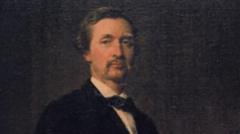
Most people think of Victorian England as a monolith of stiff collars, Sunday church bells, and rigid social hierarchies. They aren't entirely wrong. It was a time when your status was defined by your birth and your devotion to the Church of England. That’s why the story of Henry Edward John Stanley, the 3rd Baron Stanley of Alderley, is so jarring. He didn't just flirt with "Orientalism" like many of his bored, wealthy peers. He actually became the first Muslim member of the House of Lords.
It's a piece of British history that usually gets buried under the weight of Empire narratives. Stanley wasn't a rebel without a cause. He was a man of immense intellect who found the spiritual and legal frameworks of the East more compelling than the stuffy traditions of his own backyard.
A Lord in the Ottoman Courts
Stanley’s journey wasn't a sudden epiphany. It was a slow burn. Born into a powerful political family—his father was a cabinet minister under Lord Palmerston—he was groomed for the highest levels of British diplomacy. He spent years traveling through the East, serving in the British Embassy at Constantinople.
While other diplomats stayed in their bubbles, Stanley went deep. He learned Arabic. He studied Islamic law. By the time he was in his late 20s, he had privately converted. He didn't make a grand announcement to the London press immediately. Instead, he lived a double life for years, navigating the salons of London while maintaining a private devotion to a faith his peers viewed with deep suspicion.
Why Stanley Chose Islam Over the Church of England
If you look at the letters and records of the time, Stanley’s conversion wasn't about "finding himself" in a modern, New Age sense. He was drawn to the clarity of Islam. He often expressed frustration with what he saw as the moral inconsistencies of the British Empire.
To Stanley, Islamic law offered a more coherent approach to social justice and temperance. He was a fierce advocate for teetotalism—abstaining from alcohol—which aligned perfectly with his new faith. In a London society practically lubricated by gin and port, this made him an oddity. He didn't care. He was more interested in the intellectual rigor of the Quran than the social expectations of the Carlton Club.
He eventually succeeded to his father’s title in 1869. This made him the 3rd Baron Stanley of Alderley and, crucially, gave him a seat in the House of Lords. Suddenly, the British establishment had a Muslim peer sitting in their midst, whether they liked it or not.
Rebuilding the Narrative of British Islam
We often hear about the Woking Mosque or the Liverpool Muslim Institute, but Stanley was the quiet powerhouse behind the scenes. He wasn't just a figurehead. He used his wealth and his title to protect the interests of Muslims across the Empire.
When the British government tried to interfere with religious endowments in India or Malaysia, Stanley was the one standing up in the House of Lords to call them out. He understood the legal nuances of Waqf (Islamic endowments) better than most of the colonial administrators. He saw the hypocrisy of an Empire that promised religious freedom but often trampled on it for the sake of administrative convenience.
His contribution to the building of the Shah Jahan Mosque in Woking is a perfect example of his commitment. He wasn't just writing checks; he was ensuring that the first purpose-built mosque in the UK had the political cover it needed to exist in a deeply Christian country.
The Quiet Life at Alderley Park
Despite his radical shift in faith, Stanley stayed connected to his roots in Cheshire. He didn't abandon his responsibilities as a landlord. He just did things differently. He funded the restoration of local churches because he felt a sense of duty to his tenants, even if he didn't share their creed.
His lifestyle was a weird, fascinating blend of East and West. He reportedly had a small prayer room in his manor and followed a strict halal diet, which must have been a logistical nightmare for his kitchen staff in the 1880s. He avoided the hunt—a staple of aristocratic life—and preferred the company of scholars over hunters.
The Scandal of His Burial
The real drama happened when he died in 1903. His family was in a bind. How do you bury a British Lord who is also a devout Muslim? The Church of England had rules, but Stanley had left very specific instructions.
He didn't want a traditional Christian funeral. He wanted to be buried in unconsecrated ground, facing Mecca, according to Islamic rites. The compromise was fascinating and a bit grim. He was buried in the woods of his estate at Alderley Park. No bells. No hymns. Just a quiet, private ceremony conducted by the imam from the Turkish Embassy.
The local papers were scandalized. The idea that a Peer of the Realm would choose the woods over the family vault was seen as a final act of rebellion. But for Stanley, it was the only way to remain consistent with the life he’d chosen.
Understanding the Legacy Beyond the Title
Stanley of Alderley wasn't just a "first." He was a bridge. He proved that you could be deeply British and deeply Muslim at a time when the world thought those two things were at war.
If you want to understand the history of Islam in Britain, you can't just look at migration patterns from the 1950s. You have to look at the Victorian aristocrats who saw something in the faith that their own culture was missing. Stanley’s life challenges the "clash of civilizations" trope that we still deal with today.
He wasn't an outsider coming in. He was an insider who looked out, saw something better, and had the guts to bring it home.
If you're ever in Cheshire, you can still find the spot where he was buried. It's a quiet reminder that British identity has always been more complex and more porous than the history books like to admit.
For those interested in the deeper history of this era, check out the archives at the John Rylands Library or look into the correspondence of the Stanley family. You'll find a man who was far ahead of his time, navigating a world that wasn't quite ready for him. Don't just take the surface-level "eccentric lord" narrative at face value. Look at his speeches in Hansard. Read his defenses of the Ottoman Caliphate. You'll see a political mind that was trying to reconcile the power of the West with the spiritual depth of the East.
Stop thinking of Victorian history as a finished, closed book. There are still chapters like Stanley’s that remind us how much we still have to learn about the people who built the modern world. Grab a copy of The Crescent and the Cross by Timothy Furnish or look up the work of Ron Geaves if you want the full academic breakdown of how these early converts shaped the British Muslim identity.