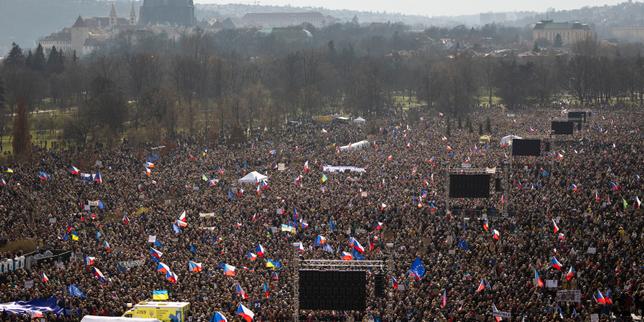
The streets of Prague are once again echoing with a sound that should haunt every populist autocrat in Europe. It is the rhythmic jingling of keys, a symbolic callback to the 1989 revolution that toppled communism. This time, however, the target is not a foreign-backed ideology but a homegrown entanglement of corporate power and political office embodied by Andrej Babiš. While surface-level reporting often frames these protests as simple partisan disagreements, the reality is far more systemic. The Czech Republic is currently the primary laboratory for a dangerous experiment in "agro-populism," where the machinery of the state is being recalibrated to serve the balance sheet of a single massive conglomerate.
The Architecture of a Conflict of Interest
At the center of this storm lies Agrofert. Before he was Prime Minister, Andrej Babiš built an empire that touches nearly every aspect of Czech life, from the bread on the table to the fertilizer in the fields and the newspapers on the stands. When he entered politics promising to run the country "like a firm," many voters found the efficiency narrative appealing. They are now discovering the hidden costs of that business model.
The fundamental issue is not just that Babiš is wealthy. It is that his political power creates a feedback loop with his commercial interests. Even after placing his assets in trust funds to comply with local laws, European Union audits have repeatedly flagged a persistent conflict of interest. The logic is inescapable. As Prime Minister, Babiš influences the distribution of billions in EU subsidies; as the beneficial owner of Agrofert, he is one of the largest recipients of those same funds. This is not a glitch in the system. It is the system.
Subsidy Mining as a Political Strategy
To understand why a quarter of a million people would stand in the rain at Letná Park, you have to look at how subsidies have been weaponized. In the traditional European model, agricultural subsidies were designed to support small farmers and maintain rural landscapes. Under the Babiš administration, the flow has shifted toward industrial-scale operations.
Agrofert’s dominance in the Czech agricultural sector means it is perfectly positioned to capture "per-hectare" payments. This creates a perverse incentive for land consolidation, driving smaller, independent competitors out of business. When the state and the dominant market player share the same nervous system, competition dies. The protesters aren't just angry about corruption; they are witnessing the slow strangulation of the Czech middle class and the independent farming sector.
The Capture of the Regulatory Watchdogs
A billionaire in power does not just influence the budget. He influences the people who are supposed to watch the budget. We have seen a systematic replacement of key figures in the Ministry of Justice and the police force whenever investigations into the "Stork's Nest" affair—a scandal involving alleged fraud of EU small-business subsidies—gain momentum.
This is the "how" of modern authoritarianism. It doesn't require tanks in the streets. It requires a quiet, administrative erosion of independence. By placing loyalists in oversight roles, the administration ensures that any legal challenge becomes a bureaucratic marathon that eventually ends in a cul-de-sac. This legal insulation is what makes the public's frustration so volatile. When the courts and the police appear compromised, the street becomes the only remaining venue for accountability.
The Media Shield
It is impossible to analyze the Babiš phenomenon without acknowledging his ownership of major media outlets, including Mladá fronta DNES and Lidové noviny. In an era of fractured information, owning the two most influential dailies in the country provides a formidable defensive perimeter.
Journalists within these organizations have reported subtle and overt pressures to avoid certain topics or to frame the Prime Minister’s legal troubles as "campaigns" or "plots" orchestrated by a shadowy elite. This creates a dual reality. Half the country sees a titan of industry being unfairly persecuted for his success, while the other half sees a kleptocrat dismantling the rule of law. The media capture ensures that these two groups never speak the same language, effectively neutralizing a unified opposition.
The European Union’s Existential Headache
Brussels is currently paralyzed by the Czech situation. On one hand, the EU is built on the principle of non-interference in the domestic politics of member states. On the other, the EU is a club of taxpayers who are increasingly tired of seeing their money used to enrich a political leader who frequently uses "Brussels-bashing" as a campaign tool.
The European Commission’s audit reports are clear: Babiš still controls Agrofert. Yet, the mechanism to stop the flow of funds is clunky and slow. If the EU cuts off funds to the Czech Republic to punish Babiš, it risks fueling the very nationalist sentiment he uses to stay in power. It is a hostage situation. Babiš knows that as long as he maintains a disciplined voting bloc at home, the EU's ability to discipline him is limited by its own desire for regional stability.
A Legacy of Institutional Decay
The long-term danger of the Babiš era isn't just the money lost to subsidies. It is the precedent. He has demonstrated that if you are rich enough to buy the media and powerful enough to influence the judiciary, the traditional checks and balances of a Western democracy can be bypassed. This is the "Babisification" of politics—a merger of the CEO's office with the Prime Minister's office that treats the national treasury as a revolving credit line.
The protesters in Prague are aware that the clock is ticking. Each year this structure remains in place, the roots of the billionaire state grow deeper into the civil service. The young professionals, students, and pensioners gathering in the squares are not just fighting a person; they are fighting a transformation of their state into a private subsidiary. They are demanding a return to a government that serves the public interest, rather than one that serves a quarterly earnings report.
The persistence of these demonstrations, despite a global pandemic and economic shifts, suggests that the "Velvet" spirit has not entirely evaporated. However, passion in the streets does not always translate to victory at the ballot box. Babiš has built a loyal base of older voters and rural residents by increasing pensions and state wages—effectively using the state's resources to buy the very consent he needs to stay in power. It is a high-stakes game of economic patronage that leaves the country's future mortgaged to the interests of a single firm.
If you want to understand where the Czech Republic is headed, stop looking at the polling data and start looking at the land registry and the subsidy flow. Follow the money, and you will find a trail that leads directly from the halls of power to the silos of Agrofert. The question is no longer whether Babiš has a conflict of interest; the question is whether the Czech state can survive being owned by its leader.
Check the latest audit findings from the European Commission to see exactly how many millions in contested subsidies are currently being withheld or reclaimed.