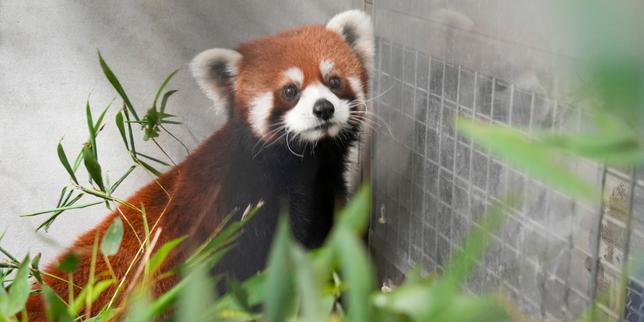
The wooden crate slid across the concrete floor of the Taipei Zoo cargo bay with a low, metallic scrape. Inside, a three-year-old male shifted nervously, his rust-colored fur catching the harsh fluorescent light. Next to him, a two-year-old female sniffed the air, her white-whiskered snout twitching as she encountered a humidity she had never known in Shanghai.
They do not know they are political capital. They do not know that their transit across the Taiwan Strait is the first animal exchange of its kind in over twelve years. To them, the journey is just noise, confinement, and the scent of unfamiliar bamboo. To the rest of the world, they are a pair of Chinese red pandas "infiltrating" Taiwan under the guise of ecological cooperation.
But look closer at the human faces surrounding the enclosure.
A keeper from Taipei reaches through the mesh with a piece of apple, murmuring in a soft Mandarin accent. A few feet away, a conservation official from the mainland nods silently, watching the animals adjust. In this room, the air is thick with unspoken protocol. Outside these walls, fighter jets regularly streak across the Formosa Strait, and official communications between Beijing and Taipei remain frozen in a block of ice. Yet here, in the quiet quarantine sector of a municipal zoo, a city-level handshake has just occurred.
The exchange was simple on paper: two endangered red pandas left the mainland, and in return, Taipei will send white-handed gibbons back to Shanghai. A clean swap. A genetic rescue mission to diversify a dwindling gene pool.
But in the geography of modern statecraft, nothing is ever just a transaction.
Consider how we viewed this game decades ago. In 2008, when Beijing sent the giant pandas Tuan Tuan and Yuan Yuan to Taipei, the names combined meant "reunion." It was a grand, loud spectacle. Children dressed in black-and-white suits lined the streets. It felt like an imperial gift, a soft-power velvet glove wrapping a iron fist. The pro-independence factions in Taiwan saw it exactly as that—a Trojan horse wrapped in fluff, designed to win the hearts of the Taiwanese public while eroding their sovereignty.
Now, the strategy has shrunk. The giant pandas have been replaced by their smaller, solitary cousins. Red pandas are not even closely related to the giant panda; they are the original bearers of the name, described by western science decades earlier, wandering the high-altitude forests of the Eastern Himalayas like solitary fire-cats.
They are quiet. They are subtle. They are the perfect metaphor for a relationship that cannot speak its own name.
The real tension isn’t found in the grand political speeches delivered in Beijing or the defiant press conferences in Taipei. It is lived by the people who have to navigate the space between them. Think of the zookeepers who spent months negotiating nutritional charts and veterinary records via third-party channels because direct ministerial phone lines are dead. Think of the scientists who know that extinction does not care about national borders or maritime boundary lines.
For a red panda, survival is a numbers game. Their global population has plummeted by half over the last two decades due to habitat fragmentation and disease. The females are fertile for only a few fleeting days each year. If the Taipei Zoo cannot introduce new bloodlines, their local population faces genetic stagnation.
The mainland knows this. Taipei knows this.
So, a quiet arrangement was struck. Not between capitals, but between cities. It is a masterclass in grey-zone diplomacy, where cooperation is permitted only if it remains small enough to ignore but significant enough to function.
Critics will look at the two new arrivals and see an infiltration—a soft, adorable deployment of propaganda designed to normalize relations under Beijing's terms. They aren't entirely wrong. Every animal sent across that water carries the invisible weight of a flag.
Yet, as the young male finally takes the apple slice from the Taiwanese keeper's hand, the geopolitics recede into the background, if only for a second. The animal chews slowly, its amber eyes reflecting the humans watching it from both sides of the divide.
The statecraft will continue. The jets will keep flying. But for the next month, in a quiet, climate-controlled room in Taipei, two tiny, displaced creatures will sleep in the canopy, oblivious to the fact that their regular breathing is the only bridge left standing across the strait.


