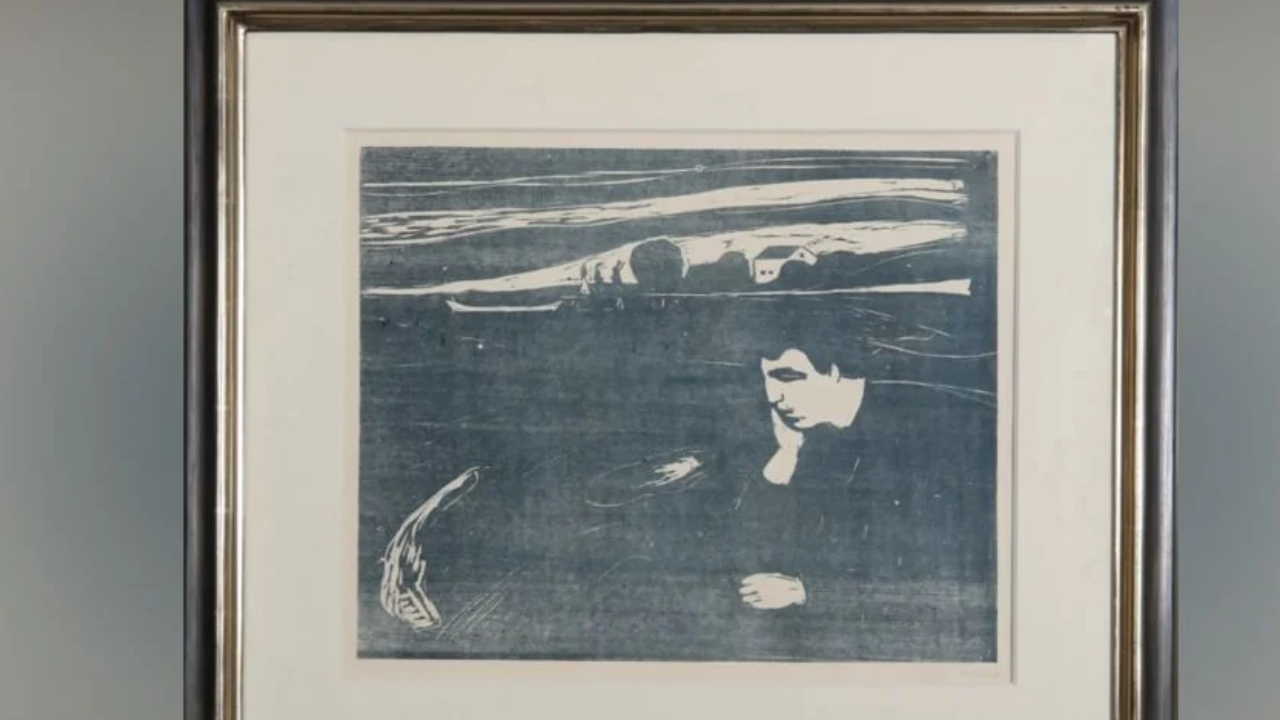
The discovery of a rare Edvard Munch print in England—originally purchased in 1969 and recently valued at up to £80,000—demonstrates how asymmetric information and multi-decade holding periods generate extreme capital appreciation in the secondary art market. While mainstream coverage treats such events as stroke-of-luck anomalies, institutional art advisors and auction specialists evaluate them through strict financial, material, and provenance frameworks. Understanding why a single impression acquired during a post-war market trough commands mid-five-figure valuations half a century later requires deconstructing the printmaking medium, the mechanics of institutional authentication, and the liquidity dynamics of blue-chip Expressionist works.
The Structural Economics of Multi-Decade Art Appreciation
Fine art prints occupy a distinct asset class within the broader collectibles market. Unlike unique oil paintings, where supply is strictly fixed at one, prints exist as multiples. Yet within the market for late nineteenth- and early twentieth-century printmakers like Edvard Munch, the economic reality diverges sharply from modern commercial editions. Munch did not operate under the standardized, strictly numbered editioning practices that govern contemporary printmaking. He treated the printing plate or stone as a dynamic matrix, altering inking techniques, paper stocks, and hand-coloring across different sessions.
This operational approach creates a tiered supply curve. An impression pulled early in the life of a plate, on high-grade paper such as Japan or heavy wove stock, functions economically as a near-unique work rather than a mere reproduction. When a buyer acquired such a piece in 1969, the global market for Northern European Expressionism suffered from severe geographic and informational fragmentation. Post-war British and European collectors could access works through regional galleries or estate sales at prices reflecting local liquidity rather than global demand.
Over a fifty-year holding period, three compounding forces drive the valuation from a modest 1969 acquisition cost to an £80,000 auction estimate:
- Institutional Absorption: Major museums and permanent collections steadily remove high-grade impressions from the circulating supply. Every acquisition by an institution permanently shrinks the available float for private collectors, forcing competitive bidding onto the remaining public impressions.
- Information Centralization: In 1969, verifying an impression's exact state required physical consultation of dense, often incomplete print catalogues. Today, digital databases, high-resolution comparative imaging, and standardized catalogue raisonné references allow global buyers to verify rarity instantly, eliminating the uncertainty discount that previously suppressed prices.
- Currency Devaluation and Hard-Asset Allocation: Across five decades, persistent fiat currency inflation pushes high-net-worth capital toward tangible, culturally validated stores of value. Blue-chip graphic works act as fractional entry points into an artist's market when unique canvases trade in the tens of millions.
The Four Pillars of Fine Print Valuation
When an auction house or private dealer establishes a pre-sale estimate of up to £80,000 for a resurfaced Munch graphic work, the figure is not arbitrary. Valuers apply a rigorous multi-variable underwriting process. A failure in any single variable can reduce an estimate by 70 percent or render the work unsellable at a major house.
1. Catalogue Raisonné Verification and State Identification
The foundational requirement for value is inclusion in Gerd Woll’s Edvard Munch: The Complete Graphic Works, the definitive catalogue raisonné for the artist's prints. Specialists examine the impression under magnification to identify the exact "state"—the specific stage of development of the woodblock, lithographic stone, or copper plate. Early states, or impressions pulled before the plate was cancelled or steel-faced for larger commercial runs, carry exponential premiums. If the English find represents a lifetime impression printed under Munch's direct supervision (often executed by master printers like Auguste Clot in Paris or Lassally in Berlin), its baseline value immediately separates from posthumous restrikings.
2. Physical Condition and Paper Integrity
Prints are acute victims of environmental degradation. Because the 1969 acquisition remained in private hands for decades, specialists evaluate the sheet for structural compromises that typically occur in domestic settings:
- Light Burn and Foxing: Prolonged exposure to ultraviolet light oxidizes wood-pulp fibers, turning margins brown and fading sensitive pigments. High humidity triggers fungal blooms known as foxing.
- Trimming: Historically, framers frequently cut down wide paper margins to fit standard commercial frames. Removing the original deckle edges or reducing margin width below documented tolerances severely penalizes market value, as collectors view the full sheet as integral to the artist's intended composition.
- Mounting Damage: Adhesive residues from acidic cardboard backings leach into the paper, requiring costly conservation treatments by a paper restorer to stabilize the sheet prior to sale.
3. Signature Status and Edition Markings
Munch’s signing habits were notoriously inconsistent. Some lifetime impressions bear his graphite signature in the lower right margin, occasionally accompanied by the printer's signature in the lower left. Others remain unsigned, stamped with the estate mark (Munch-museet or estate executor stamps) after his death in 1944. A crisp, un-faded lifetime pencil signature acts as a primary price multiplier, bridging the gap between an archival artifact and a trophy asset.
4. Unbroken Provenance
A documented acquisition history extending back to 1969 provides crucial insulation against title disputes and forgery risks. The period between 1933 and 1945 represents a high-risk window for German and Scandinavian Expressionist works due to Nazi confiscations of "Degenerate Art" (Entartete Kunst). While establishing a 1969 purchase date does not automatically clear pre-1945 history, it establishes a clean fifty-seven-year chain of peaceful possession, allowing auction house compliance teams to run targeted checks against international art loss registries without facing an opaque recent history.
Market Friction and the Auction Liquidity Trap
A headline valuation of £80,000 represents a gross hammer projection, not net cash in the seller's account. Sellers who misunderstand the fee architecture of the secondary art market frequently miscalculate their actual return on investment. When bringing a rediscovered print to a major international auction house in London or New York, the transaction incurs layered friction costs.
On the sell side, consignors negotiate a seller's commission, though for high-demand works estimated near £80,000, houses often waive this fee to secure the lot. However, sellers routinely absorb fixed operational deductions:
- Insurance Fees: Typically calculated at 1 to 1.5 percent of the hammer price or reserve value to cover transit and exhibition liability.
- Illustration and Marketing Charges: Fees for high-resolution cataloguing, photography, and digital placement.
- Conservation Costs: If the print requires de-acidification or hinge removal to achieve a clean condition report, those laboratory expenses are deducted directly from proceeds.
Simultaneously, the buyer faces a buyer's premium—often 25 to 27 percent on the first tranche of the hammer price—plus applicable Value Added Tax (VAT) on the premium and Artist’s Resale Right (DROIT de Suite) royalties where statutory thresholds apply. Because rational bidders factor these all-in acquisition costs into their maximum bid ceilings, the buyer's premium directly compresses the hammer price the seller receives. A buyer willing to spend £100,000 total will cap their hammer bid at approximately £78,000 to absorb the house's fee structure.
The Risk of Over-Valuation and the "Burned" Lot Phenomenon
In regional discoveries, the greatest threat to realizing maximum value is aggressive pre-sale pricing. If an auction specialist sets the reserve price—the confidential minimum amount the seller will accept—too close to the upper £80,000 estimate, the lot risks failing to sell.
In the fine art market, an unsold lot is publicly recorded as "bought in" (BI) across major price databases like Artnet and MutualArt. Once a print is "burned" in a public auction room, its marketability degrades immediately. Dealers and collectors assume the work suffers from hidden condition defects, questionable authenticity, or an unrealistic seller, forcing the owner to wait years before re-offering the piece, usually at a steep discount.
To mitigate this downside, institutional sellers utilize conservative estimates—for example, publishing a range of £40,000 to £60,000 for a print believed capable of reaching £80,000. Lower estimates bypass the psychological resistance of early bidders, generate competitive bidding momentum across telephone and online channels, and frequently push the final hammer price beyond the initial high projection through competitive auction dynamics.
Limitations of the Rediscovery Thesis
Treating this English discovery as a blueprint for general art investing introduces severe survivorship bias. For every 1969 purchase that appreciates to £80,000, thousands of prints acquired in the same era were posthumous reproductions, photomechanical offsets, or works by minor regional artists whose market value declined to zero in real terms.
Furthermore, the fine print market exhibits extreme sensitivity to micro-trends. While Munch’s iconic subjects—such as The Scream, Madonna, or Vampire—command deep, recession-resistant global liquidity, his lesser-known landscape or portrait prints experience wider bid-ask spreads and longer time-to-sale metrics. Valuation estimates remain strictly conditional until physical inspection under raking light and ultraviolet lamps confirms the absence of sophisticated restoration or bleached margins.
Strategic Execution for Private Holders of Unverified Graphic Works
When a private individual uncovers a potentially significant twentieth-century print acquired decades ago, immediate public exposure or premature restoration destroys value. Executing a disciplined monetization strategy requires following a strict operational sequence:
- Freeze Physical Intervention: Do not remove the print from its existing frame, attempt to clean the glass, or trim frayed paper edges. Amateur handling introduces skin oils, tears, or creases that permanently lower the condition grade.
- Compile Documentary Evidence: Gather all 1969 receipts, gallery labels on the reverse of the frame, correspondence, and inheritance records. Provenance documentation must be digitized before the work leaves the owner's possession.
- Solicit Blind Multi-House Valuations: Submit high-resolution photographs of the recto (front), verso (back), signature, and any watermarks to the print departments of at least three competing international auction houses. Request written estimates alongside proposed fee waivers and marketing commitments.
- Enforce Conservative Reserve Structuring: Select the house that demonstrates deep catalogue raisonné expertise rather than the one offering the highest speculative estimate. Anchor the reserve price at or slightly below the low estimate to guarantee liquidity and force competitive bidding to establish the true market ceiling.