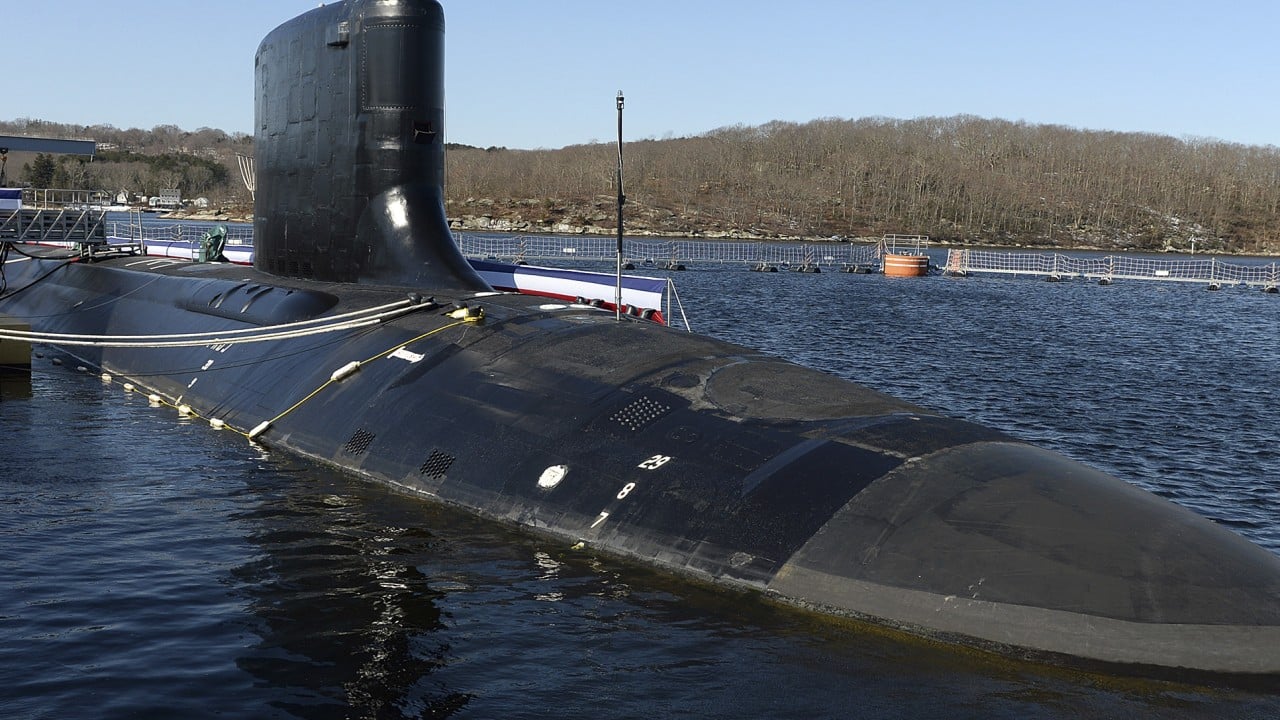
Australia is preparing to host the USS Colorado at HMAS Stirling near Perth, marking the first rotational deployment of an American Virginia-class nuclear-powered submarine under the trilateral AUKUS pact. While headlines frame this arrival as a ceremonial milestone in defense cooperation, the operational reality runs much deeper. Washington, Canberra, and London are actively constructing a forward-operating maintenance and logistics hub on the eastern edge of the Indian Ocean, a move designed to bypass the geographic tyranny of the Pacific and complicate naval planning for Beijing.
For decades, the primary bottleneck for American submarine operations in the Indo-Pacific has been distance. A boat deployed from Pearl Harbor or Guam burns weeks of valuable patrol time simply transiting to and from contested waters in the South China Sea or the Indian Ocean. When a submarine requires routine maintenance, crew rest, or minor repairs, that transit penalty doubles. By establishing Submarine Rotational Force-West (SRF-West) at Fleet Base West on Garden Island, the Pentagon gains a forward sanctuary outside the immediate reach of regional ballistic missile threats while cutting transit times to strategic chokepoints like the Malacca, Sunda, and Lombok straits by days.
The Mechanics of Forward Submarine Sustainment
Parking a nuclear-powered attack submarine at a foreign pier requires far more than deep water and extra mooring lines. The USS Colorado (SSN-788), a Block III Virginia-class fast-attack boat commissioned in 2018, operates on a pressurized water reactor fueled by highly enriched uranium. Unlike conventional diesel-electric vessels—such as Australia’s aging Collins-class submarines—nuclear boats do not need to surface to recharge batteries, giving them virtually unlimited underwater endurance limited only by food supplies and crew stamina.
Supporting that capability in Western Australia demands an industrial ecosystem that previously did not exist in the southern hemisphere. Over the past several years, Australian and American defense planners have poured billions of dollars into upgrading HMAS Stirling. These upgrades are not merely cosmetic. They include specialized shore power infrastructure capable of feeding massive electrical loads to the boat while its reactor is shut down, radiation monitoring networks, secure communications links, and heavy-lift crane facilities.
More importantly, the arrival of the Colorado serves as a live-fire stress test for Australian technicians and engineers. Under the AUKUS Pillar One timeline, Australia is scheduled to purchase between three and five Virginia-class submarines from the United States starting in the early 2030s, bridging the gap until the joint UK-Australian SSN-AUKUS design enters service in the 2040s. You cannot hand over keys to a nuclear submarine without first building a workforce that knows how to fix one.
Australian personnel have already been embedding aboard US submarines, attending nuclear power school in South Carolina, and working alongside American shipyard crews in Pearl Harbor and Guam. When the USS Colorado ties up at Garden Island, those theoretical lessons meet salt water and steel. Australian maintainers will participate directly in intermediate-level maintenance—swapping out pumps, calibrating sonar arrays, and servicing non-nuclear mechanical systems under the supervision of US Navy tender crews.
The Quiet Deterrence of the Virginia Class
To understand why Beijing views the USS Colorado’s presence in Perth with acute alarm, look at what the boat actually carries beneath its hull. The Virginia-class platform was originally conceived in the post-Cold War era for littoral operations, intelligence gathering, and special forces insertion. However, the Block III variant—which includes the Colorado—introduced major structural redesigns tailored for high-end naval warfare.
The traditional spherical sonar array in the bow was replaced with a Large Aperture Bow (LAB) array backed by water rather than air, dramatically improving passive acoustic detection ranges in noisy coastal waters. Even more consequential is the weapons payload. Block III boats replaced twelve individual vertical launch tubes with two massive Virginia Payload Tubes (VPTs), each capable of launching six Tomahawk land-attack cruise missiles using multiple-all-up-round canisters.
Combined with four 533mm torpedo tubes firing Mark 48 Advanced Capability (ADCAP) heavyweight torpedoes and Harpoon anti-ship missiles, a single boat like the Colorado holds enough firepower to threaten both surface task forces and hardened coastal infrastructure from hundreds of miles away. Because nuclear propulsion allows the vessel to sprint across ocean basins at speeds exceeding 25 knots without betraying its position to overhead satellites or maritime patrol aircraft, an adversary never knows precisely when a boat has left Perth or where it has gone.
That ambiguity is the entire point. Deterrence in undersea warfare relies on uncertainty. When the USS Colorado operates out of Western Australia alongside up to four US boats and one British Astute-class submarine by 2027, naval strategists in the People's Liberation Army Navy (PLAN) face a two-ocean dilemma. They can no longer concentrate anti-submarine warfare assets solely along the First Island Chain in the Western Pacific. They must now account for silent, heavily armed submarines entering the theater from the southwest, flanking traditional defensive perimeters.
The Industrial Bottleneck Nobody Wants to Admit
Despite the strategic logic behind SRF-West, the AUKUS submarine enterprise rests on a precarious industrial foundation. Critics in both Washington and Canberra have repeatedly pointed out a glaring mathematical problem—the United States Navy is currently struggling to build enough submarines for its own fleet.
American shipyards, primarily General Dynamics Electric Boat in Connecticut and Huntington Ingalls Industries in Virginia, have been bogged down by supply chain fractures, skilled labor shortages, and post-pandemic inflation. The US Navy’s stated goal is to produce two Virginia-class boats per year while simultaneously building the massive Columbia-class ballistic missile submarines, which are the nation's top nuclear modernization priority. In reality, production rates for the Virginia class have hovered closer to 1.2 to 1.4 boats annually.
This production deficit creates real political friction on Capitol Hill. Under the AUKUS agreement, Washington must sell at least three existing or newly built Virginia-class boats to Australia in the next decade. Skeptical lawmakers in the US Congress have argued that transferring scarce hulls to an ally—even one as reliable as Australia—temporarily shrinks the American submarine force at the exact moment tensions over Taiwan are peaking.
To mitigate this concern, Canberra agreed to invest roughly $3 billion directly into the US submarine industrial base to help expand shipyard capacity and train welders and pipefitters. Yet money cannot instantly conjure experienced naval architects or specialized forging facilities. If American production rates do not climb significantly over the next five years, a future US president will face an agonizing choice between honoring the AUKUS transfer schedule or retaining hulls for the US Seventh Fleet.
Sovereignty and the Nuclear Question in Australia
Inside Australia, the rotational presence of the USS Colorado revives long-standing debates over national sovereignty, environmental safety, and strategic autonomy. Australia has maintained a strict ban on domestic nuclear power generation since the late 1990s, and public sensitivity regarding radioactive waste and reactor safety remains high, particularly in Western Australia.
Government officials have spent months assuring residents in Perth and Rockingham—the coastal town adjacent to HMAS Stirling—that visiting US submarines pose virtually zero radiological risk. Pressurized water reactors on modern American boats are sealed units designed to operate for the entire 33-year lifespan of the hull without refueling. When the USS Colorado visits Perth, no nuclear fuel will be loaded or unloaded, and high-level radioactive waste will not be stored on Australian soil.
Low-level radioactive waste, however, is another matter. Routine maintenance on primary coolant loops generates contaminated rags, filters, and protective clothing. Under Australian legislation passed to enable AUKUS, the Australian Defence Force will eventually establish facilities on defense land to manage and store low-level waste generated by its own future nuclear fleet, though waste from visiting US boats remains the legal responsibility of the United States.
Beyond environmental concerns lies a deeper geopolitical critique voiced by former Australian Prime Minister Paul Keating and various foreign policy realists. Their argument is blunt—by anchoring Australia’s premier naval base to American submarine rotations and integrating its defense industry into US supply chains, Canberra forfeits the ability to stay out of a future conflict between Washington and Beijing.
If war breaks out in the Taiwan Strait, HMAS Stirling instantly becomes a high-priority target. Critics contend that hosting the USS Colorado locks Australia into a forward-deployed posture that serves American primacy rather than independent Australian defense. Proponents counter that isolationism in the twenty-first century is an illusion, arguing that a coercive regional hegemon would strangle Australia’s maritime trade routes regardless of whether American submarines tied up in Perth.
What Happens Once the Lines Are Cast Off
The docking of the USS Colorado is neither the beginning nor the end of this transformation; it is the point of no return. Once American nuclear submarines begin operating routinely out of Western Australia, the logistical, political, and military integration between the two nations becomes exceptionally difficult to unwind.
Over the next 24 months, activity at Garden Island will accelerate rapidly. Hundreds of US Navy sailors, civilian technicians, and their families will relocate to Perth, testing local housing markets, schools, and municipal infrastructure. Australian defense contractors will transition from theoretical readiness audits to hands-on maintenance work under strict US Naval Reactors oversight—an organization legendary for its zero-tolerance approach to engineering shortcuts.
Meanwhile, regional neighbors across Southeast Asia are watching closely. Nations like Indonesia and Malaysia have expressed mixed reactions to AUKUS, publicly emphasizing adherence to the Treaty of Bangkok, which establishes Southeast Asia as a nuclear-weapon-free zone, while privately remaining wary of any escalation in great-power competition on their doorstep. Because Virginia-class boats carry only conventional weapons, AUKUS technically complies with non-proliferation treaties, yet the transit of naval reactors through Indonesian archipelagic sea lanes remains a diplomatic tightrope for Canberra.
For the crew of the USS Colorado, pulling into HMAS Stirling means fresh supplies, shore leave in a friendly port, and a brief respite from the monotonous hum of submerged patrol. For defense planners in Washington, London, and Beijing, that quiet arrival on the Indian Ocean coast marks the physical birth of a new undersea architecture—one that stretches the reach of Western naval power across two oceans and alters the strategic geometry of the Indo-Pacific for the next half-century.