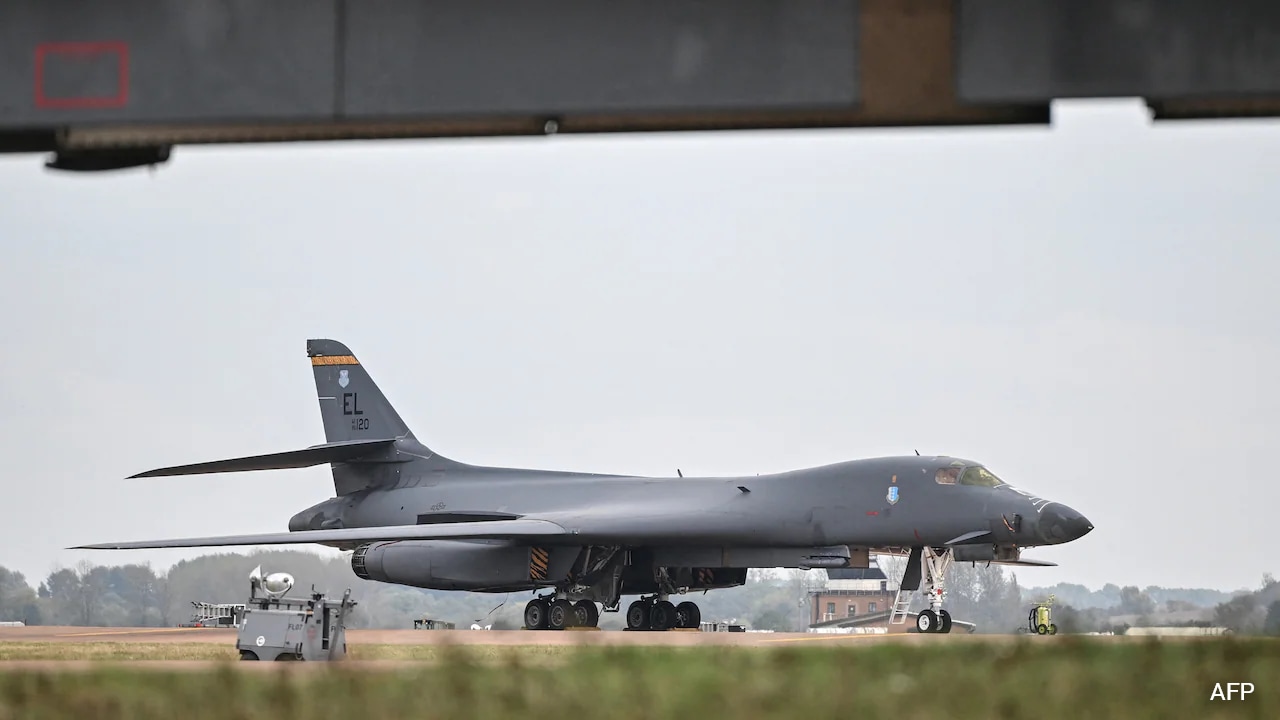
The Pentagon does not move high-value air assets across the Atlantic on a whim. When reports surfaced that the United States had withdrawn military aircraft from a key British air base due to an Iranian threat, surface-level commentary immediately framed the move as a retreat. That reading misses the mechanics of modern force protection entirely. The withdrawal is not an admission of weakness; it is a calculated dispersal maneuver designed to strip Tehran and its proxy networks of stationary, high-visibility targets while positioning American airpower closer to operational theaters or inside hardened, less predictable nodes.
To understand what is actually happening on the tarmac in the United Kingdom, you have to look beyond the sensationalist headlines and examine the vulnerability of forward-operating hubs in Western Europe. For decades, bases like RAF Fairford, RAF Lakenheath, and RAF Mildenhall have served as the indispensable logistical bridge between the continental United States and the Middle East. They are predictable. Everyone from commercial satellite operators to hostile intelligence services knows the exact coordinates of every hangar, fuel farm, and runway apron on those installations.
The Vulnerability of Predictable Tarmac
Static airfields are an intelligence officer's dream. When heavy bombers, aerial refueling tankers, or reconnaissance platforms sit parked on British soil during periods of heightened tension with Iran, they become magnets for asymmetric disruption.
The threat matrix in Western Europe has shifted dramatically over the past several years. Historically, security planners at British bases worried primarily about conventional state espionage or localized protests at the perimeter fence. Today, the threat environment includes commercial off-the-shelf drones, cyber-enabled sabotage against local power grids, and covert operative cells capable of conducting stand-off attacks. An aircraft worth hundreds of millions of dollars sitting on an unhardened apron in Gloucestershire or Suffolk is uniquely exposed to a five-hundred-dollar quadcopter carrying an improvised explosive device.
Dispersal solves this problem instantly. By pulling aircraft out of a known staging post, military planners force an adversary to restart their targeting cycle from scratch.
Consider how Agile Combat Employment works in practice. Rather than massing dozens of airframes at a single massive hub where one successful strike or sabotage operation could cripple an entire wing, commanders scatter smaller detachments across multiple locations or pull them back to sovereign bases with layered, domestic air defense architectures. If the aircraft are relocated forward to hardened bases in the Persian Gulf or the Eastern Mediterranean, they gain the protection of integrated Patriot and THAAD batteries. If they are pulled back to the United States, they sit outside the operational reach of Iranian proxy networks entirely while remaining capable of global strike missions via aerial refueling.
The Intelligence Blind Spot
Public reporting on military movements rarely captures the full picture because operational security dictates silence during active force posture adjustments. When a news outlet reports that the US withdraws military aircraft from a UK air base, the story almost always relies on open-source flight tracking data—ADS-B transponders pinging over the North Atlantic—or amateur plane spotters photographing empty ramps through chain-link fences.
Both sources have severe blind spots. Military aircraft routinely turn off their public transponders when entering sensitive airspace or executing classified repositioning flights. Spotters see a bomber task force depart RAF Fairford and assume a withdrawal has occurred, without seeing the specialized transport aircraft arriving at a different British airfield under the cover of darkness, or understanding that the deployment window had simply concluded ahead of a scheduled rotation.
Yet even when a withdrawal is directly tied to a specific threat warning, the public narrative usually gets the causality backward. Intelligence agencies do not wait for an attack to materialize before recommending a posture change. They look for indicators and warnings—anomalous communications traffic, unusual travel patterns by known intelligence officers, or heightened surveillance around base perimeters. Moving aircraft in response to those signals is standard risk management, not panic.
Why Britain Sits on the Front Line of Iranian Asymmetric Reach
Geography offers no sanctuary when an adversary relies on covert networks rather than ballistic missiles. Iran cannot hit the United Kingdom with its conventional missile arsenal, which maxes out around two thousand kilometers. Tehran does not need to.
Western intelligence services, including MI5 and the FBI, have repeatedly warned about Iran's reliance on criminal syndicates and proxy operatives to conduct surveillance and lethal plotting on European soil. Over the last few years, British authorities have disrupted numerous plots linked to Tehran, targeting dissidents, journalists, and diplomatic infrastructure. Extending that operational model to monitor or disrupt American military staging bases in the UK requires minimal logistical adaptation.
British air bases occupy a unique legal and operational gray area. They are sovereign Royal Air Force stations hosting American forces under longstanding visiting forces agreements. Perimeter security is primarily a British responsibility, governed by UK domestic law and policing standards, which operate under much tighter constraints regarding the use of lethal force and domestic surveillance than bases inside the United States.
Hostile actors exploit these seams. Flying a reconnaissance drone near a British airfield often results in a local police response rather than an immediate kinetic intercept, simply because peacetime airspace regulations over rural England prioritize civil aviation safety over military shoot-down protocols. For an American wing commander responsible for strategic bombers or specialized surveillance jets, those peacetime constraints become unacceptable liabilities the moment intelligence chatter spikes.
Operational Mechanics of a Tactical Pullback
When the Pentagon decides to reduce its footprint at a European base due to threat reporting, the execution follows a strict hierarchy of priorities.
First come the high-demand, low-density assets. These are aircraft that cannot be easily replaced and whose loss would degrade global intelligence or strike capabilities for years. Strategic reconnaissance platforms, specialized electronic warfare aircraft, and nuclear-capable bombers top this list. Getting them off exposed tarmac takes precedence over everything else.
Second are the force multipliers, primarily aerial refueling tankers like the KC-135 Stratotanker and KC-46 Pegasus. Without tankers, the US Air Force cannot project power across the Atlantic or sustain combat air patrols in the Middle East. However, tankers are large, slow, and notoriously difficult to hide inside standard hardened aircraft shelters. Leaving rows of them parked wingtip-to-wingtip on a British runway during a period of elevated threat is an invitation to disaster.
Third comes the logistical tail—maintenance crews, munitions handlers, and command-and-control elements. Moving the jets takes hours; moving the people and spare parts takes weeks. Frequently, what looks like a total withdrawal is actually a shell-game posture. The aircraft depart to safer operating locations, while the ground crews remain in place, maintaining the infrastructure so the jets can surge back into the base at a moment's notice if hostilities erupt.
The Hypothetical Alternative
To see why withdrawal makes operational sense, consider a hypothetical scenario where commanders ignore threat warnings to avoid looking weak in the press. Imagine a squadron of strike fighters remains parked on an open ramp in East Anglia despite intelligence indicating a localized drone threat. To protect those jets in place, the military would have to deploy short-range air defense systems, jam commercial GPS frequencies across a wide swath of the English countryside, restrict civil air traffic, and place hundreds of security personnel on exhausting twenty-four-hour alert cycles.
That defensive posture is unsustainable. It burns through readiness, strains diplomatic relations with the host nation, and degrades the aircrew's ability to actually fly combat missions. Moving the aircraft out of the threat ring costs a fraction of the effort and preserves combat power for when it is actually needed.
The Strategic Cost of Emptying the Ramp
Every tactical adjustment carries strategic trade-offs, and pulling aircraft out of the UK is no exception. Adversaries watch the runways just as closely as plane spotters do, and they use those observations for information warfare.
Iranian state media and its aligned proxy channels thrive on narratives of American retreat. Images of empty dispersal pads in Britain feed directly into Tehran's domestic propaganda, reinforcing the message that American power in the region is brittle and easily deterred by the mere threat of retaliation. Even if the Pentagon knows the aircraft were simply repositioned to more advantageous bases, the visual optics of a pullback hand an easy messaging victory to Iranian information operators.
There is also the subtle friction it introduces into the transatlantic alliance. The United Kingdom prides itself on being Washington's most reliable military partner, the unsinkable aircraft carrier moored off the coast of Europe. When the US pulls assets out of British bases due to security concerns, it implicitly highlights limitations in host-nation force protection. While defense officials in London and Washington routinely coordinate these moves behind closed doors, sudden withdrawals can spark uncomfortable questions in Parliament about the readiness of UK domestic defenses to protect critical allied infrastructure.
Furthermore, lengthening the logistical tether slows down response times. An aircraft launching from Britain can reach the Eastern Mediterranean in roughly five hours. Launching that same aircraft from the continental United States adds another six to eight hours of flight time, requires multiple mid-air refuelings, and leaves aircrews fatigued before they even enter contested airspace. By stepping back from the UK to reduce vulnerability, the US military accepts a tax on its operational tempo.
What the Movement Actually Signals
The media obsession with whether a military move constitutes a "retreat" or an "escalation" obscures the reality of modern deterrence. Force posture is dynamic. In an era where commercial surveillance satellites pass over every major military installation multiple times a day, keeping high-end warplanes parked in static formations is an obsolete doctrine.
The withdrawal of US military aircraft from a UK air base in the face of an Iranian threat is best understood as hardening through absence. You cannot hit a target that is no longer there. By clearing the ramps in Britain, American commanders deny Tehran an asymmetric flashpoint on European soil, strip away an easy intelligence collection opportunity, and preserve their strike and reconnaissance fleets for operations on their own terms.
Watch the tanker tracks over the Atlantic and the Mediterranean over the coming weeks rather than the empty hangars in England, because the real story is never where the planes left—it is where they quietly landed.