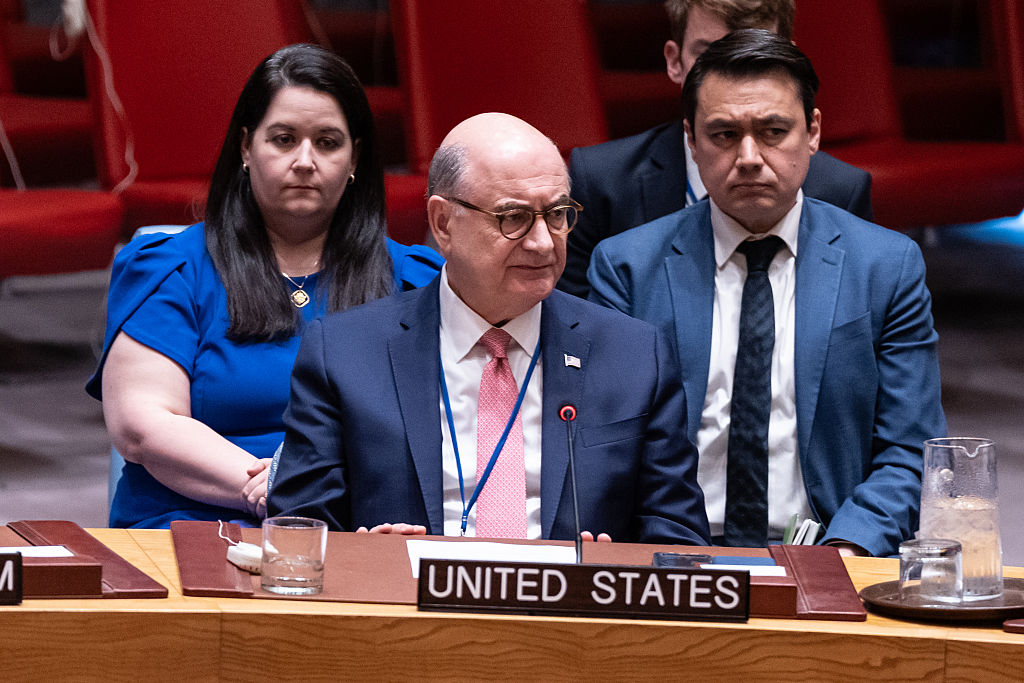
The lazy consensus in every mainstream newsroom is that the recent diplomatic spat at the United Nations—where American diplomats staged a dramatic walkout during France's Security Council address—represents a tragic breakdown of historic transatlantic ties. Pundits are weeping into their morning croissants, wringing their hands over fractured alliances, fading multilateralism, and the supposed death of polite international order.
They have it completely backwards.
The walkout led by U.S. Deputy Ambassador Dan Negrea, sparked by France’s petty social media grandstanding over the Volker Türk human rights mandate vote, is not a diplomatic crisis. It is a long-overdue reality check. For decades, international relations have operated on a theater of polite hypocrisy where European powers lecture Washington from moral pedestals while relying entirely on American defense architecture to keep their borders secure.
The Anatomy of Institutional Hypocrisy
To understand why the UN floor spat matters, we must first dismantle the terminology. Mainstream commentators love to throw around phrases like "rules-based international order" and "historic partnership" as if they are sacred, immutable laws of physics. They are not. They are diplomatic smoke screens designed to mask unequal burdens.
Look at the scoreboard that triggered this mess. The United Nations General Assembly voted 144 to 10 to reappoint Volker Türk as the UN High Commissioner for Human Rights. The United States voted no, standing alongside a tiny bloc of nations. Immediately, France’s UN Mission in Geneva took to social media to publicly knife its primary security guarantor, declaring that the U.S. was no longer a human rights beacon and grouping Washington with rogue states.
Paris wanted the cheap thrill of moral superiority without any of the blowback. When the U.S. delegation responded by packing up their folders, refusing to sit there and listen to what Washington accurately termed "politicized drivel", the diplomatic establishment panicked. Why? Because the script was violated. Allies are apparently supposed to take the public shaming with a smile, nod, and keep writing defense checks.
I have watched corporate partnerships collapse over this exact dynamic—junior partners using public virtue-signaling to punch upward at the entity carrying financial and operational weight, expecting zero retaliation. When the heavy hitter finally refuses to play along, the offenders act bewildered.
The Myth of Multilateral Equivalence
Imagine a scenario where a corporate board member publicly trashes the company's primary revenue generator on social media before a shareholder meeting, and then expects an uninterrupted, polite listening session when it is their turn to talk. They would be escorted out of the building before they could finish their opening sentence.
Yet, international relations have coddled European foreign ministries for generations. France, under Emmanuel Macron, has made a cottage industry out of strategic autonomy—attempting to build up a separate European military umbrella and positioning itself as the independent conscience of the West. That is a fine geopolitical ambition. But you cannot demand strategic independence on Tuesday and demand the shelter of the American security blanket on Wednesday.
When U.S. Ambassador Mike Waltz and Deputy Ambassador Dan Negrea drew a hard line, they were not destroying diplomacy; they were ending a parasitic dynamic. For years, Washington tolerated French grandstanding "out of a sense of camaraderie and mutual respect". That tolerance expired the moment Paris decided that social media point-scoring superseded alliance management.
The Real Question Nobody Is Asking
People are asking: How can the United States and France repair their fractured relationship?
That is the wrong question. It assumes the relationship needs repairing rather than a complete, fundamental re-architecting.
The right question is: Why should sovereign democracies pretend to agree on transnational governance structures that no longer serve their domestic interests?
The United Nations has morphed into a forum for bureaucratic posturing where nations with dubious domestic records lecture countries funding the very institutions they inhabit. When the U.S. opposed Türk's mandate—citing concerns over how the office handles sovereign democracies versus authoritarian regimes—it was exercising a national interest vote. France responded with kindergarten-level diplomatic bullying.
The walkout was the most honest diplomatic act witnessed in Turtle Bay in decades. It established a new boundary: if you want to treat Washington like an adversary in public forums, you will no longer receive the courtesy of an audience.
The Actionable Takeaway
If you are running an organization, a coalition, or a cross-border partnership, take a page from this playbook. Stop absorbing passive-aggressive friction from junior partners under the banner of preserving harmony. Harmony built on swallowed resentment is just a delayed explosion.
Call out the grandstanding immediately. Refuse to sit in the room for manufactured theater. Real respect does not come from absorbing condescension; it comes from establishing consequences.
France wanted to test if Washington's patience was infinite. They got their answer. The free lunch of unchecked moral lecturing is officially closed.


