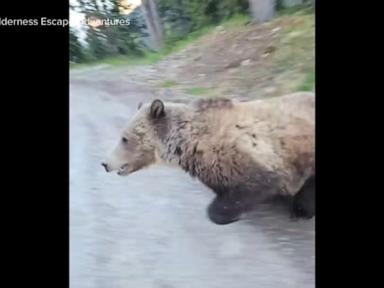
A standard morning walk outside Mount Engadine Lodge in Alberta’s Kananaskis Country abruptly shifted from a peaceful mountain routine into a desperate survival scenario when a 180-kilogram grizzly bear targeted a woman and her leashed dog. The viral footage captures the apex predator executing a series of aggressive, dog-focused lunges, coming within a single meter of the hiker. While mainstream media outlets have treated this terrifying encounter as a simple viral spectacle of human composure, the incident exposes a far deeper, systemic breakdown in North American wildlife management. Humans are moving deeper into wild spaces, domestic animals are triggering predatory instincts, and changing environmental pressures are altering how large carnivores view humans.
This is not an isolated piece of bad luck. It is the predictable outcome of an ecosystem under severe stress.
The Canine Trigger and Predatory Math
The footage from Kananaskis reveals an animal that was not merely startled; it was explicitly locked onto the hiker's dog, Skoki. To a grizzly, a domestic dog represents two distinct things depending on the context. It is either a competitor or an easy meal.
Wildlife biologists have long documented that domestic dogs are the single most common catalyst for defensive and predatory wildlife charges in western Canada. When a bear spots a dog, its threat evaluation shifts instantly. The presence of a canine elevates the tension, transforming a routine visual encounter into a territorial standoff.
[Human + No Dog]  ---> Likely Avoidance or Neutral Watch
[Human + Leashed Dog] ---> High Alert / Territorial Assessment
[Human + Unleashed Dog] ---> Immediate Escalation / Aggressive Lunge
In this specific encounter, the hiker managed to survive by maintaining a slow retreat and holding her ground during the bluff charges. She did this despite being equipped only with a bear bell, a tool that field experts widely dismiss as ineffective in dense brush. The bear repeatedly reared onto its hind legs to maintain a clear line of sight over the gravel trail, calculating the distance between itself and the canine. This dog-focused behavior is a specific behavioral classification used by Alberta Forestry and Parks officials when issuing public safety warnings. It denotes an animal that has bypassed its natural aversion to humans because the proximity of a domestic pet creates an overriding behavioral trigger.
The Failure of the Bell and the Illusion of Safety
Relying on a bear bell in high-density grizzly territory is a dangerous gamble. Heavy winds, rushing water, and dense pine forests easily muffle the high-pitched tinkle of a commercial bell. Predators do not associate the sound with danger; in some instances, curious sub-adult bears may even move toward the unfamiliar noise out of curiosity.
Packable deterrents change the mechanics of a close-quarters encounter entirely.
- Bear Spray: This remains the most statistically reliable tool for stopping an aggressive encounter. It creates an expansive cloud of capsaicin that temporarily incapacitates a bear's respiratory system and eyes without causing permanent injury.
- Firearms: While legally carried by some backcountry professionals, firearms require precise shot placement under extreme physiological stress, often resulting in wounded, highly dangerous animals.
- Bear Bells: These provide a false sense of security while failing to deliver enough audio volume to alert a sleeping or feeding bear before a human enters its immediate defensive perimeter.
The Kananaskis hiker lacked bear spray, a omission that nearly cost her life. When the grizzly initiated its rapid lunges, a can of pressurized spray would have established a physical barrier between the hiker and the animal. Standing down an apex predator using only vocal commands requires a level of psychological restraint that few casual trail users possess.
Changing Food Sources and Hardened Bears
The deeper crisis stretching across the Canadian Rockies involves the rapid success of conservation policies colliding with shrinking wilderness boundaries. Over the last two decades, grizzly populations in parts of Alberta have grown significantly due to strict hunting bans and coordinated habitat protections.
This conservation victory is now rubbing against severe environmental realities.
Wildfires, prolonged droughts, and erratic seasonal shifts have damaged traditional foraging options. In the late summer and fall, grizzlies enter a physiological state called hyperphagia, during which they must consume up to twenty thousand calories a day to prepare for winter hibernation. When wild berry crops fail due to extreme summer heat, bears are forced down from high alpine meadows into low-elevation valleys. These valleys are exactly where human infrastructure, highways, and luxury wilderness lodges are situated.
As these large carnivores spend more time in valley bottoms foraging for alternative food sources like early greening roadside grasses or introduced clover, they undergo habituation. They lose their natural, evolutionary fear of human voices and vehicles. A habituated bear is not necessarily an aggressive one, but it is an animal that allows the distance between itself and humans to shrink to zero. When a domestic dog enters that zero-distance zone, the results are explosive.
The Economic Pressure of Wilderness Tourism
Ecotourism and backcountry recreation drive millions of dollars into the Alberta economy each year. Tourism operators market the pristine, untouched nature of the Rocky Mountains, drawing travelers from across the globe who are wholly unprepared for the realities of traveling through active carnivore territory.
This economic reliance creates a conflict of interest for regional managers. Closing major trail networks or camping zones during peak tourist season hurts local businesses, yet leaving these areas open increases the frequency of close-range encounters. Following the Kananaskis incident, authorities banned tents in two nearby campgrounds, restricting access exclusively to hard-sided recreational vehicles. This temporary measure acknowledges a hard truth. Human recreation and wild predators are competing for the exact same strips of valley land, and the current management framework is struggling to keep them separated.
The solution requires moving beyond basic warning signs and viral video commentary. Backcountry users must face strict enforcement regarding pet regulations, and carrying active deterrents like bear spray must become a non-negotiable legal requirement for entering these designated wildlife zones. Relying on luck and vocal commands on a mountain trail is a strategy that will eventually run out of time.