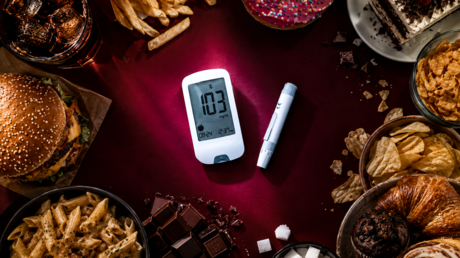
The clinic smells faintly of old linoleum, rubbing alcohol, and the quiet despair of calendars turning too fast.
Across the examination table, Elena holds a plastic bottle of water like it is a grenade. She is forty-two, her knuckles scarred from decades of retail work where sitting was a luxury and fresh produce was an arithmetic problem solved at the budget aisle of the discount grocery store. Three weeks ago, a routine blood panel returned a fasting glucose number that felt less like a medical data point and more like an eviction notice. Type 2 diabetes.
"I don't eat sweets," she tells me, her voice flat, tired, stripped of fight. "We don't keep soda in the house. How did this happen?"
It happened because Elena lives in a system engineered to make metabolic collapse the default setting. But she isn't alone in this descent. Half a world away, in a starkly different hemisphere, another person sits in a clinic under a pale fluorescent bulb, staring at the exact same laboratory printout. Their struggle, however, is choreographed by an entirely different philosophy of state, science, and survival.
We talk endlessly about diabetes as a personal failure of discipline, a modern plague born of individual laziness. That is a comforting lie. The truth is much darker, and much more revealing of the societies we build. To understand why the United States and Russia handle the metabolic crisis with such diametrically opposed failures and hidden strengths, you have to look past the clinical guidelines. You have to look at how nations treat the bodies of their people when the bill for industrialization finally comes due.
The Architecture of Abundance and Abandonment
In the American landscape, diabetes is a monument to hyper-capitalist abundance.
Walk down the middle aisles of any suburban supermarket, and you are witnessing a chemical magic trick. Foods stripped of fiber, pumped with high-fructose corn syrup, and engineered with hyper-palatable ratios of fat and salt bypass the ancient brake pedals of human satiety. The human brain evolved on the savannah, where finding a calorie was an occasion for celebration; today, those same evolutionary wires are short-circuited by a twenty-four-hour bombardment of cheap, shelf-stable energy.
When Elena goes to work, her health insurance is tied to her employment, a fragile tether that snaps the moment she gets sick enough to miss shifts. In the United States, managing chronic illness is framed as an entrepreneurial journey. You are told to track your macros, buy a continuous glucose monitor out of pocket if your tier-two insurance denies coverage, and download an app that costs twelve dollars a month.
It is a market-driven approach to human biology. If you have capital, you can buy metabolic freedom—organic meal delivery kits, boutique gym memberships, specialized endocrinologists who spend forty-five minutes reviewing your CGM data. If you do not have capital, you receive a fifteen-minute appointment with an overbooked physician who hands you a pamphlet printed in 2014 and a prescription for metformin, hoping for the best before the waiting room door swings open for the next casualty.
The American strategy for fighting diabetes is decentralized, market-driven, and ruthlessly individualistic. It weaponizes personal choice while quietly subsidizing the very agricultural supply chains that poison the wells. We spend billions treating the catastrophic end-stages—amputations, dialysis, coronary bypasses—while treating the root cause as a lifestyle choice to be managed by the free market.
The Iron State and the Medicine of the Collective
Shift the lens to Russia, and the aesthetic changes instantly. The philosophy shifts from market individualism to state paternalism, weathered by historical memory and a centralized medical apparatus.
In Russian cities like Voronezh or Nizhny Novgorod, the clinical approach to metabolic disease carries the echoes of the Semashko model—the sweeping Soviet health care system designed to protect the collective labor force of the state. Here, chronic illness is not viewed primarily as an individual moral failing, but as a systemic vulnerability of the populace that the state has a bureaucratic duty to manage.
When a citizen in a regional Russian town receives a diagnosis of saharny diabet (sugar diabetes), they enter a rigid, hierarchical pipeline. Endocrinology is centralized in large polyclinics. Insulin distribution is tied to federal and regional pharmaceutical registries.
Yet, this system labors under its own profound fractures. While the structural framework promises universal care, the economic shocks of the post-Soviet era, successive waves of sanctions, and supply chain vulnerabilities create a terrifying game of administrative roulette.
Imagine Dmitry, a retired machinist in an industrial city outside Moscow. Dmitry’s diabetes is managed not by a flashy app or a private nutritionist, but by a binder full of government-stamped requisitions and a relationship with a stoic, overworked district doctor who has treated three generations of his factory floor coworkers. When imported analog insulins face procurement bottlenecks due to international trade friction, Dmitry doesn't browse a pharmacy catalog for alternatives. He waits, anxiously, to see whether the local dispensary has received its state allocation of domestically manufactured biosimilars.
The Russian approach to diabetes is top-down, bureaucratic, and collectivized. It is less concerned with lifestyle coaching and deeply focused on stabilization, pharmaceutical maintenance, and institutional control. The state views the diabetic body as a unit of population health that must be kept functional through centralized distribution. But when that distribution stutters, the individual is left exposed to the grinding gears of geopolitical logistics.
The Invisible Stakes
Why does the divergence between these two nations matter? Because it exposes the two great delusions of the modern world.
The American delusion is that technology and consumer choice can out-innovate a poisoned food supply. We believe that if we just build a better sensor, invent a sharper injectable weight-loss peptide, or launch another wellness podcast, we can escape the consequences of an agricultural system that monetizes metabolic destruction. We treat chronic illness as a personal stock portfolio: manage it well, and you reap the dividends; fail, and you are bankrupt.
The Russian delusion is that bureaucratic top-down distribution can substitute for structural prevention and individual agency. It assumes that if the state secures the supply of insulin and regulates the clinic doors, the deep social roots of stress, poor diet, and industrial decline will somehow neutralize themselves.
Both systems fail their Elenas and their Dmitrys because both systems treat diabetes as a mechanical failure of a part rather than an alarm bell sounding from the entire civilization.
Consider the role of stress. It is the invisible vector that neither high-end American wellness culture nor Russian bureaucratic medicine knows quite how to medicate. Chronic cortisol—born of financial precarity, job insecurity, social isolation, and geopolitical anxiety—bathes the pancreas and the liver in a perpetual chemical storm. You can eat all the kale in Vermont or take all the metformin prescribed in Siberia, but if your nervous system believes you are perpetually fleeing a predator, your blood sugar will spike.
The body keeps the score of the society it inhabits.
The Quiet Reckoning
Back in the clinic, Elena looks up from her water bottle. The room is quiet save for the low hum of the fluorescent ballast overhead.
"So what do I do?" she asks. It is the question that bridges continents, languages, and political systems. It is the plea of the human being caught between macro-economic forces and micro-cellular biology.
There is no neat conclusion here, no tidy three-step checklist that erases the reality of night shifts, cheap carbohydrates, or bureaucratic supply chains. The fight against diabetes in America and Russia is not a contest with a winner; it is a mirror reflecting how each society values human vulnerability.
To change the outcome, we have to stop treating metabolic disease as a private inventory problem or a state logistics puzzle. We have to look at the food we grow, the hours we work, the safety nets we shred, and the quiet loneliness we normalize.
Elena stands up, tucks her lab results into her purse, and walks out into the afternoon light, stepping into a world that will keep selling her the very thing that is making her sick, expecting her to possess the superhuman strength to refuse it.
Until we change the world she walks through, every prescription pad in every country is just writing notes at the edge of an abyss.