Twenty years is a long time to keep a secret in your own head.
Imagine standing in a room cluttered with old coffee cups, papers yellowing at the edges, and notebooks filled with sprawling equations that nobody else believes. You are chasing a ghost. You wrote down a math problem in the early two-thousands, a neat theoretical prediction about how light and matter might dance together in ways textbooks said were impossible. You handed it to the world. And the world shrugged.
Physics has a way of breaking hearts through sheer indifference.
For two decades, that theory sat on a shelf in Chicago. It wasn't wrong. It just lived in the uncomfortable space between what we could imagine and what we could actually build. The math worked out on the chalkboard, but chalk is forgiving. Reality is not. Reality demands copper, wiring, cooling systems that hiss with liquid helium, and materials that behave with absolute, stubborn precision.
To understand what happened next, you have to understand the sheer frustration of looking at something you know is true while lacking the tools to prove it.
Quantum mechanics is notoriously cruel to human intuition. Down at the scale of atoms and photons, things refuse to stay put. They blur. They hide. For years, physicists tried to capture images of quantum phenomena using clumsy instruments, stumbling around in the dark like children trying to map a dark room by throwing tennis balls at the walls and listening for the bounce.
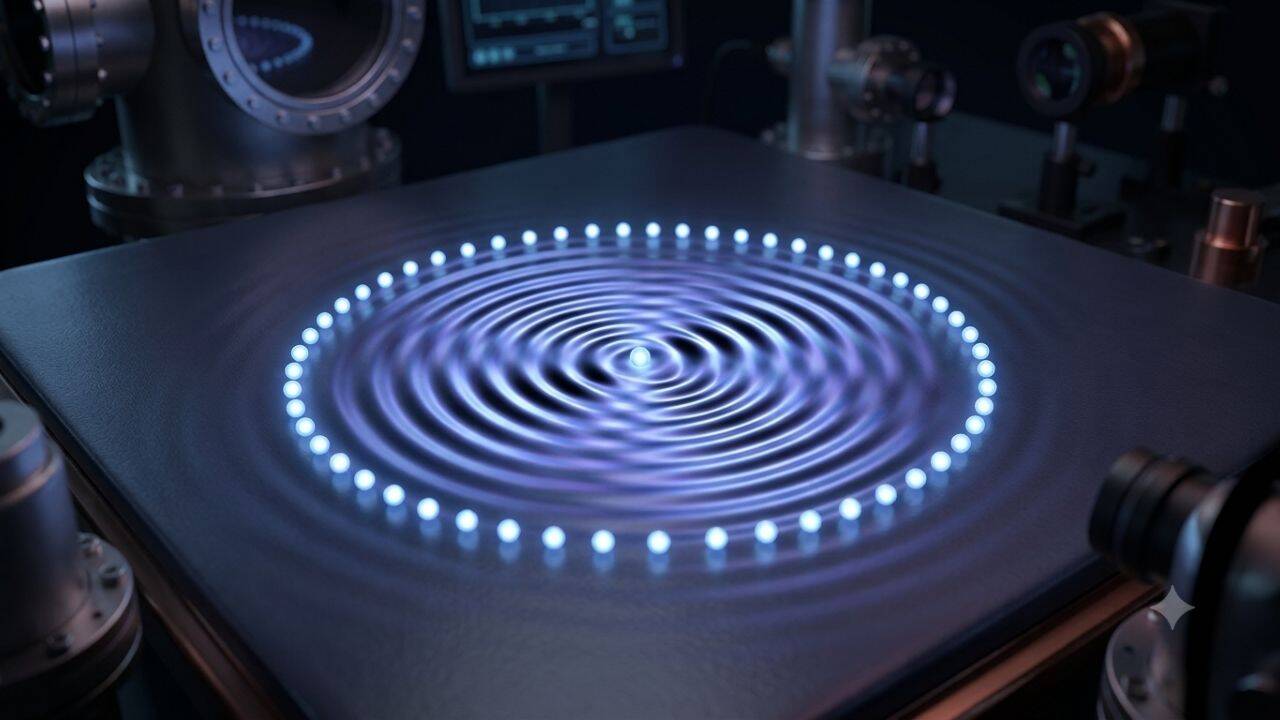
Enter quantum imaging. The premise sounds like science fiction because, for a long time, it was. Instead of looking directly at an object with light that bounces off it, you use pairs of entangled photons. One photon interacts with the object, while its twin—its invisible, instantaneously linked partner—goes somewhere else entirely, carrying the picture. You never touch the target with the light you actually measure. It is a ghost photograph.
But seeing ghosts requires extraordinary sensitivity. The theory proposed in Chicago suggested that by using superconductors—materials that let electricity flow with zero resistance, operating in deep, icy isolation—you could sharpen those ghost images. You could bypass the fundamental noise that plagues every camera ever built. You could peer through the fog of quantum uncertainty.
Only, the technology to build that superconducting detector didn't exist yet.
So, the physicist waited. Students graduated. Grant cycles came and went. Fashions in physics shifted toward string theory, then quantum computing, then condensed matter anomalies. The twenty-year-old paper remained a ghost itself—cited occasionally by academics who admired the elegance of the math, but written off as an experimental dead end.
Until recently.
Laboratories caught up. Superconducting electronics evolved from fragile academic curiosities into robust, micro-engineered circuits capable of counting individual particles of light with blinding speed. Researchers finally built the apparatus required to test the old Chicago equations.
They turned it on.
Data poured into the screens. Lines of code rendered shapes out of statistical noise. And there it was. Exactly what the math had predicted twenty years ago. The superconducting layers trapped and amplified the subtle quantum correlations, pulling a crystal-clear image out of a signal that should have been pure static.
The silence in the lab must have been deafening.
We forget, when we read headlines about breakthroughs, that science is fundamentally an act of faith. It is carried out by people who spend decades staring at blank walls, betting their careers on equations scrawled on napkins. Most of those bets fail. Most theories turn out to be elegant delusions.
When a twenty-year-old theory finally gets its proof, it changes the texture of the room. It validates the lonely hours. It whispers to every young researcher currently banging their head against a chalkboard that sometimes, the math is just waiting for the world to catch up.
This is not merely a technical milestone for microscopy or secure communication. It is a reminder of the strange, stubborn endurance of human thought. A mind sat down in Chicago two decades ago, looked at the fundamental laws governing light and matter, and saw a path that did not yet exist.
The wires are cooled. The data is verified. The ghost has finally sat for its portrait.