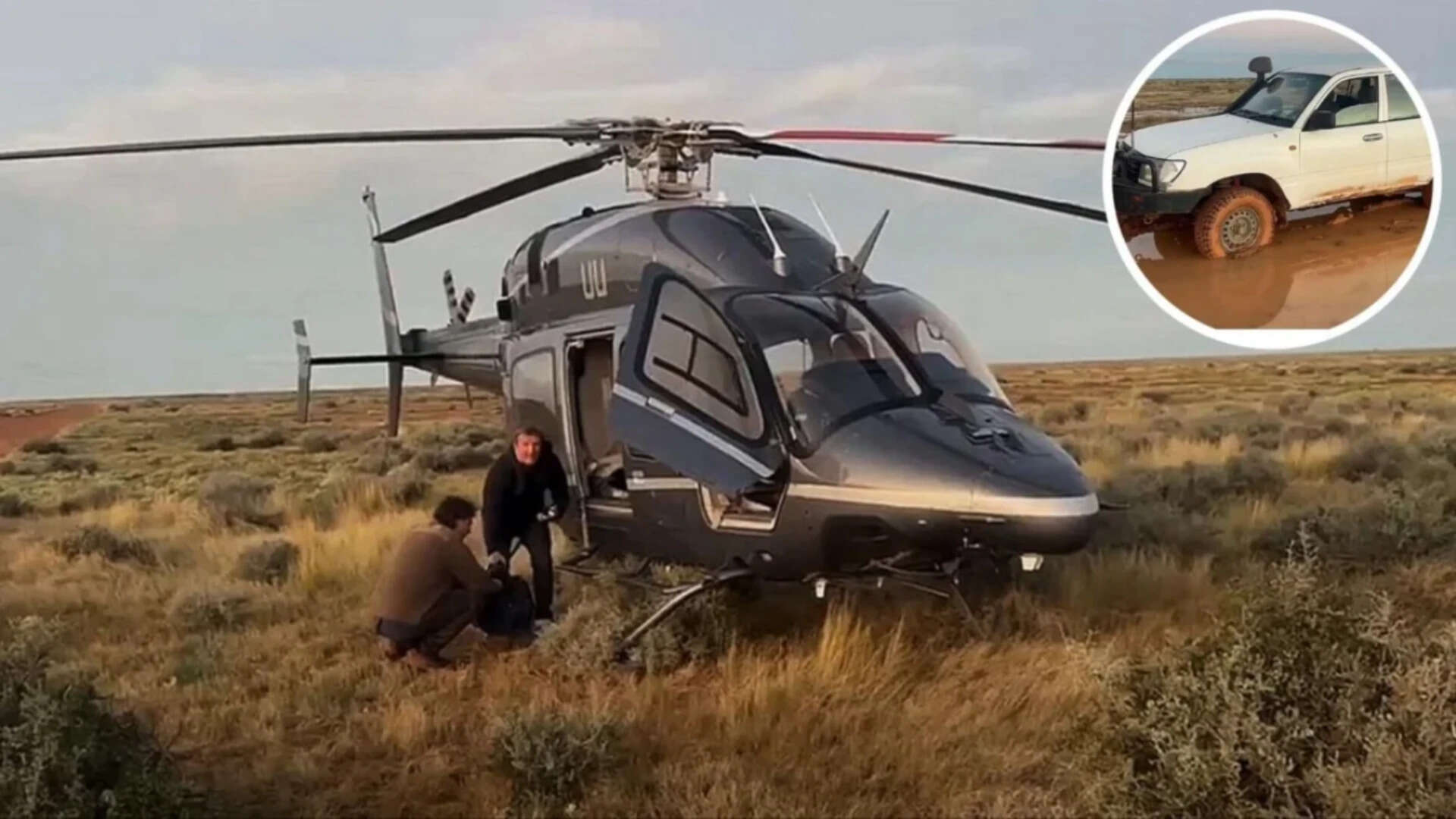
The Australian outback does not care about your plans. It has no interest in your preparation, your vehicle’s engine capacity, or the bond between a father and his son. When the red dirt swallows a road, it does so with absolute indifference.
The heat hits first. It is not a gentle warmth; it is a heavy, suffocating weight that presses down on your chest the moment the air conditioning cuts out. You notice the silence next. The hum of the engine, the familiar vibration of tires against gravel, the casual banter of a road trip—all gone. In their place is a quiet so profound it makes your ears ring.
A father and his young son sat in that silence. Their vehicle was immobilized, a useless metal shell trapped in the middle of nowhere. Around them stretched hundreds of kilometers of nothingness. No cell service. No passing traffic. Just the relentless, blinding glare of the sun bouncing off the iron-rich earth.
Twelve hours. To someone sitting in an air-conditioned office, twelve hours is a standard workday plus a long commute. In the remote expanses of northern Australia, twelve hours is a lifetime. It is the difference between discomfort and catastrophe.
The Shrinking Perimeter of Survival
When a breakdown happens in the remote bush, the psychological shift is instantaneous. The vehicle changes from a symbol of freedom into a cage.
Consider what happens next: the immediate urge is to fix the problem. You open the hood. The metal is too hot to touch. The heat rising from the engine block distorts the air. You realize quickly that tools are useless against a catastrophic mechanical failure or a deep, treacherous sand bog.
Then comes the inventory. You count the water bottles. You calculate the hours until sunset. You look at your child. That is the moment the true panic tries to claw its way into your throat. A father’s primary instinct is protection, the absolute assurance that he can keep his family safe. The outback strips that illusion away in minutes.
The human body under the searing sun loses moisture at an alarming rate. Sweat dries instantly, leaving a fine crust of salt on the skin. Mouths turn to cotton. Every breath feels like inhaling fire. They stayed with the vehicle, which is the golden rule of survival in the bush, but watching the shadow of the truck grow longer while the water levels drop is a lesson in powerlessness.
They waited. The afternoon bled into evening. The horizon turned from a searing white to a bruised purple, and the temperature began its sharp drop. In the desert, the cold can be just as brutal as the heat. The psychological toll of the dark is immense. Every rustle of dry brush sounds like a threat. Every star looks like a satellite that should see you, but won't.
When Worlds Collide in the Dirt
Help rarely comes from the sky by accident. In the vast majority of search and rescue operations, it requires a synchronized chain of emergency beacons, police coordination, and specialized tracking teams.
But sometimes, the universe operates on a different logic.
High above the red dust, a private aircraft cut through the sky. Inside was a man whose daily reality exists in a completely different sphere from the survival struggle occurring on the ground. A billionaire. A person accustomed to corporate boardrooms, high-stakes investments, and the global flow of capital.
From thousands of feet in the air, the outback looks like a beautiful, abstract painting. It looks harmless. But an experienced eye knows how to spot the anomalies. A glint of reflected glass. A vehicle parked where no vehicle should be. A flashing hazard light or a makeshift distress signal scratched into the clay.
The decision to descend is where the story shifts from a standard emergency log to something profoundly human. It requires a willingness to stop, to interrupt a tight schedule, and to look closely at the earth below. The aircraft altered its course. The engines changed pitch, a sound that, to the father and son on the ground, must have sounded like an absolute miracle.
The contrast was stark. On one hand, a family facing the raw, elemental reality of mortality. On the other, an individual with the immense resources necessary to bend geography to his will. The chopper or light plane touched down, kicking up a massive cloud of ochre dust that coated the pristine paint of the aircraft and the weathered skin of the stranded travelers.
The Aftermath of the Horizon
Rescue changes a person. The transition from total isolation to safety is jarring. One moment you are preparing yourself for the worst, whispered conversations with your child to keep their spirits up, and the next, you are drinking cold water in the cabin of a luxury machine.
The physical recovery from dehydration takes days. The psychological recovery takes much longer. Long after the dust has been washed from the boots, the mind returns to that twelve-hour window. You remember the exact moment you realized nobody was coming, right before someone did.
This incident highlights a broader truth about modern travel in the ancient parts of the world. We rely heavily on technology, on maps that tell us where we are, and on vehicles that promise to take us anywhere. We forget that the wilderness remains wild. It does not negotiate.
The intervention of a wealthy benefactor makes for a spectacular headline. It feels like a modern fairy tale, a literal deus ex machina arriving from the clouds to snatch a family from the jaws of the desert. Yet the core of the story isn't the wealth of the rescuer.
The core is the fragility of the human condition. It is the simple fact that out there, under the immense Australian sky, we are all remarkably small. Whether you are a father holding your son's hand in the dark, or a billionaire looking down from the sky, the red dirt treats everyone exactly the same.
The night finally settled over the plains, cold and quiet again. But the tracks left by the rescue aircraft remained pressed into the clay, a temporary scar on an ancient land that had already forgotten the two souls it very nearly kept.