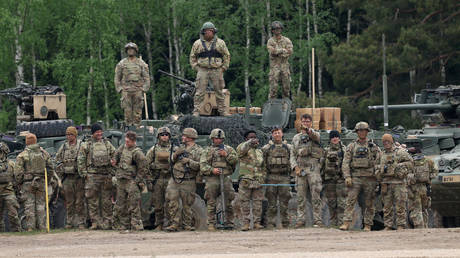
The headlines claim Donald Trump just "gifted" Poland 5,000 more U.S. troops, but geopolitical strategy is never about charity. This is about power, shifting alliances, and a massive rebuke to Western European nations that failed to fall in line.
On May 21, 2026, President Trump officially reversed a series of defense cuts, announcing an influx of 5,000 American military personnel to Polish soil. The decision, dropped casually via Truth Social, completely upends the Western security architecture. It comes right after the administration halted a planned deployment of 4,000 troops to Poland, making this sudden reversal a dizzying logistical flip-flop that left both Berlin and Brussels scrambling for answers.
If you want to understand why this matters, look past the shock value. This isn't just a sudden change of heart. It is the culmination of a highly calculated political alliance between Trump and Poland's freshly elected conservative nationalist president, Karol Nawrocki.
The Political Bromance Paying Dividends for Warsaw
To truly grasp why Warsaw is getting an influx of American boots on the ground, you have to look at the relationship between the leaders. Trump explicitly credited his deep ties with Karol Nawrocki as the main catalyst for the deployment. This isn't a new partnership. Trump hosted Nawrocki at the White House back in May 2025, offering a critical endorsement that helped propel Nawrocki to victory over the pro-European, centrist candidate backed by Polish Prime Minister Donald Tusk.
They met again in September 2025 to lay the groundwork for this defense pivot. While Prime Minister Tusk has publicly worried that shifting troops signals a dangerous breakdown in transatlantic relations, Nawrocki is leaning hard into Washington's orbit. Warsaw isn't just accepting these troops; they actively lobbied for them.
Poland has spent the last few years aggressively expanding its military infrastructure. The country's Defense Ministry recently launched an ambitious multi-year scale-up intended to build the strongest land army in Europe. For Warsaw, hosting more Americans isn't a burden. It fits perfectly into their plan to act as the ultimate shield for Central Europe and the Baltic states against any threats from the east.
Punishing Germany and Rewarding the Highest Spender
The reality of this troop movement is simple: what Poland gains, Germany loses.
Earlier this month, the Pentagon announced a sweeping withdrawal of roughly 5,000 U.S. troops from German bases. That decision wasn't random. It followed months of public bickering between Washington and Berlin. German Chancellor Friedrich Merz openly criticized the White House's management of the ongoing conflict in Iran, prompting Trump to label Merz "totally ineffective."
The administration has long complained that Western European allies are freeloading on American defense spending while failing to fund their own militaries. Poland, by contrast, spends over 4% of its GDP on defense, vastly exceeding the standard NATO benchmark.
Estimated U.S. Troop Posture Changes in Europe (May 2026)
-------------------------------------------------------
Germany:   -5,000 troops (Phased withdrawal over 6-12 months)
Poland:    +5,000 troops (New deployment announced by White House)
By pulling forces out of Germany and redirecting an equivalent force to Poland, the White House is sending a crystal clear message to NATO. If you don't pay your bills and you don't support Washington’s foreign policy, American protection leaves. If you build the bases and buy American hardware, you get the troops.
The Operational Reality on the Ground
Moving thousands of military personnel across a continent is a massive headache for the Pentagon. The Department of Defense previously stated that the German drawdown would take six to twelve months to execute, aiming to reset European troop levels closer to pre-2022 benchmarks.
Just days ago, Vice President J.D. Vance told reporters that any additional Polish deployments were delayed while the administration reviewed its overall global footprint. The sudden Truth Social announcement blindsided defense officials, forcing military planners to quickly adapt to a fast-tracked timeline.
Logistically, Poland is uniquely prepared for this sudden arrival. The country already hosts the U.S. Army's V Corps Command and saw its first permanent American military base open back in 2023. Longtime Polish aspirations for a massive, permanent base complex—frequently dubbed "Fort Trump" by Polish officials—are suddenly looking a lot more realistic. Warsaw has the infrastructure ready to absorb these forces immediately, minimizing the typical friction of a major deployment.
What This Means for Your Security and Global Markets
This reshuffle radically changes the security dynamics of Eastern Europe. With major Russian oil refineries like the Kirishi facility halting production due to targeted drone strikes, regional tensions are highly volatile. Shifting the core of American military power further east places U.S. forces right on the edge of the friction point.
For defense analysts and investors, the implications are obvious:
- Defense Procurement Shifting East: Poland is quickly becoming the primary buyer of American military gear in Europe, already eyeing massive orders of F-35 fighter jets and air defense systems.
- A Fractured NATO: The traditional U.S.-Germany defense axis is fracturing, moving the center of geopolitical gravity toward Central and Eastern European nations who align closely with Washington's populist wave.
- Logistics and Supply Line Overhauls: Expect major infrastructure investments along the Polish-Lithuanian border as supply chains adapt to support a much larger, permanent American presence.
The era of relying on legacy Cold War bases in Western Europe is ending. Washington is actively rewarding absolute political alignment and direct financial investment in defense. If you want to keep up with how these shifting borders impact global markets and regional stability, keep a close eye on the construction schedules along Poland's eastern flank. The infrastructure being built there right now will dictate European security for the next decade.
This video offers an in-depth breakdown of how recent Pentagon force posture reviews and political tensions directly shaped the administration's sudden troop decisions in Poland: US scraps plans to deploy thousands of troops to Poland