The white marble walls of the John F. Kennedy Center for the Performing Arts don't carry Donald Trump’s name anymore. A three-judge panel for the U.S. Court of Appeals for the D.C. Circuit made sure of that on July 8, 2026. They flatly denied a high-stakes request to put the branding back up while a larger legal battle plays out.
It's a massive defeat for Trump and his hand-picked board of trustees. They wanted to pause a lower court order that forced them to strip the 45th president’s name from the iconic Washington building. The judges didn't buy their arguments. Not even close.
The decision shows just how difficult it is to change a national monument on a whim. Congress created the Kennedy Center to honor a specific president. You can't just slap another name on it because political control shifted.
The Failed Argument Over Money and Donors
The board of trustees tried a classic tactic. They argued that removing Trump’s name would devastate the institution's finances. According to their legal team, the loss of the branding would tank fundraising efforts and push the venue deeper into a financial hole. They even brought up a newly minted entity called the Trump Kennedy Center for the Performing Arts Foundation. They claimed this foundation would have to return millions of dollars to donors if the name came down.
The judges saw right through it.
The three-judge panel, consisting of Judges Patricia Millett, Robert Wilkins, and Gregory Katsas, pointed out a glaring flaw. The board didn't back up any of these terrifying financial predictions with actual evidence. The court noted that the appellants failed to support their claims with specific facts.
Worse for the board, they brought up the foundation argument too late. They never mentioned this foundation during the original district court hearings. You can't just spring new factual arguments on an appeals court without a great reason. They didn't have one.
The legal standard for a stay pending appeal is incredibly high. You have to prove that you'll suffer irreparable injury if the court doesn’t step in. Speculation about a drop in donations doesn't cut it. The judges made it clear that without hard data, the name stays off.
How the Battle Began in the Boardroom
To understand how a massive cultural venue ended up covered in construction tarps and entangled in federal court, you have to look back to late 2025. That's when Trump replaced several members of the Kennedy Center's board of trustees. The new board immediately named Trump as its chairman.
By December 2025, the board took a radical step. They voted unanimously to change the venue's official title. The new name was a mouthful: “The Donald J. Trump and The John F. Kennedy Memorial Center for the Performing Arts.”
The change was swift. Crews affixed large lettering to the facade. Marketing materials were rewritten. The website got an immediate overhaul. It was a blatant attempt to etch Trump's legacy directly onto the capital's cultural footprint before his term wrapped up.
The backlash was instant. Musicians started pulling out of scheduled performances. Patrons voiced outrage over the sudden politicization of a space meant to unite the public through the arts. The venue became a battleground instead of a theater.
The Lawsuit That Stripped the Name
U.S. Representative Joyce Beatty, a Democrat from Ohio and an ex-officio member of the center's board, didn't let the name change slide. She filed a federal lawsuit to stop the rebranding.
Beatty’s legal argument leaned heavily on the original 1964 legislation that established the center. That law explicitly designated the building as a living memorial to John F. Kennedy. The statute didn't leave room for a sitting president or a compliance-minded board to add co-headliners to the building's marquee.
U.S. District Judge Christopher Cooper handled the initial case. In May 2026, he delivered a blistering 94-page opinion. Cooper stated that federal law is crystal clear on this issue. Congress gave the Kennedy Center its name. Only Congress has the power to change it.
Cooper didn't just order the name removed. He also blocked a controversial plan by the Trump-led board to shut down the entire facility for two years of renovations. The board claimed the venue needed urgent repairs, but critics saw the shutdown as an excuse to avoid hosting events under intense public scrutiny. Cooper allowed necessary maintenance to move forward but kept the doors open to the public.
The Tarp Controversy and Public Optics
After Judge Cooper's ruling, the board faced a strict deadline of June 12, 2026, to scrub Trump's name from all digital and physical assets. Internal memos flew through the organization. Staffers hurried to update email signatures, letterheads, websites, and brochures to reflect the original name.
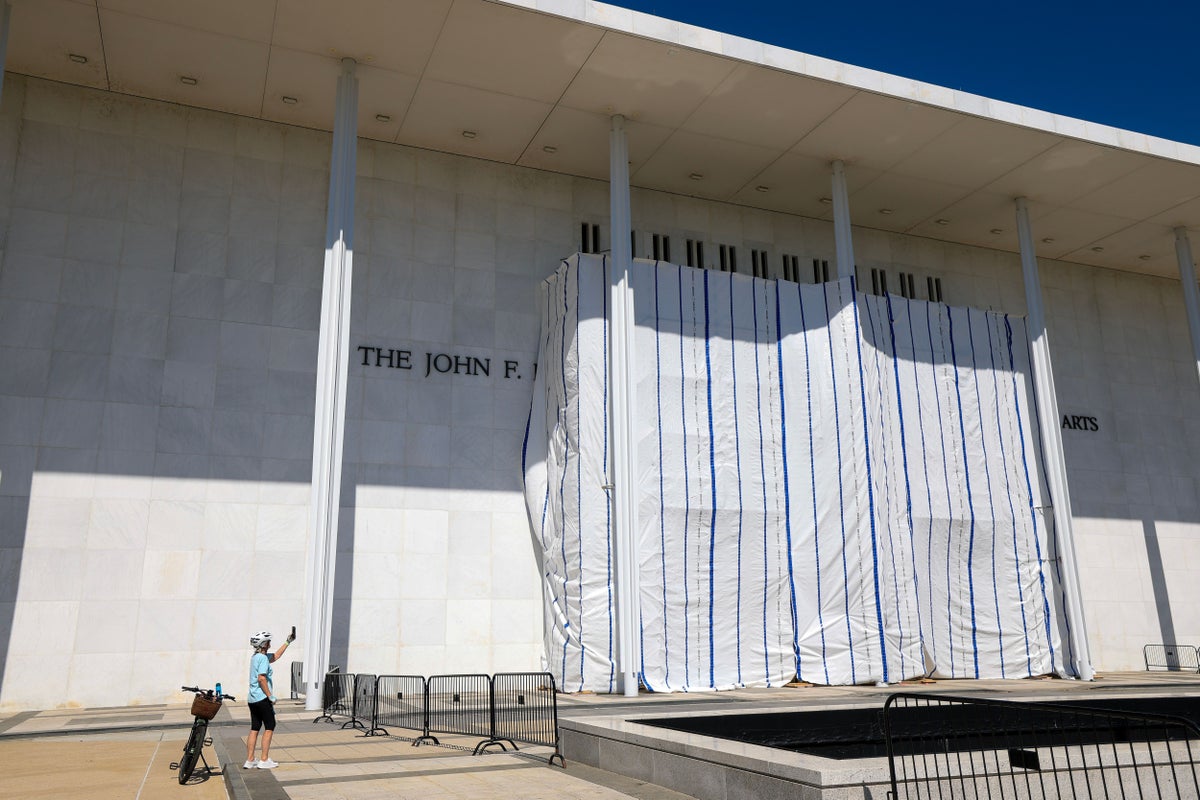
The physical removal proved more dramatic. Workers set up scaffolding around the marble facade just as a summer thunderstorm rolled through Washington. They managed to pry the letters off, but the job left scars on the building's pristine exterior.
Instead of leaving the bare marble exposed, someone ordered a massive tarp to be hung over the section. The tarp obscured the damage but also became an eyesore. It drew more attention to the dispute.
Representative Beatty publicly called out the administration for the move. She argued that the tarps were just a way to hide the reality of the court order. After the latest appellate defeat, Beatty renewed her demand for the administration to accept the legal reality and take the tarps down. The memorial belongs to the public, not a political brand.
Why This Fight is Far From Over
It’s crucial to realize that this latest ruling isn't the final decision on the merits of the case. The three-judge panel only ruled on an emergency request to pause the lower court's order. The actual appeal regarding whether the name change was legal will grind forward through the court system.
The composition of the appellate panel makes the unanimous denial even more fascinating. Judges Millett and Wilkins were appointed by Barack Obama. Judge Katsas was appointed by Trump himself. When a judge appointed by the very president fighting the case signs onto an order denying that president's request, it tells you everything you need to know about the strength of the government's legal position. The law simply doesn't support the board's overreach.
The center remains open, though attendance has dropped significantly since the drama began. Staff members are stuck in limbo, unsure if the board will try another back-door strategy to halt operations or if the legal team will find a new loophole to exploit.
If you are following this case, the next steps are purely legal. The Trump administration's lawyers must now prepare their full arguments for the formal appellate review. They need to find a way to convince the D.C. Circuit that Judge Cooper misinterpreted the original 1964 Act. Given the wording of that statute, that's an uphill climb they aren't likely to win. Expect the tarps to stay up, the letters to stay down, and the Kennedy Center to remain named solely after the 35th president for the foreseeable future.