Sand gets everywhere. It invades the folds of your clothes, coats your teeth with a thin, gritty film, and bakes under an unforgiving desert sun that feels less like warmth and more like a physical weight pressing down on your shoulders. In the mid-nineteenth century, that sand drank something else entirely. It drank sweat, tears, and the lifeblood of an entire nation.
Picture a fellah, an Egyptian peasant standing barefoot in the choking dust of the Sinai periphery. His hands are blistered raw from swinging a pickaxe into ground that yields only to brute stubbornness. He is not building a path for his children, nor is he carving out a passage for the prosperity of his own villages. He is digging a ditch for foreign masters.
History often talks about canals and trade routes as if they were lines drawn on a clean map with a pristine ruler. We see the blue ink, the neat measurements, the global shipping statistics, and we forget the human cost required to shift water from one sea to another.
To understand the Suez Canal is to understand a scar.
The Blueprint of Debt
Conceive of ambition stripped of any moral compass. In the 1850s, French diplomat Ferdinand de Lesseps charmed the Egyptian viceroy into granting a concession to slice open the desert. It sounded magnificent on paper. East meets West. Europe dances with Asia. The Mediterranean kisses the Red Sea.
The reality was far darker.
Egypt was forced to supply the labor through forced conscription—the corvée system. Tens of thousands of Egyptian laborers were marched to the desert year after year. Cholera swept through the makeshift camps like wildfire. Dehydration turned tongues to leather. Thousands died, their bodies buried in unmarked graves beneath the very dunes they were moving.
And for what? Not for Egyptian wealth. The canal was designed to siphon the riches of the Orient straight to London and Paris, bypassing the long, perilous journey around the Cape of Good Hope. Egypt was left holding the bill. By the time the waters finally rushed into the channel in 1869, the Khedive of Egypt was drowning in foreign debt, having financed a project that drained the national treasury.
Soon enough, the shares were sold. The British Empire stepped in, occupying the country to protect its financial interests. The ditch in the sand became a literal chokehold. A foreign flag flew over a national artery. When ships sailed through, millions of tons of cargo slipped past Egyptian shores, enriching everyone except the people whose ancestors built the trench with their bare hands.
You can feel the humiliation in the historical records. It is the quiet, burning anger of a host locked out of their own house while strangers track mud across the carpets.
The Midnight Hour
Fast forward nearly a century.
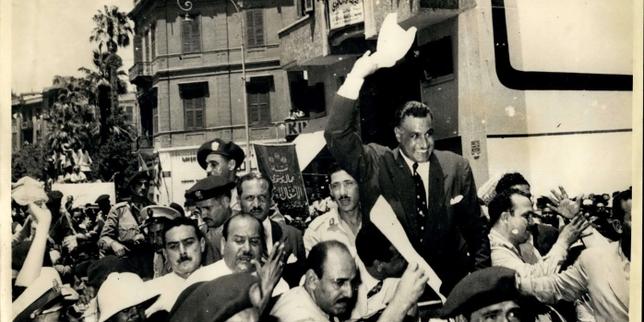
It is July 26, 1956. The air in Alexandria is thick with the heavy humidity of a Mediterranean summer. In a crowded public square, Gamal Abdel Nasser steps up to the microphone. The crowd murmurs, then hushes. The radio transmitters hum, broadcasting his voice to millions of living rooms across the Arab world.
Nasser speaks with measured, deliberate gravity. Then, he drops a name into the microphone. Ferdinand de Lesseps.
A ripple goes through the crowd.
With three words, Nasser announces the nationalization of the Suez Canal Company. He declares that the revenues from the canal will now pay for the construction of the Aswan High Dam—a project to bring electricity and controlled water to millions of Egyptian farmers who had lived at the mercy of the Nile's floods for millennia.
Pandemonium erupts.
In London and Paris, politicians slam their fists on mahogany desks. Prime Minister Anthony Eden paces the floor, viewing the move as an existential threat to British hegemony. To them, the canal is international property, a vital pipeline that belongs to the civilized world—code for European empires.
To Egypt, it is a matter of basic dignity.
What followed was the Suez Crisis, a violent collision of dying empires and rising nationalism. British, French, and Israeli forces launched a military assault to retake the waterway. Bombs fell. Smoke choked the Port Said skyline.
Yet, something fundamental had shifted in the global consciousness. The era of gunboat diplomacy was bleeding out. Pressure from the United States and the Soviet Union forced the invading forces to withdraw. The foreign troops packed their bags and left Egyptian soil.
The canal was closed, physically blocked by sunken ships, but the psychological barrier had been smashed to pieces.
The Current of Sovereignty
Stand today on the banks of the canal near Ismailia, and the atmosphere is entirely transformed.
The water here does not just move cargo; it moves history. Enormous container ships, taller than apartment buildings, glide silently across the desert horizon, their hulls cutting a deep line through the yellow sand. They are floating cities of steel, carrying everything from electronics to grain, stitching together the commerce of continents.
Every single one of those ships pays a toll. And today, that toll goes into the ledger of the Suez Canal Authority, funding Egyptian infrastructure, education, and modern development.
The transformation from an instrument of colonial exploitation to a symbol of sovereign emancipation was neither simple nor clean. It required decades of struggle, diplomatic tightrope walking, and immense national resilience. When the massive container ship Ever Given ran aground in 2021, blocking the channel and holding up billions of dollars in global trade by the hour, the world held its collective breath. All eyes turned back to that narrow strip of water, realizing overnight how fragile global supply chains truly are without it.
Egypt managed the crisis, refloated the behemoth, and proved its enduring competence in managing the world's most critical maritime shortcut.
The sand still blows across the banks. The sun still beats down with relentless intensity. But the fellah's descendants no longer dig with bare hands under the whip of a foreign overseer. They pilot the tugboats. They manage the electronic radar systems. They keep the channel open.
Power changes hands not when maps are drawn, but when the people who bear the weight finally decide to stand upright. The water flows through the desert, gleaming under the sun, carrying the weight of a past that cannot be undone, straight into an independent horizon.


