You are sitting at home playing video games or working on your laptop when sirens suddenly start blaring down your street. Within minutes, police officers knock on your door and tell you to drop everything and leave. A massive freight train just jumped the tracks less than a mile away, and nobody knows yet if the air you are breathing is safe.
This isn't a hypothetical movie plot. It is exactly what happened to residents in Bucks County, Pennsylvania, when a massive CSX cargo train derailed right in the middle of a densely populated suburban corridor. The incident triggered an immediate emergency response, forcing frantic evacuations and strict shelter-in-place orders for nearby homes, businesses, and schools.
While local authorities eventually gave the all-clear after intense hours of anxiety, the wreck highlights a terrifying reality of modern infrastructure. Our neighborhoods are routinely lined with rolling chemical pipelines, and first responders are constantly left playing catch-up when things go sideways.
Inside the Bensalem Train Wreck
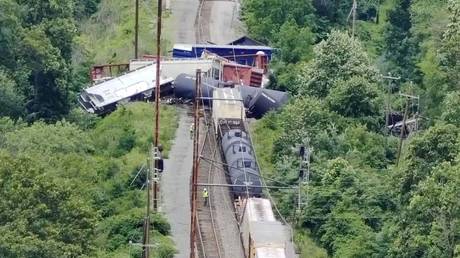
The chaos unfolded on a Tuesday afternoon when an eastbound CSX freight train hauling 72 cars experienced a massive failure. As the train rolled between Street Road and the Neshaminy Falls station in Bensalem Township, 16 of its heavy cargo cars violently smashed off the tracks.
Emergency response teams rushed to the perimeter. Specialized hazardous materials technicians from the Bucks County Special Operations Team immediately set up a containment zone. Local businesses began dismissing employees early, and roads like Bristol Road were completely shut down to make room for massive cleanup cranes and flatbeds.
Initial panic centered around what exactly those mangled steel cars were holding. Aerial drone footage showed a chaotic pileup of steel near critical community infrastructure, including a local water treatment plant and Neshaminy High School.
The immediate concern wasn't ungrounded. Two of the overturned cars bore markings indicating they carried hazardous, highly flammable chemicals. Bensalem Public Safety Director Bill McVey later confirmed during a press conference that the cargo included an acidic substance and a volatile alcohol compound.
Crews lucked out. Hazmat technicians meticulously checked the integrity of the tanks and determined that nothing leaked. Because the containment structures held up during the violent impact, the local police department officially lifted the evacuation and shelter-in-place orders by late afternoon, allowing rattled residents to head back home.
The Broken Rail Epidemic on American Tracks
While the Bensalem incident is still under investigation by CSX and local authorities, it follows a repetitive pattern across the country. Just months prior, a major federal investigation into a 30-car Union Pacific derailment along Interstate 80 in Nevada revealed a glaring culprit: a broken rail. That train was traveling at 43 mph when the track literally disintegrated beneath it, causing nearly $3 million in property damage and disrupting transit routes for weeks.
Track failures, overheated wheel bearings, and aging infrastructure are not rare anomalies. They are systemic issues that the rail industry has failed to adequately solve. According to data compiled by the International Association of Fire Fighters (IAFF), a train derails in the United States and releases at least 1,000 gallons of toxic chemicals every two months on average. Nearly half of those specific incidents result in emergency community evacuations.
The sheer volume of chemical transit means that major metro areas and quiet suburbs alike are constantly exposed to catastrophic risk. When an incident occurs, local volunteer firefighters and municipal police are the ones who have to run toward the wreckage without knowing what chemicals are burning or mixing in the air.
Why First Responders Are Demanding Immediate Rail Reform
The close call in Pennsylvania has brought renewed political pressure from labor unions and emergency personnel who argue that the current safety system is fundamentally broken. Firefighters are tired of being left in the dark during the crucial first hour of a hazardous materials disaster.
During the catastrophic East Palestine, Ohio disaster, it took over an hour for specialized hazmat teams to arrive on site with accurate data about the chemical cargo. Local crews were forced to fight a massive chemical fire using basic equipment, completely unaware of the lethal cocktail of vinyl chloride and butyl acrylate they were breathing in.
Emergency organizations are heavily backing the Railway Safety Act to force real accountability onto major rail corporations. The proposed legislation targets several critical gaps in current operations:
- Real-Time Data Access: Forcing railroads to immediately transmit digital, real-time cargo manifests to local emergency dispatchers the second a derailment occurs.
- Mandatory Crew Sizes: Banning single-person crews to ensure at least two qualified operators are on the train to assist in an emergency.
- Defect Detectors: Implementing strict federal mandates on the placement and frequency of trackside defect detectors to catch overheated bearings before they snap.
- Inspection Standards: Outlawing arbitrary, hyper-short time limits imposed by rail companies on safety inspectors who examine the cars before they leave the yard.
Rail corporations frequently claim they are investing millions into safety technology and training centers, but the sheer volume of weekly derailments across the nation tells a very different story.
What You Need to Do Before an Emergency Hits Your Neighborhood
You can't control whether a multi-ton freight train derails near your house, but you can control how prepared you are for a chemical release. When a hazmat alert is issued, your reaction window is incredibly small.
First, identify the transport lines near your home. If you live within a mile of a commercial rail line, you are in the impact zone. Download a reliable local emergency alert app on your phone and ensure your wireless emergency alerts are turned on. Do not ignore sirens assuming they are just routine traffic accidents.
Second, understand the difference between evacuating and sheltering in place. If local authorities tell you to shelter in place due to a chemical accident, turning off your HVAC system is the single most important action. Central air conditioners and heaters pull outside air into your home. If toxic fumes are lingering in your neighborhood, your AC will pump those poisons straight into your living room. Tape plastic sheeting over drafty windows and seal the gaps under your doors with wet towels.
Ultimately, federal oversight and corporate accountability are the only things that will stop these massive trains from jumping the tracks. Until the laws change, communities living along the tracks will have to keep an eye on the rails and a bug-out bag by the front door.