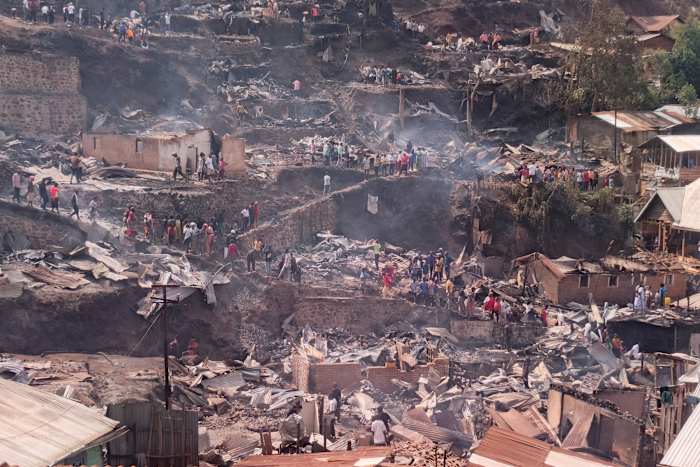
At least 24 students lost their lives when a residential fire tore through two schools in Bukavu, eastern Congo. Nineteen girls and five boys died in the disaster, trapped by narrow exits and a rapid wall of flames.
Most international headlines focus purely on the immediate casualty count. They treat the incident as an isolated tragedy. But if you look closer at how eastern Congo functions right now, this disaster was waiting to happen.
The Anatomy of a School Fire in Bukavu
The blaze began at a residential home. Because the neighborhood is densely packed and most buildings are constructed out of wood, fire moves fast. It jumped quickly to the adjacent Furaha secondary school and Ujamaa primary school.
Local neighborhood administrator Moïse Lubala laid out the grim mechanics of the panic. Students inside Furaha secondary school found themselves cornered. The exit was far too narrow for hundreds of children trying to escape at once. Some students tried jumping through windows. Others rushed the primary door, leading to a deadly crush where children were knocked down and trampled.
Nurse Ciza Jean-Baptiste, working at the Nyamulagira BDOM health center, watched students arrive in their school uniforms. Medical personnel struggled to track the injured because the clinic was immediately overwhelmed. At least 29 people required urgent medical treatment for burns, smoke inhalation, and crush injuries.
Why Infrastructure and Governance Fail the Region
You cannot separate this tragedy from the political reality of eastern Congo. The central government in Kinshasa struggles to maintain authority here. M23 rebels, backed by Rwanda, seized control of Bukavu in February 2025. When insurgent groups control urban centers, basic municipal services collapse entirely.
There are no functional fire departments in many parts of eastern Congo. Building codes are non-existent or ignored out of pure economic survival. Families live and send their kids to school in densely crowded neighborhoods built from flammable materials because decades of conflict have displaced millions.
More than 100 armed groups fight constantly for control over the region's mineral wealth. Trillions of dollars in raw materials sit beneath this soil, crucial for global technology. Yet the people living above those minerals lack basic public safety infrastructure, reliable electricity, or emergency services.
Compounding Crises in Eastern Congo
The disaster hits a region already pushed past its breaking point. Health services face immense strain. Local clinics are battling a severe Ebola outbreak that has killed thousands, alongside chronic supply shortages and malnutrition.
When a school fire breaks out in a zone gripped by ongoing armed conflict, the local capacity to respond is practically zero. Hospitals run out of beds within minutes. Families are left to search for missing children among charred ruins and makeshift triage centers without official support networks.
Standard international reporting tends to log these numbers and move on. Yet the structural neglect, the lack of fire safety regulation, and the humanitarian strain caused by continuous rebel occupation remain unaddressed. Until local infrastructure receives attention, vulnerable communities will continue bearing the cost of a forgotten war.