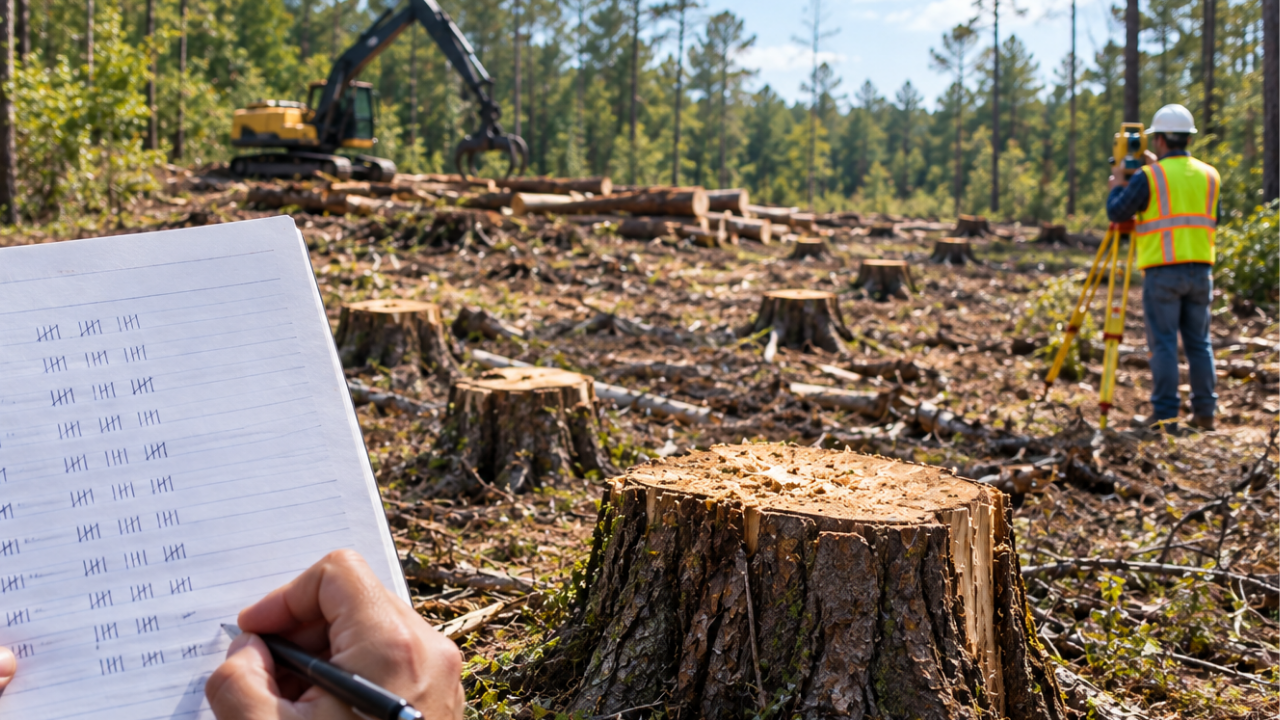
Property boundaries in rural land management function as precise legal thresholds rather than ambiguous transition zones. When unauthorized timber harvesting occurs across these lines, property owners face an immediate valuation challenge: determining the economic loss when a biological asset with decades of compound growth is abruptly removed. The case of the Mississippi landowners who recovered a $41,920 judgment after loggers cut 1,299 trees provides a structural window into how courts assess environmental damages, how timber tallies are engineered, and why standard real estate appraisal models fail to capture the true replacement cost of standing timber.
Understanding timber trespass requires deconstructing property law, arboricultural inventory methods, and damage calculation models. Unauthorized logging is rarely a simple matter of market timber value per board foot. It involves complex legal doctrines regarding statutory damages, ecological remediation, and the distinction between commercial timber operations and ornamental woodland stewardship. Recently making waves recently: Why Blaming River Pirates and Weather for Congo River Disasters is Pure Laziness.
The Economic Mechanics of Timber Valuation
Evaluating the loss of 1,299 trees demands a multi-tiered economic framework. Unlike manufactured assets, trees appreciate through biological growth while simultaneously providing ecological and aesthetic value that resists standard market pricing.
The Three Valuation Tiers
- Stumpage Value: This represents the baseline commercial value of the standing timber as if it were sold to a logging mill on the open market. It is calculated by measuring the diameter at breast height, estimating merchantable volume in board feet or cords, and multiplying by prevailing regional stumpage prices for specific species such as pine or hardwood. In trespass cases, stumpage alone severely underrepresents total loss because it ignores the time value of money embedded in decades of growth.
- Replacement or Restoration Cost: For ornamental, boundary, or non-commercial trees, courts frequently apply the replacement method. This calculates the expense of sourcing, transporting, and planting mature specimens of comparable species and caliper size. When 1,299 trees are removed, physical replacement often proves economically impractical or physically impossible due to root infrastructure disruption and site access limits, forcing courts toward alternative metrics.
- Sentinel and Functional Value: Trees contribute directly to property valuation through erosion control, wind buffering, privacy screening, and microclimate regulation. The loss of a dense timber buffer alters hydrology and topsoil stability, introducing long-term remediation costs that extend far beyond the immediate loss of wood fiber.
The Information Asymmetry Problem
Landowners typically operate at an informational disadvantage when timber trespass occurs. Loggers possess technical measuring equipment, specialized knowledge of timber cruising, and direct access to regional mill pricing indices. Conversely, landowners often lack baseline inventories of their acreage. More details on this are covered by Reuters.
When an unverified contractor crosses a boundary, the affected party cannot simply point to a missing asset without documentation. Establishing liability requires reconstructing the pre-trespass state of the land through forensic forestry methods. Experts must analyze adjacent undisturbed tracts, remaining root systems, stump diameters, and canopy coverage aerial imagery to reconstruct the exact demographic profile of the harvested flora.
Forensic Forestry and Tally Methodology
A successful legal claim depends entirely on the empirical validity of the timber tally. Estimating the loss of 1,299 individual trees requires rigorous sampling protocols and exhaustive field measurement.
Forensic foresters employ stratified random sampling and 100-percent tallies where feasible. For every cut stump discovered on the property, investigators record specific arboreal metrics:
- Stump diameter inside bark to account for taper and basal flare.
- Species identification via bark morphology, remaining branch litter, and surrounding ecological associations.
- Growth ring analysis on select stumps to establish the age cohort and historical growth rate of the stand.
- Spatial mapping using high-resolution GPS coordinates to delineate the precise trespass corridor and quantify acreage affected.
This empirical rigor bridges the gap between raw visual damage and legally admissible evidence. Without a documented tally, claims dissolve into unprovable estimations, leaving landowners vulnerable to nominal settlements.
Statutory Remediation and Legal Multipliers
Judicial systems recognize that accidental or intentional timber removal carries a unique deterrent challenge. Because timber theft can be highly lucrative for rogue operators, statutory frameworks in many jurisdictions incorporate damage multipliers to alter the economic calculus of illegal harvesting.
Compensatory Versus Punitive Damages
Standard property law dictates that compensation should make the injured party whole. However, in timber trespass litigation, the calculation diverges based on the mental state of the trespasser:
- Negligent Trespass: Occurs when operators fail to properly verify boundary surveys or exercise reasonable care. Damages are typically calculated based on double stumpage value or actual replacement cost.
- Willful or Intentional Trespass: Applies when loggers knowingly cross boundaries or ignore clear property markers. Statutes in multiple states mandate treble, or triple, the stumpage value, alongside legal fees and site restoration expenses.
The $41,920 award secured by the Mississippi couple reflects this interaction between baseline forestry inventories and statutory damage enhancements. A precise count of 1,299 trees converted a subjective grievance into an exact mathematical equation, preventing the defense from arguing speculative valuation.
Systemic Vulnerabilities in Rural Land Management
The mechanics of timber trespass expose structural weaknesses in how rural property is monitored and protected. Absent active stewardship, land parcels remain vulnerable to boundary creep, historical survey errors, and opportunistic harvesting by contractors operating on adjacent tracts.
Property owners frequently rely on outdated fencing or natural landmarks like creeks and ridgelines, which shift over time or lack legal precision. Modern land management requires proactive risk mitigation strategies to prevent evidentiary gaps before a dispute arises.
Preventive Infrastructure
- Boundary Monumentation: Establishing visible, permanent survey pins and painted blaze lines every few hundred feet deters casual encroachment and establishes clear notice for commercial operators.
- Baseline Timber Inventories: Conducting periodic forest cruises creates a legally binding record of standing assets, species composition, and commercial value prior to any neighboring logging activity.
- Operational Surveillance: Utilizing periodic drone overflights or engaging local foresters for routine boundary inspections provides time-stamped visual evidence of site integrity.
Strategic Execution for Timber Dispute Resolution
When unauthorized harvesting is identified, landowners must execute a sequenced response to preserve claims and maximize recovery potential.
- Secure the Chain of Evidence: Halt all site disturbance immediately. Document every cut stump, skid track, and boundary marker with high-resolution, geo-tagged photography.
- Engage Independent Forensic Experts: Retain a certified consulting forester independent of local timber buyers to execute a 100-percent tally and draft an independent valuation report.
- Establish Legal Counsel Specialized in Natural Resources: Standard real estate attorneys frequently misunderstand timber law mechanics. Retain counsel experienced in statutory damage multipliers and forestry litigation.
- File Notice of Trespass and Preserve Claims: Issue formal demands backed by the forensic tally, establishing a firm baseline for negotiation before entering formal judicial proceedings.
The recovery achieved in the Mississippi case demonstrates that precise measurement neutralizes uncertainty. By replacing emotional appeals with empirical forestry data and statutory damage frameworks, landowners transform ambiguous environmental losses into quantifiable legal liabilities.