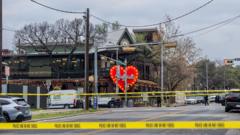
The flashing red and blue lights reflecting off the cracked pavement outside a local Texas bar didn't just signal another night of senseless violence. When the FBI stepped in to lead the investigation into the recent mass shooting, the conversation shifted instantly. This wasn't just a "local tragedy" or a "dispute gone wrong." The Bureau’s move to label the attack as a potential act of terrorism changes everything about how the case is prosecuted, how the public perceives the threat, and how law enforcement tracks extremist cells across state lines.
People are scared. They’re also confused. Usually, when we hear the word terrorism, we think of foreign entities or complex political plots. But the reality in 2026 is much closer to home. The lines between a hate crime, a mental health crisis, and a coordinated terror strike have blurred. If you're trying to make sense of why a bar shooting in Texas is being treated with the same federal intensity as a high-level security breach, you have to look at the specific criteria the FBI uses to pull the trigger on a terrorism designation.
The FBI Threshold for Domestic Terrorism
It’s not enough for a crime to be horrific. For the FBI to classify an event as domestic terrorism, the act must appear intended to intimidate or coerce a civilian population, influence the policy of a government by intimidation, or affect the conduct of a government by mass destruction, assassination, or kidnapping.
In this Texas case, investigators aren't just looking at the shell casings. They’re scouring digital footprints. They want to know if the shooter was shouting a manifesto or if their social media was a breeding ground for radicalized ideologies. When the FBI says an act is "potentially terrorism," they're signaling that they’ve found evidence of a motive that transcends personal grievance. They’ve likely found a link to a broader movement or a specific intent to send a message through blood.
The shift in language matters for the victims’ families too. Federal involvement brings resources that local departments simply don’t have. We're talking about advanced forensics, behavioral analysts, and a legal framework that allows for "terrorism enhancement" during sentencing. It’s the difference between a life sentence and a case that defines national security policy for the next decade.
Why Bar Settings are Becoming Soft Targets
Why a bar? It’s a question that haunts the community. Bars are "soft targets." They have limited security, high density, and a predictable flow of people. Unlike a government building or an airport, a neighborhood pub relies on an atmosphere of relaxation and openness. That’s exactly what an extremist wants to destroy.
Targeting a social hub is a tactic designed to erode the sense of "everyday safety." If you can't grab a drink with friends without looking for the nearest exit, the perpetrator has already won a psychological victory. This Texas incident follows a disturbing pattern of attacks on "third places"—the spots where we gather outside of home and work. When these spaces are violated, the ripple effect of fear spreads much faster than an attack on a sterile corporate office.
I’ve seen this play out before. Law enforcement starts by looking at the weapon, but they end by looking at the community impact. If the shooter targeted this specific bar because of the demographics of its patrons—whether based on race, religion, or political affiliation—that’s the fastest route to a terrorism charge.
The Digital Paper Trail and Radicalization
The FBI doesn't make these announcements on a whim. They usually have a "smoking gun" in the form of data. In 2026, nobody acts in a vacuum. We’re all connected. Investigators are currently peeling back the layers of the suspect's encrypted messages and private forum posts.
Radicalization often happens in the dark corners of the internet where extremist rhetoric is packaged as "truth." It’s a slow burn. Someone feels isolated, they find a community that validates their anger, and suddenly, they have a target. The Texas shooting is a grim reminder that "lone wolf" is often a misnomer. These individuals are usually part of a digital pack, even if they pull the trigger alone.
What Federal Investigators Look For
- Pre-attack surveillance: Did the shooter scout the bar multiple times?
- Ideological literature: Was there a digital or physical library of extremist content?
- Communication: Did they signal their intent to anyone else in a "manifesto" style?
- Weapon acquisition: Was the firearm obtained specifically for this "mission"?
The Legal Aftermath of a Terrorism Label
If the "potentially an act of terrorism" tag becomes official, the legal landscape shifts. Federal prosecutors take the lead. This isn't just about a murder charge in a Texas state court anymore. Under federal law, the suspect could face charges related to the use of a weapon of mass destruction (depending on the equipment used) or providing material support to terrorist organizations.
This also opens the door for the "Terrorism Follow-up." This is a process where the government investigates anyone who might have known about the plan and failed to report it. In a standard murder case, "looking the other way" might not get you in much trouble. In a terrorism case, it can land you in a federal cell for years.
The community in Texas is understandably on edge. The presence of federal agents in windbreakers isn't exactly a comforting sight. It reminds everyone that the threat is sophisticated. But there’s a silver lining. Federal resources mean a higher likelihood of uncovering the "why" behind the "what." Understanding the motive is the only way to prevent the next one.
How to Stay Informed Without Spiraling
It's easy to get lost in the 24-hour news cycle when "terrorism" is in the headline. Don't let the sensationalism override the facts. Watch for official updates from the Department of Justice or the FBI’s regional field office. Ignore the speculative threads on social media that claim to have "inside info" minutes after an event.
If you’re in the Texas area or a similar metropolitan hub, pay attention to local safety briefings. Most cities have updated their emergency response protocols for active shooter situations in high-traffic social areas. Knowing the layout of the places you frequent isn't paranoia; it's basic situational awareness.
Demand transparency from local officials about how they’re coordinating with the FBI. The more we know about how these investigations work, the less power the "terror" element actually has. The goal of terrorism is to keep you guessing and keep you scared. Accurate information is the best defense against that specific kind of psychological warfare.
Check the official FBI Texas field office press releases for the latest on the suspect’s background. Look for community town halls that discuss local security measures. Don't wait for the next headline to think about how your local area is protected.
The investigation is far from over. The FBI will continue to sift through terabytes of data to confirm if this was a coordinated strike or a radicalized individual acting on a warped sense of duty. Either way, the "terrorism" label is a wake-up call that the nature of American violence has fundamentally shifted. It’s no longer just about the crime itself, but the message the criminal is trying to send to the rest of us.