The Arithmetic of a Press Release
Ten.
That is the number that flashes across the ticker, the number squeezed between a semicolon and a verb in a cold police dispatch about settler violence in the West Bank. Ten arrests announced by Israeli police. To a reader scrolling past on a rainy commuter train, ten sounds substantial. Ten people in cuffs. Ten names logged into an incident file. Ten reasons to believe the machine of law and order is humming along just as it should.
Wait.
Look closer at the number ten before you celebrate or despair. A single olive grove on a hillside near Nablus or Hebron holds hundreds of trees whose roots have drunk winter rain for generations. A single disputed ridge in the West Bank can be watched from three hilltops at once by young men who know every goat path, every blind spot in the patrol route, and every hour when the sun turns the limestone white-hot and makes radio signals skip across the valleys. Ten arrests is a snapshot, not a ledger. It tells you police picked up ten suspects in connection with settler violence. It does not tell you what happened twenty minutes before the sirens arrived, who walked away unchallenged, or whether the person standing in a scorched orchard holding a pruning saw feels any safer tonight than yesterday morning.
I have stood on enough dry, stone-strewn slopes in that part of the world to know what dust tastes like when a pickup truck tears past a grove at noon. It is chalky, bitter, and sharp at the back of the throat, coating your tongue until every word you speak sounds raspy. You hear gravel popping under bald tires before you see the vehicle. You smell diesel exhaust mixing with crushed wild thyme and bruised leaves. When you have lived with that sensory grammar—the sudden silence of songbirds when an engine revs on a dirt track, the way a stone wall casts a shorter shadow as midday peaks, the knot that tightens in your stomach whenever headlights sweep across a courtyard after dark—a bare headline about ten arrests feels strangely thin. Almost weightless.
Let me be honest with you right away. Writing about settler violence in the West Bank without flattening human lives into talking points is hard, and sometimes the hardest part is admitting how incomplete our outside view really is. Even people who follow every dispatch from the West Bank struggle to hold all the moving pieces in focus at once: military zones, civilian settlements, outposts built overnight from shipping containers and solar panels, Palestinian villages hemmed in by checkpoints and agricultural gates, and police forces operating under competing pressures and jurisdictions. If you feel confused by the headlines, you are not alone. Confusing is the baseline weather here.
A Hypothetical Morning on the Ridge
To see what a bare police announcement leaves out, let us build a hypothetical morning—clearly a composite sketch drawn from recurring patterns on the ground rather than a single documented file. Call the Palestinian farmer Tariq. Call the young Israeli settler activist Noam. Neither name belongs to a real person in a specific arrest report, yet every detail reflects realities documented repeatedly across the West Bank.
Tariq wakes before dawn because the heat arrives early and punishes anyone still bending over low branches at ten in the morning. His hands are stained dark green and black from last season's harvest, calloused along the ridges of his knuckles where heavy shears rub. In his mind, a tree is like a stubborn relative: you prune it firm, you respect its age, and you remember who planted the first sapling when your grandfather was a boy.
Four kilometers away across a scrubby wadi, Noam is already awake too, pulling on boots caked with pale clay. In his world, the hill is not an inherited orchard; it is a front line in a sacred struggle over biblical land, a place where state hesitation looks like weakness and where bold action—blocking a road, smashing a water pipe, confronting villagers near contested grazing land—feels like seizing history with bare hands.
Think of the West Bank like a patchwork quilt stitched together with mismatched thread, pulled tight over uneven ground. Where the stitches strain, fabric tears.
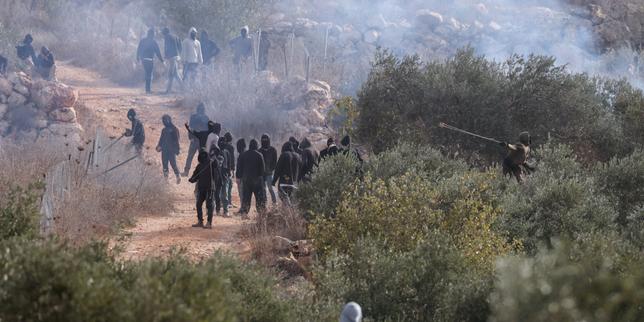
At 7:40 a.m., Tariq hears engines on the upper track. Not the steady rumble of a municipal tractor, but the sharp whine of an off-road vehicle climbing too fast over loose rock. Within minutes, voices carry down the slope. Stones rattle against stone. Smoke—thin at first, then thick and oily—rises from near the edge of the parcel where plastic irrigation lines snake between young trees.
What happens next in real incidents varies wildly, and that variation is crucial. Sometimes soldiers or police arrive quickly and separate groups. Sometimes clashes escalate with rocks, sticks, or worse. Sometimes property is vandalized and attackers melt back toward nearby hilltops before forces reach the scene. On this hypothetical morning, a police patrol responds, detains several individuals, and later issues a terse notice: ten people arrested in connection with settler violence in the West Bank.
Ten arrests.
On paper, the state acted. A legal process flickered to life. Yet when Tariq walks back toward his smoking irrigation line, his questions do not sound like a police press release. He wants to know who cut the main pipe. He wants to know if the same group will return on Friday when the patrols are thinner. He wants to know whether an arrest means prosecution and real accountability, or a brief period in custody followed by release on conditions that are hard to enforce on a rugged hillside.
Why Numbers Alone Miss the Stakes
Why do people argue so fiercely over a single headline like "ten people arrested"?
Because two observers can read the exact same sentence and hear two completely different stories.
One reader sees enforcement. To them, Israeli police arresting ten suspects over settler violence proves that the rule of law is not dormant, that violent extremism faces pushback from authorities, and that headlines claiming total impunity ignore concrete policing actions.
Another reader sees a drop in an ocean. To them, a single announcement of ten arrests cannot be separated from decades of friction over land, checkpoints, contested outposts, and long-standing debates over how often violence against Palestinians leads to convictions and lasting deterrence.
Both reactions tap into real anxieties, yet both can miss the quieter mechanics underneath. In conflicts shaped by deep historical grievance and fractured authority, arrests are only one gear in a much larger transmission. If the gear turns without engaging the axle, you hear plenty of clicking and grinding, while the wagon barely moves forward.
History teaches us that when friction becomes routine, language grows numb. We start treating human shock as background noise. A burned car becomes a statistic. A shattered windshield becomes a line item. A headline about ten arrests becomes a brief pause between two other alerts on a phone screen.
Stop and ask yourself what happens to a community when violence—or the threat of it—becomes part of the seasonal calendar, right alongside rain, harvest, and heat.
It changes how people plan a Tuesday. It changes whether parents let children walk a familiar path alone. It changes whether a farmer buys new drip-tape or wonders if paying for repairs is throwing good money onto dry earth. Even when no one is hurt on a given afternoon, the anticipation of trouble taxes every hour. Economists call hidden drag on daily life a transaction cost; for people living under constant tension, the cost is measured in sleeplessness, caution, and quiet exhaustion.
The Invisible Ledger of Fear and Friction
To understand why settler violence in the West Bank carries stakes far beyond a single police blotter, look at what sits beneath the surface of any clash.
First, there is physical harm and property loss. A smashed solar panel in an off-grid hamlet is not just a piece of glass and silicon; on a chilly night, it is the difference between light and darkness, between a charged phone and a dead battery. An uprooted sapling takes years to replace. A blocked rural road turns a twenty-minute clinic trip into a long detour.
Second, there is the erosion of trust. When residents watch incidents unfold, the credibility of institutions rises or falls on what happens after the cameras leave and the press release goes out. Arrests matter—they mark an official boundary where police say a line was crossed. Yet people judge justice not only by who is picked up on the road, but by whether investigations hold up, whether courts follow through, and whether everyday protection feels steady rather than episodic.
Third, there is the ripple outward. Events in the West Bank rarely stay sealed inside a single valley. They echo in diplomatic rooms thousands of miles away, shape domestic political arguments in Israel, fuel anger and sorrow across Palestinian communities, and test international norms around civilian protection and accountability.
Let us be candid about what we cannot see from afar. We do not sit in the patrol car watching a tense intersection unfold in real time. We do not sit in the interrogation room listening to every claim and denial. We do not sit at Tariq's table counting what was lost, nor inside Noam's circle hearing the slogans that convince young men they are doing something righteous.
Acknowledging those blind spots does not weaken our judgment. It sharpens it. Good storytelling—and honest civic thinking—starts by refusing fake omniscience. You do not need to pretend you have X-ray vision into every motive to see clearly that human lives, property, and fragile stability hang in the balance whenever violence flares in the West Bank.
What Ten Arrests Can—and Cannot—Solve
Suppose you are trying to make sense of the next headline like this one. What should you look for so you are neither fooled by spin nor drowned in cynicism?
Look for continuity rather than a single flash. One announcement of ten arrests tells you police made arrests in a given instance. A pattern of consistent investigation, clear legal consequences, and preventive presence tells you much more about whether violence is actually being curbed.
Look for the human footprint behind the administrative language. Police statements use clean, institutional verbs: detained, arrested, investigated, reported. Those words are necessary for official clarity, yet they sanitize the chaos of a confrontation on rocky ground. Translating them back into human terms—who was scared, what was damaged, what was prevented—restores scale to the story.
Look for the deeper roots that keep pulling new sparks into dry grass. Arresting ten people after an incident addresses a symptom or a specific act; resolving disputes over land access, settlement expansion, enforcement authority, and mutual fear requires addressing structural pressures that an arrest warrant alone cannot erase.
Sometimes, when a situation feels knotted beyond repair, the temptation is to look away. It hurts to read about friction that has no neat ending. It feels easier to lock the phone, move on to a lighter topic, and leave the dust to settle on its own.
Dust does not settle on its own when wheels keep spinning over it.
Think back to Tariq on that hypothetical morning, standing near a smoking line of black plastic while dry wind bends the silver-green leaves of an olive tree. Think of the silence that follows shouting on a hillside—that heavy, ringing quiet where all you hear is gravel sliding slowly downward toward the valley floor. Ten arrests were announced. The ink on the report is dry. Out on the ridge, the sun is climbing higher, the stone is warming up, and the road ahead is still dusty.