The fog that rolls off the Thames in the cinematic world of Victorian London is rarely just weather. It is a mood, a heavy shroud designed to keep secrets buried and to keep certain people in their place. For decades, that place belonged entirely to men with pipes, deerstalker hats, and an absolute monopoly on intellect. Then came a girl on a bicycle, breaking the fourth wall and shattering the quiet dignity of the traditional detective story.
Millie Bobby Brown returns to the screen in the third installment of the franchise, stepping back into the boots of Sherlock’s fiercely independent younger sister. But looking past the cobblestones and the corsets reveals something much deeper happening beneath the surface of this latest mystery. This is a story about the exhausting, exhilarating act of carving out an identity when the entire world has already written your script.
The Weight of a Famous Last Name
Imagine growing up in a house where your older brother is literally the smartest man in the world. Every room you walk into, his shadow gets there first. For Enola, the Holmes name is both a golden key and a heavy iron anchor.
In this new chapter, the stakes shift from simple survival to professional legitimacy. Enola is no longer just a runaway matching wits with her brothers; she is a young woman trying to run a business in a society that views female autonomy as a polite eccentricity at best and a dangerous delusion at worst. Her office is drafty. The clients are scarce. When people look at her, they do not see a brilliant investigator. They see a girl playing dress-up.
We often treat period pieces as safe, distant fantasies. We watch them to escape. But the frustration lining Enola’s face as she is dismissed by men with half her intellect feels instantly modern. It echoes the quiet sigh of every young person sitting in a boardroom or a classroom, waiting for their voice to carry the same weight as the loudest person in the room.
The brilliance of the performance lies in this vulnerability. Brown plays her not as an invincible superhero, but as someone who is visibly tired of having to prove herself every single morning. Her bravado is real, but it is also a shield. When that shield cracks, the movie finds its true pulse.
The Chemistry of Independence
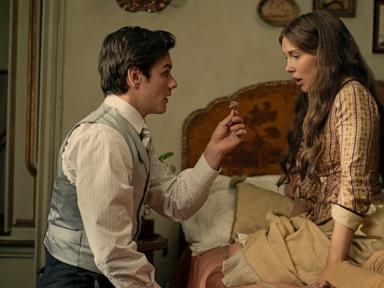
A massive part of the franchise's charm relies on the friction between Enola and the people orbiting her universe. Consider her relationship with Viscount Tewkesbury. In a standard Hollywood formula, the romantic interest exists to either rescue the heroine or domesticate her. Here, the dynamic functions more like two distinct celestial bodies trapped in the same orbit, constantly pulling at each other without colliding.
They share a quiet scene early in the film near a crowded London market. The camera lingers on the space between them. There is an unspoken understanding that love, for a woman in Enola’s position, cannot look like surrender. It is a delicate dance.
Then there is Sherlock. Henry Cavill plays the legendary detective not as an arrogant monolith, but as a brother who is slowly, painfully learning how to respect a peer. Their interactions are no longer just teacher and student. They are two distinct philosophies of deduction clashing under one roof. Sherlock relies on cold, detached isolation; Enola thrives on empathy and human connection. She listens to the people the world ignores—the matchgirls, the maids, the runaways.
This ideological rift forms the backbone of the central mystery. The case itself begins with a missing person, a familiar trope that quickly spirals into a web of institutional corruption. But the plot is merely the scaffolding. The real narrative engine is Enola’s realization that she cannot solve the world's problems by using her brother's cold, mathematical formula. She has to find a different way to think.
Breaking the Screen and the Mold
The defining stylistic choice of these films has always been the direct address. Enola looks at us. She winks. She groans. She rolls her eyes when a man explains something she figured out three days ago.
Some critics argue this technique pulls the audience out of the illusion of the nineteenth century. In reality, it does the exact opposite. It creates an exclusive alliance between the main character and the viewer. We become her confidants, her co-conspirators. When she glances at the camera after a particularly absurd piece of Victorian advice, she is checking to see if we see the ridiculousness of it too.
This device transforms the historical setting into something vibrant and immediate. It reminds us that history was not lived in black and white or with stiff, formal posturing. It was lived by real people who got mud on their hems, who lost their tempers, and who desperately wanted to laugh at the absurdity of their social codes.
The pacing of the third film mimics this frantic, youthful energy. The editing cuts sharply between internal monologues, quick flashbacks, and breathless chases through narrow alleys. It feels alive.
The High Cost of Loneliness
But running against the grain of an entire century takes a toll. The narrative does not shy away from the isolation that comes with independence. There is a quiet sequence in the middle of the film where Enola returns to her empty lodgings. The adrenaline of the chase has faded. The fire in the hearth is low.
Here, the film asks a difficult question: Can you be entirely self-reliant without locking yourself away from the world?
It is a question that resonates far beyond the boundaries of a Victorian detective story. In our rush to build our own brands, secure our own futures, and prove our independence, it is terrifyingly easy to build walls instead of bridges. Enola's struggle to accept help, to admit that she cannot carry the weight of every injustice on her own shoulders, provides the emotional climax of the story.
She learns that asking for an ally is not a confession of weakness. It is the ultimate strategy for survival.
The final act moves away from the cerebral puzzles of Baker Street and into the raw, messy reality of the streets. The resolution of the mystery does not come down to a neat explanation in a drawing room. It culminates in a moment of collective action, a reminder that real change is never accomplished by a single solitary genius, no matter how famous their last name happens to be.
The screen fades to black not on a note of neat, tidy closure, but on a promise of continued defiance. Enola stands on a crowded London street, looking directly at us one last time. She does not smile. She simply adjusts her cap, turns on her heel, and disappears into the crowd, entirely on her own terms.