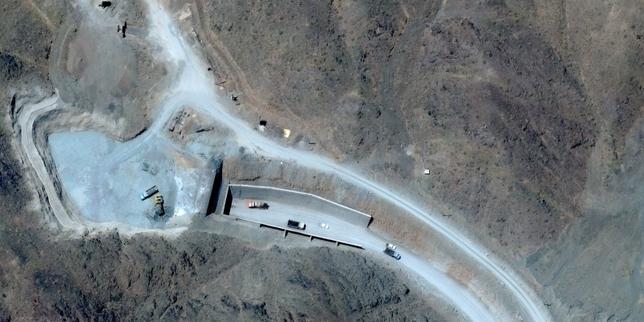
Donald Trump’s explicit reference to "Pickaxe Mountain" as a potential target signals a sharp escalation in rhetoric surrounding Iran’s subterranean nuclear infrastructure. Located deep within hardened rock formations, Iranian facilities like Fordow and suspected sites near Natanz are engineered specifically to survive conventional airstrikes. Targeting these deep underground installations presents staggering technical, strategic, and political hurdles that extend far beyond standard military capabilities. Destroying or neutralizing a facility buried hundreds of meters beneath solid granite requires specialized munitions, precise targeting intelligence, and a willingness to accept massive regional fallout.
The Engineering Behind Underground Fortresses
Iran learned critical lessons from previous military campaigns in the Middle East. Observing how standard bunker-busters performed against conventional concrete structures, Iranian engineers turned to natural geography. They began digging into mountains.
By placing enrichment cascades beneath hundreds of feet of mountain cover, fortified with heavy layers of reinforced concrete and blast doors, Iran created sites virtually immune to standard ordnance. Fordow, built inside a mountain base near Qom, serves as the primary template. More recent excavations near Natanz suggest an even deeper facility, buried so far down that traditional military options grow narrow.
The Limits of Conventional Bunker Busters
To penetrate targets buried deep within rock, military planners rely on specialized ordnance like the GBU-57 A/B Massive Ordnance Penetrator. Weighing 30,000 pounds, this GPS-guided weapon uses a dense metal casing to punch through soil and rock before detonating its high-explosive warhead.
[Image of hydrogen fuel cell]
Yet even the heaviest conventional penetrators face hard physical boundaries. Granite and heavily reinforced concrete rapidly degrade a bomb’s momentum. If a facility sits 80 to 100 meters down, a single bomb cannot reach it. Attacks against such depths require precise strike sequences where multiple munitions hit the exact same entry hole sequentially, an operational maneuver with zero margin for error in contested airspace.
Beyond Destruction Mechanics
Total physical destruction of a mountain facility is not the only way to disable it. Military strategists often look at functional defeat rather than total obliteration.
A deep underground bunker relies entirely on external lifelines. It needs steady electricity, high-capacity ventilation to clear heat and gasses, water supply systems, and secure transport tunnels to move personnel and materials.
- Ventilation Shafts: High-speed centrifuges generate significant heat and require precise environmental controls. Destroying air intakes disrupts operations quickly.
- Power Grids: Striking surface transformers and backup generator housing cuts the electrical feed, forcing delicate centrifuges into uncontrolled stops that ruin the equipment.
- Access Points: Blasting tunnel portals seals the entrance, trapping equipment inside and halting work indefinitely.
Severing these critical connections degrades operational capability without needing to crush the underground chambers directly. However, Iran anticipates these tactics by installing redundant internal power generators, deep air filtration systems, and multiple blast-sealed escape tunnels.
Strategic Consequences of a Strike
Threatening a facility like Pickaxe Mountain carries severe geopolitical fallout. A military campaign against hardened sites rarely remains a contained event.
A partial strike that damages surface infrastructure without destroying the underground core risks pushing a nuclear program completely dark. History shows that military pressure often drives nations to accelerate their efforts in secret rather than abandon them. Furthermore, retaliatory measures in critical maritime corridors like the Strait of Hormuz could disrupt global energy markets overnight.
The technical reality remains unyielding. Hardened deep-underground facilities represent a structural challenge designed to resist conventional air campaigns, turning any potential strike into a high-risk gamble with profound international ramifications.