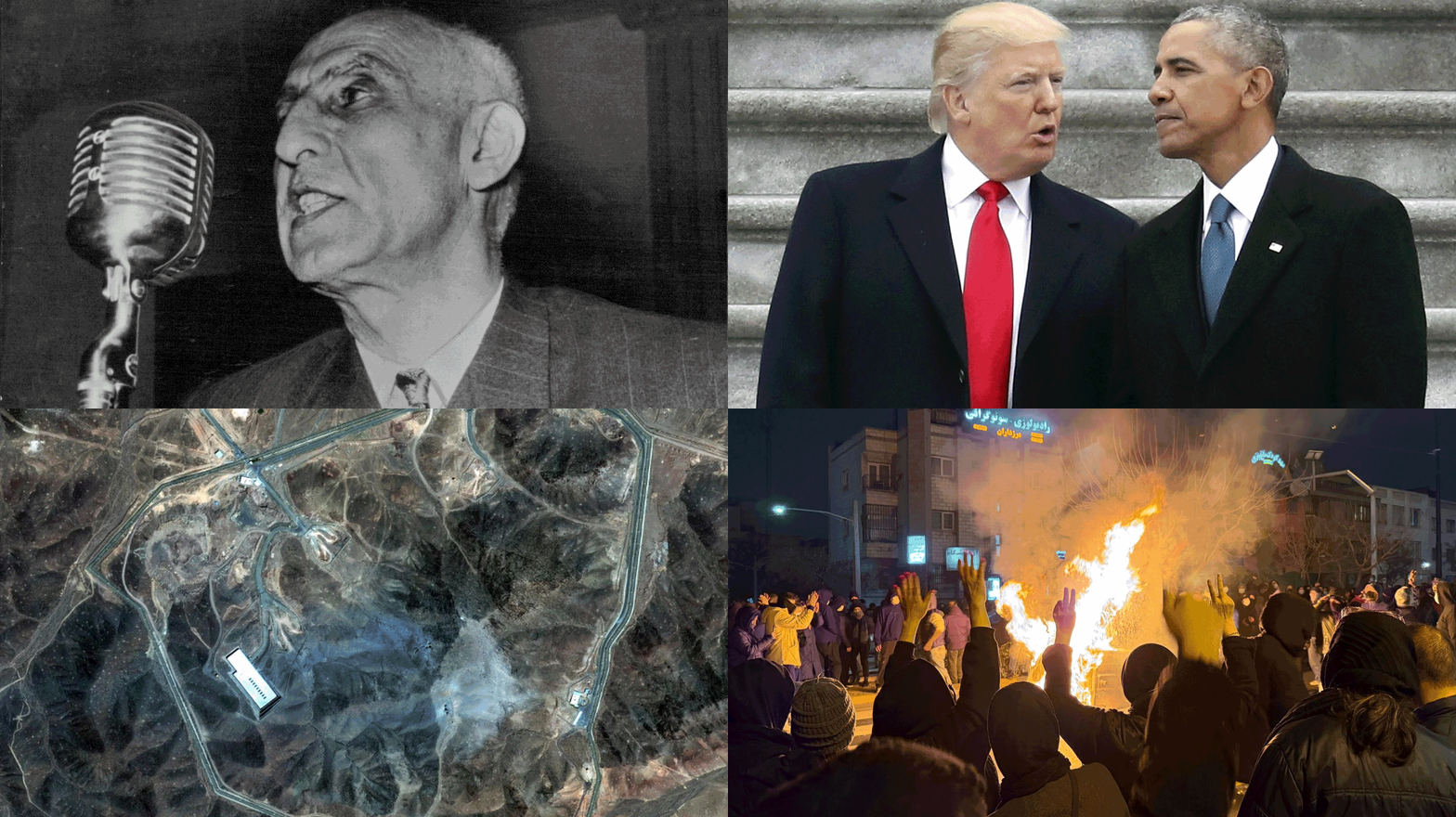
The headlines are screaming about "surgical precision" and "strategic masterstrokes" following the recent joint U.S.-Israeli kinetic operation against Iranian leadership. The consensus in the beltway is that we’ve witnessed a textbook example of how to neuter a rogue state without a boots-on-the-ground invasion.
They’re wrong. They are falling for the tactical shiny object while the strategic foundation rots.
I’ve spent twenty years watching defense contractors and intelligence agencies sell the dream of "decapitation." It’s a clean, cinematic narrative: remove the head, and the body dies. But history isn't a Hollywood script. In reality, when you remove the head of a highly decentralized, ideologically driven apparatus, you don't get a corpse. You get a hydra with a fresh grudge and a vacuum that nature—and radicalism—abhors.
The Myth of the Indispensable Leader
The biggest mistake analysts make is assuming that state actors like Iran function like a 19th-century monarchy or a mid-century corporation. They don't. The Islamic Revolutionary Guard Corps (IRGC) is not a top-down monolith where every decision requires a signature from a specific general. It is a distributed network.
When a strike takes out high-ranking officials in broad daylight, it feels like a victory because the optics are incredible. You get the high-resolution drone footage and the "confirmed kill" reports. But you haven't destroyed the infrastructure. You haven't touched the supply chains. You haven't dismantled the manufacturing hubs for the Shahed drones that are currently saturating regional airspace.
In a distributed system, a leadership vacuum is a promotion opportunity. The "lazy consensus" suggests that the remaining cadres will be paralyzed by fear. Logic suggests the opposite: the survivors are the ones most adept at operational security, and they are now incentivized to prove their mettle through escalation. You’ve traded a known quantity for a desperate, unvetted successor who has everything to prove.
Kinetic Success is a Policy Failure
If your only tool is a Hellfire missile, every geopolitical friction looks like a target. The reliance on daytime strikes as a "show of force" reveals a desperate lack of diplomatic and economic leverage. We are using $20 million platforms to solve problems that are rooted in fifty years of failed containment.
Let's talk about the math of the "surgical" strike.
$$S = \frac{T \cdot I}{V}$$
Where $S$ is Strategic Success, $T$ is Tactical Accuracy, $I$ is Intelligence Reliability, and $V$ is the Vacuum created.
The beltway focuses entirely on $T$ (did we hit the guy?) and ignores $V$. When $V$ is high, the entire equation collapses. We are currently seeing a $V$ value that is off the charts. By removing the older, perhaps more pragmatic "old guard," we’ve paved the way for the "war generation"—younger officers who grew up under sanctions, have no memory of pre-revolutionary ties, and view asymmetric warfare as the only viable language.
The Intelligence Trap
The competitor's piece praises the "unprecedented intelligence" required for such an operation. As someone who has sat in the rooms where these "unprecedented" reports are briefed, I can tell you that intelligence is never a static picture. It’s a mosaic of guesses.
The danger of a successful strike is that it creates an "intelligence feedback loop." Because the strike was successful, the agencies believe their data on the effects of the strike is equally accurate. It rarely is. We saw this in the 2003 Iraq "Shock and Awe" campaign. We saw it in the 2011 intervention in Libya. We killed the "bad guys," and the resulting chaos was infinitely more difficult to manage than the regimes we replaced.
The status quo says: "Killing the leaders prevents the war."
The reality says: "Killing the leaders ensures the war becomes unpredictable."
Stop Asking if We Can and Start Asking if We Should
The most common question on cable news right now is: "How did they pull it off?"
That is the wrong question. It’s a technical question for engineers and pilots.
The brutal, honest question is: "What is the end state?"
If you cannot define the end state, the strike is not strategy; it’s just expensive vandalism.
- The Revenge Cycle: In Western military theory, we value "deterrence." In the Middle East, "honor" and "retaliation" are not just buzzwords; they are the currency of political survival. A daytime attack isn't just a kill; it’s a public humiliation. Humiliation demands a public response.
- The Martyrdom Effect: We are dealing with a regime that views martyrdom as a logistical asset. By turning generals into posters on a wall, you provide the recruitment fuel for the next decade.
- The Tech Leak: Every time we use high-end assets in these strikes, we provide the adversary with a live-fire laboratory. They study our signatures, our timing, and our electronic warfare gaps. We are teaching them how to defeat us in the next round.
The High Cost of the "Clean" War
There is a seductive lie that we can manage global conflicts through a series of "clean" assassinations. It appeals to a public that is tired of "forever wars" but still wants to feel powerful. It’s a facade.
These strikes are a massive gamble on the stability of a region that is already on a knife's edge. We are betting that the "body" of the Iranian state will simply give up because the "head" is gone. It’s an arrogant, Eurocentric view of power that ignores how resilient ideological movements actually are.
I’ve seen this play out before. The celebration lasts 48 hours. The fallout lasts 48 months.
Stop cheering for the explosions and start looking at the map. We didn't just remove a few leaders. We removed the last vestiges of predictability in the Persian Gulf.
Go back to your spreadsheets and your "surgical" metaphors. I’ll be over here watching the "vacuum" we just created swallow the next five years of American foreign policy.
Build a bunker. The "masterstroke" just moved the clock to midnight.