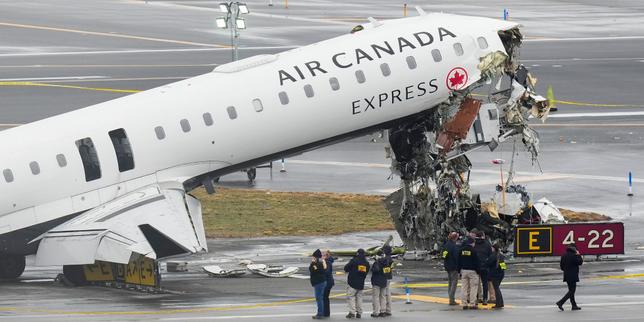
Safety in the National Airspace System relies on redundant barriers, precise communication protocols, and strict adherence to shift structures. When these layers erode simultaneously, catastrophic failures occur. The March runway collision at New York's LaGuardia Airport, which resulted in the deaths of two pilots aboard an Air Canada Express regional jet, exposes deep structural vulnerabilities within airport tower operations. Recent disclosures regarding controllers departing their shifts early focus public attention on individual misconduct, but a rigorous operational deconstruction reveals a systemic failure of resource management, technological gaps, and supervisory oversight.
The Operational Mechanics of the Incident
The collision occurred shortly after 11:30 p.m. on March 22, when an incoming Air Canada regional jet from Montreal was cleared to land on Runway 4. Less than two minutes later, an airport rescue and firefighting vehicle was cleared to cross the same active runway.
Operational data from the National Transportation Safety Board indicates that the tower was handling traffic volumes approximately twice its usual level for that hour due to weather-related delays. As the aircraft touched down on the rain-streaked strip, it converged directly with the path of the heavy rescue vehicle. The controller recognized the conflict moments before impact, issuing twelve urgent stop instructions to the vehicle within a ten-second window.
The driver of the fire truck did not realize the transmissions were directed at them. This breakdown highlights the first critical failure point: auditory-only channel management without targeted directional cues or automated transponder integration on surface vehicles. The absence of a transponder on the rescue truck meant the system lacked an independent, automated safety net to alert either the tower or the vehicle operator to an imminent spatial conflict.
The Staffing Equation and the Cost of Early Departures
Public scrutiny intensified following reports that two air traffic controllers clocked out roughly an hour before their shifts ended on the night of the accident. In agency terms, these unauthorized or irregular early departures are colloquially referenced as early shoves.
While baseline midnight staffing at many towers legally or customarily requires only two active controllers, the presence of additional staff provides crucial surge capacity during high-stress operational bottlenecks. On the night of the LaGuardia incident, the departure of the two extra personnel left only a pair of controllers in the tower. One controller was forced to manage multiple concurrent positions while the other handled a separate operational priority.
The reduction in available personnel directly impacted the cognitive bandwidth of the remaining crew. In high-density airspace management, cognitive fatigue and task saturation degrade situation awareness. When traffic volume doubles under inclement weather conditions, the loss of backup personnel converts a manageable tactical load into an overwhelmed operational state. The Federal Aviation Administration's subsequent efforts to terminate the involved controllers address the issue of time and attendance compliance, but punishing individual infractions does not rectify the underlying structural deficit in shift management.
The Three Pillars of Tower Vulnerability
A complete structural analysis requires examining the intersection of human factors, technological limitations, and supervisory oversight.
First, human factors engineering in control towers assumes a linear relationship between workload and error. In reality, error rates scale exponentially past a threshold of task saturation. When controllers execute duties across multiple frequencies without support staff to monitor blind spots or cross-verify runway clearances, safety margins narrow. The habit of leaving shifts early points to a cultural normalization of deviance, where procedural shortcuts persist until an external shock shatters the system.
Second, surface surveillance technology inside secondary airports remains underdeveloped compared to primary radar feeds. The lack of ground vehicle transponders at the time of the incident meant that safety relied entirely on voice communications. Voice communication is inherently vulnerable to misinterpretation, ambiguous recipient identity, and channel congestion.
Third, the supervisory feedback loop failed. Managers and supervisors on duty are tasked with monitoring both traffic flow and personnel presence. If early departures were an established, tacitly endorsed practice within the facility, the supervisory layer shares accountability for failing to enforce operational integrity.
Strategic Corrective Measures
Addressing these vulnerabilities requires structural intervention rather than purely punitive personnel actions. The Federal Aviation Administration must decouple shift enforcement from staffing level calculations by automating attendance verification while simultaneously deploying dynamic staffing models that scale up automatically during weather disruptions.
Furthermore, surface movement guidance systems must be mandated across all commercial airports. Equipping every airside vehicle with active transponders that interface directly with tower automation removes the single point of failure inherent in voice-activated runway crossings. Until automated conflict-prediction tools are standard for both airborne and ground assets, the National Airspace System will remain susceptible to the cascading effects of human fatigue and communication anomalies.


