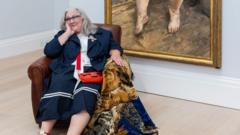
Sue Tilley did not make a single penny from the £25 million hammer price of Sleeping by the Lion Carpet at Sotheby's. She does not care. While the art world spends tens of millions trading her likeness, the woman who spent nine grueling months squashed into an armchair in Holland Park is busy enjoying her mundane, quiet life by the sea in St Leonards.
Most people look at a record-breaking art auction and see dollar signs, high society, and investment portfolios. They completely miss the human physical endurance that built the canvas. Tilley, famously known to the world as "Big Sue," spent years serving as the flesh-and-blood anchor for Lucian Freud’s heavy, sculptural brushstrokes. It was a job that required sitting perfectly still for hours on end inside a chaotic, trash-strewn workspace.
The painting, which ultimately fetched a total of £29.2 million with fees, marks the peak of Freud's obsession with the raw reality of the human form. It is a monument to what happens when an uncompromising painter meets a model who refuses to act like a traditional muse.
The Brutal Reality of the Holland Park Studio
If you picture a high-end artist's studio as a pristine, sunlit loft, you have never seen where Lucian Freud worked. Tilley remembers trudging up the stairs to a workspace she bluntly describes as "really shabby." Rubbish covered the floor, and a genuine Rodin sculpture was casually used as a doorstop.
Posing for Freud was not an exercise in glamor. It was an athletic event of absolute stillness. Freud worked on two portraits simultaneously: one by day under the morning light, and another by night under artificial bulbs. He demanded his subjects be physically present for every single brushstroke, believing the space could not be rendered honestly if the person left the room.
For Sleeping by the Lion Carpet, Tilley spent several days a week from early morning until mid-afternoon wedged into a chair.
"The painting shows me in my glorious naked bigness squashed into a chair with a lion carpet behind me," Tilley said.
Though it took nine months of intense focus, the routine was broken up by long, champagne-fueled lunches at local restaurants, where Freud would spin wild stories about riding in open-top Rolls-Royces with Marlene Dietrich or hanging out with Judy Garland. It was a bizarre mix of physical discomfort, working-class grit, and high-society storytelling.
Stop Calling Her a Muse
The art market loves the word "them," but Tilley actively loathes the label. To her, the term implies a thin, fragile person wafting around in chiffon dresses, hopelessly pining after a male artist. That simply was not the dynamic in Freud's studio.
Tilley was working a regular day job at an unemployment office when performance artist Leigh Bowery introduced her to Freud in the 1990s. She brought zero pretense to the canvas. Freud was a painter of flesh, skin, and psychological weight. He did not want to paint idealized, airbrushed bodies; he wanted to capture individuality. Tilley’s unbothered, solid presence gave him exactly what he needed to push modern figurative painting to its limit.
An earlier work from the same four-part series, Benefits Supervisor Sleeping, shattered records in 2008 when it sold for $33.6 million, making Freud the most expensive living artist at the time. That painting ended up in the hands of billionaire Roman Abramovich. The latest sale of Sleeping by the Lion Carpet, originating from the private Lewis Collection, proves that the global elite are still obsessed with the massive, uncompromising presence of a regular woman from Sussex.
Life After the Multi-Million Dollar Hammer
The auction house treats these objects as historic investments, but for Tilley, it is a strange, periodic interruption to her normal routine. While Sotheby’s executives call the painting a "magnum opus" and the "Mona Lisa of the modern era," Tilley goes right back to her house by the coast.
She didn't get a cut of the £25 million. She did get some smaller jobs, a few favors, and decent treatment from the auction houses for helping them track the history of the work. Her daily life involves lying around, watching television, heading down to the beach, and chatting with her friends. Then, out of nowhere, a major international art sale happens, her phone rings off the hook for a week, and then it goes quiet again.
If you want to understand the true value of modern portraiture, stop looking at the price tags at Sotheby's and start looking at the endurance required to make the art. If you are tracking the legacy of Freud's work, check out the current exhibition running through September 13 at Hastings Contemporary, which features his intricate etching Woman with an Arm Tattoo—another raw, honest look at Tilley that avoids the shiny polish of the billionaire art market.