The Structural Imperative of Wildfire Risk Assessment
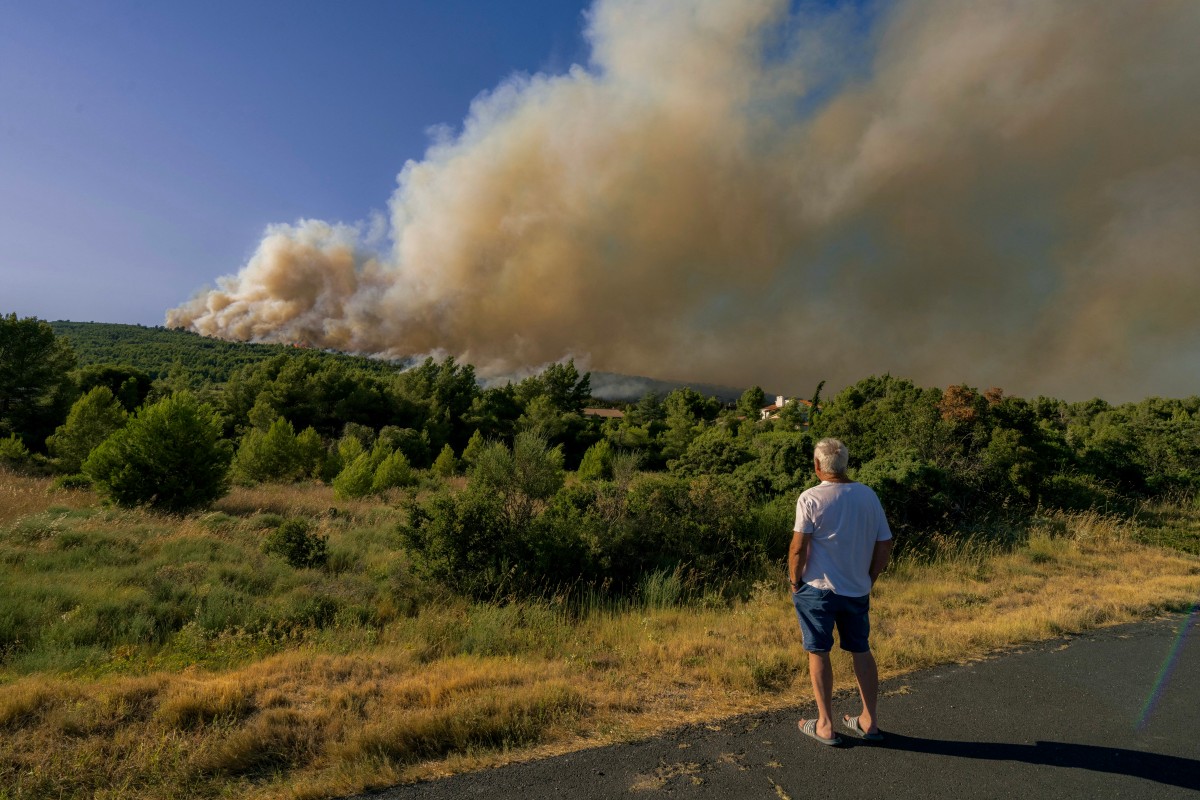
The resurgence of severe wildfire seasons across France represents a structural shift in regional environmental risk rather than an isolated meteorological anomaly. While headline figures frequently draw comparisons to benchmark years like 2022, focusing solely on surface area burned masks the underlying systemic drivers: shifting climate baselines, changes in land utilization, and tactical resource constraints within emergency response frameworks.
Understanding wildfire risk requires deconstructing the phenomenon into three interacting vectors: fuel availability, ignition probability, and suppression friction. When macro-environmental conditions force these three variables to converge, baseline response capabilities suffer localized saturation, leading to exponential growth in burned acreage.
Fuel Vectors and Biomass Accumulation Dynamics
The accumulation of combustible biomass across rural France operates as a cumulative risk function. Decades of agricultural abandonment in non-arable regions—specifically across parts of the Mediterranean arc, the Massif Central, and southern interior corridors—have transformed managed agrarian buffers into unmanaged, continuous fuel beds.
Fuel Load Stratification
Biomass accumulation exposes firefighting operations to three distinct operational challenges:
- Surface Biomass (Fine Fuels): Comprising dry grasses, leaf litter, and low-lying brush under 6 millimeters in diameter. Fine fuels govern the initial rate of spread ($ROS$) and are hyper-sensitive to ambient relative humidity.
- Ladder Fuels: Intermediate vegetation, including gorse, juniper, and young saplings, bridging the gap between ground cover and forest canopies. Ladder fuels convert manageable surface fires into active canopy fires.
- Crown Biomass (Heavy Fuels): Overstory timber canopy. Once ignited under high wind velocity, crown fires generate long-range spotting—transporting embers kilometers ahead of the main fire front and bypassing traditional containment lines.
This fuel progression changes the fundamental mechanics of fire behavior. A surface fire operates largely in two dimensions, whereas ladder-fuel ignition elevates the event into a three-dimensional crisis that severely degrades the efficacy of ground-based containment tactics.
Thermal Hydrology and the Ignition Equation
The transition from seasonal dry spells to critical fire weather is governed by atmospheric moisture deficits and soil moisture depletion. Atmospheric demand for water vapor, measured via the Vapor Pressure Deficit ($VPD$), directly dictates the rate at which dead biomass desorbs moisture.
When relative humidity drops below 30% and ambient temperatures exceed 35°C, fine fuel moisture content drops below the critical 8% threshold. At or below this moisture level, ignition energy requirements fall precipitously. A spark that would extinguish harmlessly under nominal conditions instead initiates sustained combustion.
+-----------------------------------------------------------------------+
|                       THERMAL HYDROLOGY CASCADE                       |
+-----------------------------------------------------------------------+
| 1. High VPD (> 2.0 kPa) & Low Relative Humidity (< 30%)               |
|    └─> Rapid Desorption of Moisture from Dead Fine Fuels              |
+-----------------------------------------------------------------------+
| 2. Fine Fuel Moisture Drops Below Critical Threshold (< 8%)           |
|    └─> Minimum Ignition Energy Drops Exponentially                     |
+-----------------------------------------------------------------------+
| 3. High Surface Wind Speeds (> 40 km/h)                               |
|    └─> Rapid Thermal Convection + Long-Range Ember Spotting           |
+-----------------------------------------------------------------------+
| 4. Convergence of Vectors                                             |
|    └─> Tactical Containment Saturation & Exponential Fire Growth      |
+-----------------------------------------------------------------------+
Simultaneously, prolonged meteorological droughts induce severe vegetation stress in deep-rooted species like Pinus pinaster (Maritime Pine) and Quercus ilex (Holm Oak). Stressed trees curtail transpiration, lowering their internal water potential and contributing volatile organic compounds (terpenes and resinous compounds) to the canopy micro-environment. This transforms the forest canopy into a highly volatile fuel matrix.
Tactical Suppression Friction and Resource Saturation
Fire suppression strategy relies on striking before a blaze exceeds critical heat output thresholds. The physical limit of direct attack by ground crews using water and foam suppression typically caps at a fire intensity of roughly 2,000 to 4,000 kilowatts per meter of fire front. Beyond this threshold, direct attack becomes dangerous and ineffective, forcing crews into indirect containment tactics.
Mechanics of Containment Saturation
Resource saturation occurs via two distinct operational vectors:
- Simultaneous Multi-Point Ignition: When lightning strikes or human activity causes dozens of distinct ignitions within a tight temporal window, local initial-attack assets are fractured. Response times grow from under 10 minutes to over 30 minutes, allowing secondary ignitions to transition from surface fires into high-intensity ladder-fueled events.
- Spotting and Flank Generation: High-wind conditions shear the convection column of an intense fire, casting burning material far ahead of the perimeter. Emergency managers are forced to reallocate suppression assets from primary containment lines to defend isolated spot fires, degrading the overall structural integrity of the main defense perimeter.
Aerial suppression assets—such as Canadair amphibious water bombers and Dash-8 land-based tankers—provide crucial suppression capacity, but their operational parameters are restricted by wind thresholds, air-density altitude limits, and refueling logistics. When extreme turbulence or smoke density reduces visibility below safety minimums, aerial operations are grounded, stripping responders of their primary tool for controlling high-intensity crown fires.
Policy Bottlenecks and Land Management Infrastructure
The vulnerability of southern and western European landscapes stems partly from institutional and regulatory bottlenecks surrounding proactive land management.
Fuel-Break Discontinuity
Historical zoning laws have frequently favored preserved natural landscapes without accounting for required fire-break networks. Effective fire breaks require sustained mechanical clearing, controlled livestock grazing, or prescribed burning. Prescribed burning programs often face strict regulatory windows due to air quality constraints and liability concerns, leaving large swathes of high-risk terrain untreated.
The Wildland-Urban Interface Shift
Population movement toward scenic, semi-rural zones has expanded the Wildland-Urban Interface ($WUI$). The $WUI$ creates a structural dilemma for tactical incident commanders. When a fire approaches populated zones, emergency management principles dictate shifting resources from perimeter containment to structure protection. Consequently, the fire front continues to propagate unchecked through surrounding wilderness, ultimately burning a larger aggregate surface area than if resources had remained focused purely on perimeter control.
Strategic Realignment for Long-Term Mitigation
Mitigating long-term wildfire risk requires moving beyond reactive suppression models to a structural, multi-tiered risk reduction architecture. Relying solely on expanding firefighting fleets yields diminishing returns if the underlying fuel matrix and land-use patterns remain unaddressed.
First, regulatory frameworks surrounding land management must prioritize mandatory defensible space rules within the $WUI$, strictly enforced through municipal code and property insurance conditions. Unmaintained land bordering residential zones directly threatens suppression strategy during critical events.
Second, forestry management must transition away from high-density monoculture re-afforestation projects toward ecologically resilient landscape mosaics. Interspersing broadleaf deciduous species—which feature higher fuel moisture dynamics—among highly flammable coniferous stands creates natural fire retardant barriers that slow flame propagation speed.
Finally, fire response models require strategic decentralization. Establishing pre-positioned, highly mobile initial-attack modules equipped with specialized off-road apparatus enables suppression within the critical 10-to-15-minute window post-ignition, neutralizing fire growth before atmospheric and fuel dynamics trigger unchecked escalation.