The upcoming semiquincentennial of American independence exposes a profound structural duality between the codification of democratic liberties and the execution of violent territorial consolidation. The Sand Creek Massacre of November 29, 1864, represents a systemic failure of governance, resource competition, and military command structures rather than an isolated aberration of frontier brutality. Analyzing this event requires stripping away narrative sentimentality to examine the cold mechanics of state expansion, resource extraction economics, and the institutional incentives that drive state-sanctioned violence against indigenous populations.
The conflict in the Colorado Territory was driven by a predictable sequence of structural shifts. When resource asymmetry meets poorly defined property rights, institutional violence becomes a highly probable outcome. Understanding Sand Creek requires mapping the three distinct pillars that accelerated the transition from uneasy cohabitation to systematic liquidation.
The Economic Catalyst and Property Right Asymmetry
Territorial expansion operates on an underlying economic calculus. The discovery of gold in the Pike’s Peak region in 1858 altered the geopolitical value of the Colorado plains. This influx of population disrupted the resource equilibrium established by the Treaty of Fort Laramie in 1851, which had guaranteed the Cheyenne and Arapaho nations vast tracts of land between the North Platte and Arkansas rivers.
The structural breakdown occurred across two economic vectors:
- Demographic Pressure vs. Static Treaties: Over 100,000 settlers migrated into the region within a three-year window. This rapid migration degraded the local hunting ecology, systematically depleting bison populations and timber resources along major river valleys. The initial treaty framework lacked the elasticity to absorb this demographic shock.
- The Treaty of Fort Wise as a Fractured Compromise: In 1861, a minority faction of Cheyenne and Arapaho chiefs signed the Treaty of Fort Wise, ceding more than 90 percent of the territory designated in 1851. The new reservation was a fraction of the size, located in a highly arid region unsuited for traditional subsistence models. Because the signing chiefs lacked the centralized political authority to bind the entire non-hierarchical tribal structure, a crisis of legitimacy emerged. The United States government treated the treaty as universally binding, while a significant portion of the Cheyenne and Arapaho population rejected its terms, creating a permanent structural friction point.
Fragmented Command and Civilian Incentives
The escalatory path toward the massacre was accelerated by the structural decentralization of the American state during the American Civil War. With federal military resources concentrated in the Eastern and Western theaters against the Confederacy, the administration of frontier security was effectively decentralized to local territorial authorities. This created a profound misalignment of incentives between long-term federal stabilization goals and short-term territorial political ambitions.
Governor John Evans of the Colorado Territory faced distinct political pressures. His primary objective was the stabilization and economic integration of Colorado into the Union, which required securing transportation routes (the Overland Trail) and eliminating perceived threats to economic infrastructure. In the absence of disciplined regular army units, Evans relied on the creation of the Third Colorado Cavalry, a regiment of 100-day volunteers.
The institutional design of a short-term volunteer militia introduces severe operational hazards:
- Deficient Professionalization: Unlike regular army troops, volunteer militia lacked rigorous training in military law, rules of engagement, and strategic patience. Their operational timeline was restricted to 100 days, creating a perverse incentive to force a decisive kinetic engagement before their enlistment expired.
- Political Advancement Metrics: Colonel John Chivington, the commander of the District of Colorado and leader of the Third Colorado Cavalry, possessed clear political aspirations for Colorado’s upcoming statehood. In a frontier political ecosystem, military victories against native populations served as high-value political currency. The metric of success was defined by the complete neutralization of the indigenous presence, not sustainable pacification.
This structural fragmentation manifested when Chief Black Kettle, seeking peace, complied with directives from regular army officers at Fort Lyon to camp at Sand Creek, under the assumption that they were under military protection. Chivington deliberately bypassed the authority of the regular army officers who had negotiated these terms, exploiting the lack of centralized oversight to execute his campaign.
The Ideological Framework of Securitization
To execute a policy of total elimination against a population that had actively sought peaceful terms, the territorial leadership had to employ a rigorous strategy of securitization. This process involves framing a specific group not merely as political or territorial competitors, but as an existential threat to the survival of the state, thereby justifying the suspension of normal legal and moral frameworks.
Governor Evans achieved this through a series of public proclamations in the summer of 1864. His June proclamation commanded "friendly Indians" to identify themselves at specific forts, while a subsequent August proclamation authorized citizens to "kill and destroy... all hostile Indians" and to retain any property captured. This legal mechanism effectively decentralized the monopoly on violence, deputizing the civilian population and financializing the destruction of indigenous peoples through the capture of horses and equipment.
The rhetoric deployed by Chivington and Evans framed the Cheyenne and Arapaho as a monolithic, hostile entity, deliberately ignoring the complex internal political divisions within the tribes. By conflating the actions of militant factions, such as the Dog Soldiers, with the peaceful encampment led by Black Kettle, the territorial command neutralized any internal bureaucratic friction that might have prevented the attack.
Operational Execution and Structural Failure
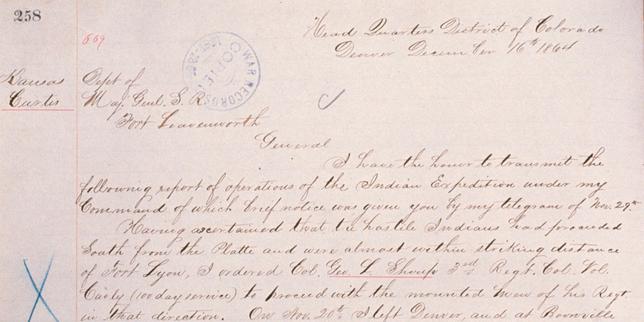
The engagement at Sand Creek on November 29, 1864, was operationally distinct from a standard military battle, functioning instead as a systematic clearing operation. Chivington’s force of approximately 670 men deployed four mountain howitzers against an unfortified village of roughly 500 people, the vast majority of whom were women, children, and the elderly.
The total breakdown of military discipline during the assault is well-documented in the subsequent federal investigations by the Joint Committee on the Conduct of the War. The deployment of artillery against domestic structures, the targeting of fleeing non-combatants, and the widespread mutilation of bodies post-mortem demonstrate the complete collapse of command control. When a military force is incentivized by racial animus and political desperation, the distinction between combatant and non-combatant is entirely erased.
The immediate operational outcome was the death of between 150 and 200 Cheyenne and Arapaho individuals. Strategically, the massacre achieved the exact opposite of its stated goal of frontier stabilization. Rather than pacifying the region, the destruction of Black Kettle’s peaceful camp vindicated the arguments of the militant Dog Soldiers, triggering a massive escalation in the Plains Wars that destabilized the region for the subsequent decade.
The Institutional Limitations of Post-Facto Justice
The response of the United States federal government to the Sand Creek Massacre illustrates the structural limits of accountability within an expanding state. While the Joint Committee on the Conduct of the War and a military commission thoroughly investigated the event, branding Chivington’s actions as a "disgrace to the very name of civilization," no criminal prosecutions followed.
Chivington had already resigned his military commission before the investigation concluded, successfully placing himself outside the jurisdiction of military courts-martial. The political and social structures of Colorado largely protected the perpetrators; the returning militia members were greeted with public acclaim in Denver, and the territorial government resisted federal attempts to fulfill the financial reparations promised to the survivors in the 1865 Treaty of Little Arkansas.
This pattern reveals a critical structural insight: while the federal center possessed the analytical tools and moral framework to recognize and condemn gross violations of human rights, it lacked the political will or enforcement mechanisms to impose meaningful punitive measures on territorial actors who were actively delivering the primary objective of state expansion—land acquisition.
Strategic Realities of the Historical Record
The historical evaluation of the Sand Creek Massacre cannot be confined to moral condemnation. It must be integrated into a realistic model of state-building metrics. The event demonstrates that the expansion of a nation-state is rarely a uniform application of its founding constitutional principles. Instead, it is an uneven, highly contested process where peripheral actors exploit institutional weaknesses, geographic distance, and demographic pressures to execute resource allocation strategies through mass violence.
For modern analysts examining historical governance risks, Sand Creek serves as a case study in the dangers of delegating security operations to short-term, politically motivated actors under conditions of acute resource competition. The structural drivers identified—economic shocks, fragmented command chains, and the deliberate securitization of minority populations—remain the primary indicators of potential mass atrocity in unstable geopolitical environments globally. The elimination of these structural vulnerabilities remains the only reliable method to prevent the replication of such failures in contemporary governance frameworks.