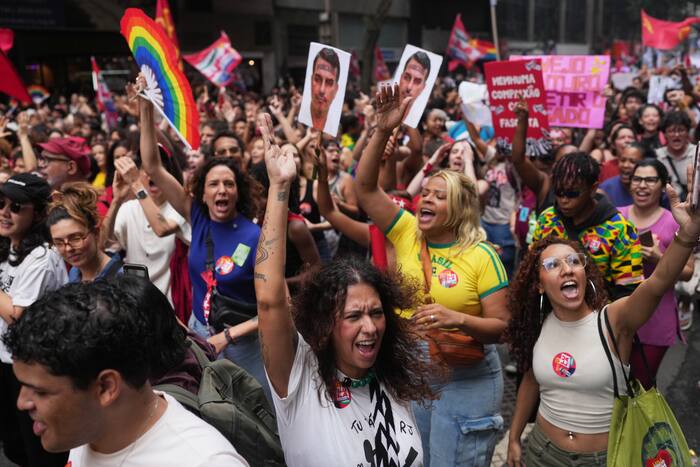
Political realignments in Latin America frequently manifest through street-level mobilization before crystallizing at the ballot box. Following the inconclusive first round of the Brazilian presidential election, which forced incumbent Luiz Inácio Lula da Silva and right-wing challenger Flávio Bolsonaro into an October runoff, urban centers have transformed into arenas of ideological consolidation. In Rio de Janeiro, thousands of university students marched through the central boulevards toward Cinelândia square. This mobilization represents more than a localized expression of partisan preference; it functions as a calculated effort to alter the electoral calculus of an electorate polarized by divergent models of state intervention and public expenditure.
To evaluate the operational impact of these demonstrations, one must examine the baseline structural advantages held by each political faction heading into the final electoral phase. Flávio Bolsonaro entered the runoff cycle carrying two distinct quantitative advantages: an aggregate plurality exceeding Lula by approximately two million votes in the initial balloting, and the consolidation of the broader right-wing coalition. Candidates occupying the third, fourth, and fifth positions on the political spectrum captured more than eight million votes combined, and their ideological alignment points heavily toward the challenger. Consequently, the incumbent administration faces a narrow mathematical path to victory, requiring a systematic activation of abstaining voters and left-leaning stalwarts to bridge the deficit.
Public universities occupy a central position in this strategic contest. Brazil houses approximately two million students distributed across more than 110 federal and state institutions, representing roughly twenty percent of the broader tertiary education demographic. These public institutions charge zero tuition, rendering them vital engines of upward mobility for working-class and middle-class segments. Student bodies harbor deep-seated structural anxieties regarding a potential conservative administration, anticipating aggressive budget rationalizations, privatization initiatives, and the systemic curtailment of institutional autonomy.
The student-led demonstrations serve a dual function within campaign logistics. First, they function as horizontal communication networks. Operating outside traditional media channels, student organizers utilize peer-to-peer mobilization via digital platforms and face-to-face outreach in public transit systems to counter right-wing messaging regarding economic stagnation, taxation burdens, and public safety failures. Second, the marches act as visible signals of ideological resistance, designed to reverse the demoralization that rippled through the progressive base following the first-round vote counts. By occupying visible urban corridors, youth movements attempt to reframe the narrative from an inevitable conservative transition to a contested mandate on democracy and public education.
Conversely, the opposition leverages a distinct set of macroeconomic grievances to sustain momentum. A significant portion of the urban working class and suburban electorate in Rio de Janeiro expresses profound fatigue with historical corruption scandals associated with the Workers' Party, coupled with acute pressures from the rising cost of living and elevated tax structures. For these voters, the rhetoric of fiscal austerity, free-market liberalization, and heightened law-and-order priorities presented by the right-wing coalition offers a tangible alternative to the incumbent economic model. The political contest thus resolves into a collision between two incompatible risk assessments: one segment of the population fears the dismantling of social safety nets and public education infrastructure, while another fears the entrenchment of systemic administrative inefficiency and inflationary state expenditure.
As the campaign enters its final fortnight, the outcome depends entirely on asymmetric mobilization capacity. The progressive strategy relies on transforming university campuses into logistical hubs for urban canvassing, aiming to pull low-propensity voters out of apathy. Meanwhile, the conservative coalition aims to consolidate the legislative right and maintain the momentum generated by its first-round legislative gains. The marches in Rio de Janeiro represent the opening salvo of this definitive phase—a high-stakes effort to shift the median voter through street-level friction before the ballots are cast.
Brazil election: Students protest possibility of another Bolsonaro
This video documents the mobilization of students in Rio de Janeiro marching against the prospect of a Bolsonaro presidency ahead of the electoral runoff.