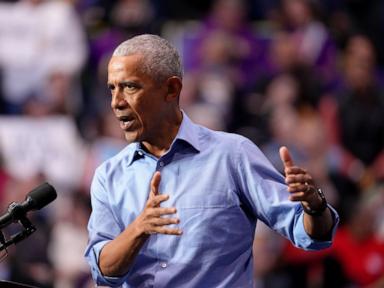
Redistricting is a technical mechanism of power consolidation often mischaracterized as a purely partisan grievance. At its core, the process of drawing electoral boundaries functions as an optimization problem where the objective is to minimize the efficiency of the opposing party’s vote while maximizing the spatial utility of one's own. The recent high-profile intervention by former President Barack Obama into a specific state redistricting measure signals a shift from decentralized legal challenges toward a centralized, brand-heavy mobilization strategy. This move aims to solve a fundamental coordination failure within the reform movement: the gap between technical legislative change and mass voter turnout.
The Mathematics of District Efficiency
To understand why a former president would expend political capital on a ballot measure, one must first quantify the "Efficiency Gap." This metric calculates the difference between the "wasted votes" cast by each party. A wasted vote is any vote cast for a losing candidate or any vote cast for a winning candidate in excess of the number needed to win.
$$EG = \frac{W_a - W_b}{Total\ Votes}$$
In this formula, $W_a$ represents the wasted votes for Party A and $W_b$ for Party B. When redistricting is handled by a partisan legislature, the goal is to drive this gap as high as possible through two primary tactical maneuvers:
- Packing: Concentrating the opposing party's supporters into a small number of districts, where they win by overwhelming margins (creating high wasted vote counts for the winner).
- Cracking: Spreading the opposing party's supporters across many districts where they will fall just short of a majority (creating high wasted vote counts for the loser).
The measure under vote seeks to replace this partisan-driven optimization with an Independent Redistricting Commission (IRC). The logic holds that removing the incumbency protection incentive will regress the efficiency gap toward a mean of zero, theoretically increasing the number of "competitive" seats.
The Presidential Endorsement as a Signaling Asset
Obama’s involvement functions less as a policy critique and more as a high-value signal to donors and low-propensity voters. In the attention economy of a mid-cycle election, redistricting is a "dry" topic that fails to trigger the emotional heuristics required for mass mobilization.
The intervention addresses three specific bottlenecks:
- Information Asymmetry: Most voters do not understand the secondary effects of precinct-level boundaries. A presidential endorsement simplifies a complex geometric and legal issue into a binary choice regarding "fairness."
- Fundraising Velocity: Large-scale redistricting reform requires expensive media buys to counter opposition from entrenched interests. High-profile endorsements serve as a catalyst for nationalized fundraising, pulling capital from outside the immediate geography of the vote.
- The Legitimacy Buffer: By framing the measure as a defense of "democracy" rather than a search for partisan advantage, the endorsement provides cover for moderate or independent voters who might otherwise be skeptical of structural changes to the voting process.
Structural Risks of Independent Commissions
While the competitive narrative favors IRCs, the operational reality is more nuanced. Transitioning from a legislative-led process to an independent commission introduces a new set of variables that do not always result in "fairer" outcomes.
The first risk is the Definition of Neutrality. How a commission defines a "community of interest" is inherently subjective. If a commission prioritizes keeping municipal boundaries intact, it may inadvertently pack certain demographics, thereby increasing the efficiency gap rather than narrowing it.
The second risk is the Technocratic Capture. IRCs often rely on hired consultants and mapmakers. If the selection process for these technical experts is flawed, the partisan bias is simply moved one level down the hierarchy, away from public accountability and into the realm of opaque data modeling.
The third risk is the Legal Stalemate. In many jurisdictions, IRC maps are still subject to legislative approval or judicial review. If the commission's output is consistently tied up in litigation, the default often reverts to "least-change" maps drawn by judges, which preserve the very status quo the reform was intended to disrupt.
The Incentive Structure for Incumbents
Incumbents within the state legislature view redistricting through the lens of career longevity. A "safe" seat is a low-risk asset. By introducing an IRC, the reform measure threatens to liquidate these assets. This creates a powerful counter-incentive where incumbents from both parties may quietly oppose the measure to maintain their mutual job security.
This bipartisan "incumbency cartel" is the primary obstacle to reform. It explains why redistricting measures often face well-funded opposition that focuses on the cost of the commission or the "unelected bureaucrats" who will run it. The opposition strategy is to pivot the conversation from the fairness of the maps to the perceived lack of accountability of the mapmakers.
Geopolitical and Macroeconomic Cascades
The outcome of a single state's redistricting vote has ripple effects that extend to federal fiscal policy. If an IRC creates more competitive districts, the representatives from those districts are forced to appeal to a broader ideological base. This typically results in:
- Decreased Polarization: Representatives in competitive seats are less likely to join extremist caucuses that threaten debt ceiling defaults or government shutdowns.
- Legislative Fluidity: A House of Representatives with more "swing" seats is more likely to pass incremental, bipartisan legislation rather than "all-or-nothing" partisan bills.
- Market Stability: Investors generally favor predictable legislative environments. Excessive gerrymandering leads to "safe-seat" politics, where the primary election—often dominated by ideological extremes—becomes the only contest that matters. This shifts the policy needle toward volatility.
Operational Variables in the Looming Vote
As the vote approaches, the success of the measure depends on the "Ground Game vs. Air Game" ratio. Obama's "Exclusive" weigh-in represents the Air Game—broad, high-level messaging designed to shape the narrative. However, the Ground Game—the door-to-door explanation of how these maps affect local school funding, infrastructure, and representation—remains the deciding factor.
The data suggests that when redistricting is on the ballot, voter fatigue is a significant risk. The complexity of the measure requires a high cognitive load to process. If the "No" campaign can successfully frame the IRC as an unnecessary layer of government spending, they can win by defaulting voters to the status quo.
The pro-reform side must counter this by quantifying the "Gerrymandering Tax." This involves demonstrating how non-competitive districts lead to inefficient capital allocation, as representatives in safe seats have less incentive to compete for federal grants or pork-barrel projects that benefit their constituents. They are instead incentivized to follow the national party line.
Strategic Requirement for Reform Success
The path forward for redistricting reform is not found in more celebrity endorsements, but in the rigorous application of data transparency. To overcome the skepticism of the electorate, the proponents of the measure must:
- Open-Source the Modeling: Provide the public with the same mapping tools used by the commission. If voters can draw their own versions of "fair" maps, the mystery—and the fear—of the process evaporates.
- Define Success Metrics: Before the first line is drawn, the commission must establish clear, quantifiable goals for compactness, contiguity, and partisan symmetry.
- Audit the Expert Selection: Create a firewall between the map-making consultants and partisan political firms. Any consultant used by the IRC should be barred from working for a political party or candidate in that state for a minimum of five years.
The current intervention by the former president is a tactical necessity to bridge the funding gap, but it is not a structural solution. The durability of any redistricting change will be measured by its ability to survive the first round of judicial challenges and the subsequent decennial census without collapsing back into partisan optimization. The focus must remain on the architecture of the commission, not the personality of its advocates.



