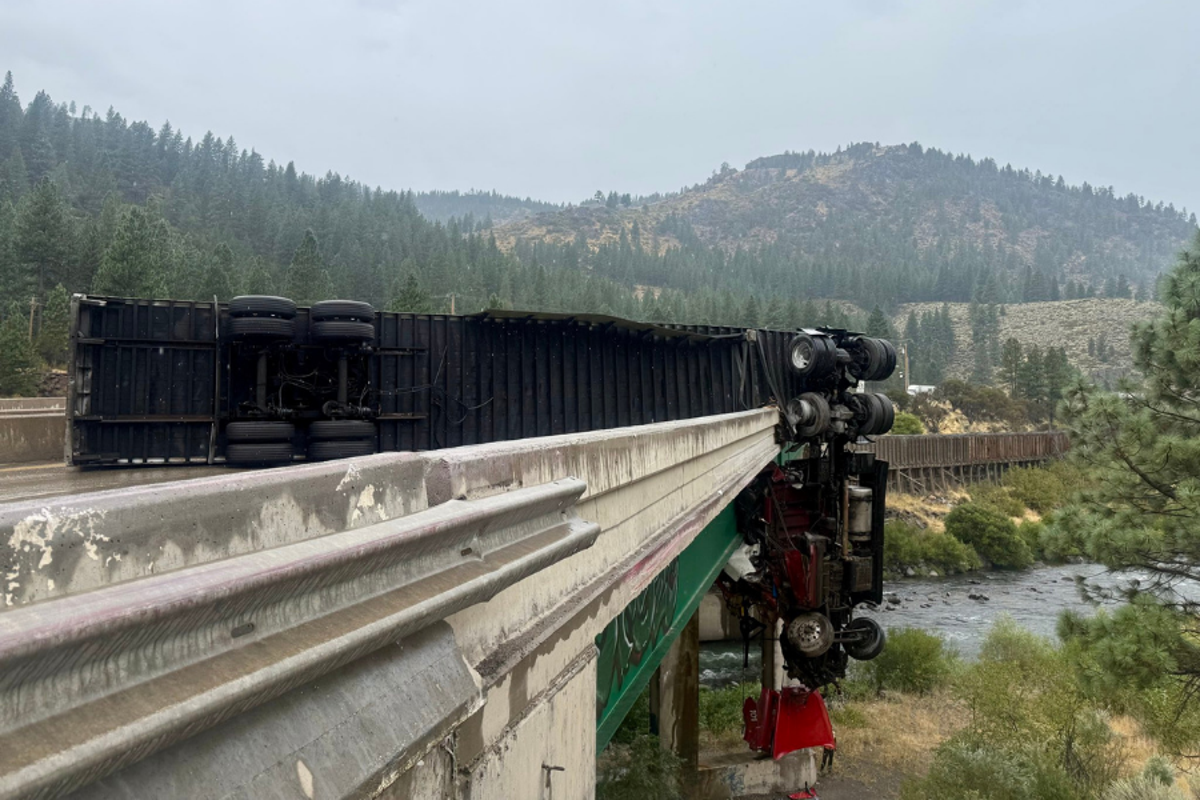
When a commercial tractor-trailer breached the concrete barrier on Interstate 80 near Floriston, California, and left its cab suspended eighty feet above a ravine, the immediate response focused on the dramatic visual of the hanging rig. Deconstructing the incident requires shifting the analytical lens away from sensational imagery and toward the physical mechanics, network vulnerabilities, and logistical bottlenecks that paralyzed a vital transcontinental corridor.
The failure event highlights three distinct systemic variables: kinetic energy management in heavy transport, the structural limits of legacy bridge rail systems, and the cascading impact on regional traffic topology.
The Mechanics of Kinetic Dispersion and Barrier Failure
Heavy commercial vehicles operating on mountainous grades face severe momentum constraints. Interstate 80 through the Sierra Nevada features sustained inclines and sharp radius curves that demand precise velocity control. When a multi-axle configuration loses traction or experiences directional destabilization, the resulting kinetic energy frequently exceeds the yield strength of standard roadside barriers.
The vehicle involved in the Floriston incident was operating under wet weather conditions, which drastically reduce the coefficient of friction between pneumatic tires and asphalt. Kinetic energy scales linearly with mass but quadratically with velocity ($E_k = \frac{1}{2}mv^2$). Even a minor miscalculation in braking force or steering input on a slick surface generates lateral forces capable of overriding standard Jersey barriers or tubular steel railings.
When the semi-trailer struck the concrete boundary, the barrier functioned as a deflection mechanism rather than a total containment wall. The transfer of momentum converted forward vector energy into rotational torque, flipping the tractor onto its side and driving the cab over the precipice while the heavier, anchored trailer maintained partial deck contact. The driver was subsequently ejected—a consequence of failing restraint integration relative to the violent deceleration forces experienced during the primary impact.
Network Vulnerability and Economic Bottlenecks
The closure of all eastbound lanes on Interstate 80 exposed the fragility of trans-Sierra transit corridors. I-80 serves as the primary economic and logistical artery connecting Northern California ports and population centers to the Intermountain West.
When a single point of failure closes this arterial highway, freight and passenger movement faces immediate gridlock. Alternative detours across the Sierra Nevada are sparse, highly constrained by terrain, and incapable of absorbing commercial freight volume without catastrophic delays. Furthermore, the timing of the Floriston accident coincided with mass transit demand spikes, specifically the migration of tens of thousands of participants toward the Burning Man festival in Black Rock City, Nevada.
This convergence of commercial freight logistics and recreational event traffic amplified the macro-level impact. A localized structural accident translated into a regional transit paralysis spanning multiple hours, forcing transport agencies to implement rolling roadblocks, diversion points at Hirschdale Road and Overland Trail, and prolonged recovery operations.
The Recovery Protocol and Infrastructure Resiliency
Clearing a suspended heavy vehicle requires a multi-staged engineering response coordinated by the California Highway Patrol and Caltrans. The operational sequence cannot prioritize speed over structural safety.
First, heavy-duty recovery cranes must isolate the dead weight of the tractor from the trailer to prevent a catastrophic secondary drop into the ravine. Second, structural engineers must assess the integrity of the bridge deck and remaining guardrail infrastructure. Concrete spalling and rebar exposure compromise the load-bearing capacity of the bridge edge, necessitating temporary shoring before lanes can be safely reopened to heavy loads.
The financial and temporal cost of these interventions points to an ongoing engineering challenge: legacy bridge infrastructure across Western mountain passes was designed decades ago under lower gross vehicle weight ratings and lower traffic densities. Upgrading these corridors requires retrofitting high-containment bridge rails engineered to redirect heavy commercial loads rather than simply yield upon impact.
Deploy structural reinforcement of high-risk mountain corridor bridges using energy-absorbing composite barriers, and mandate real-time telematics integration to dynamically adjust freight speed limits during localized weather events.