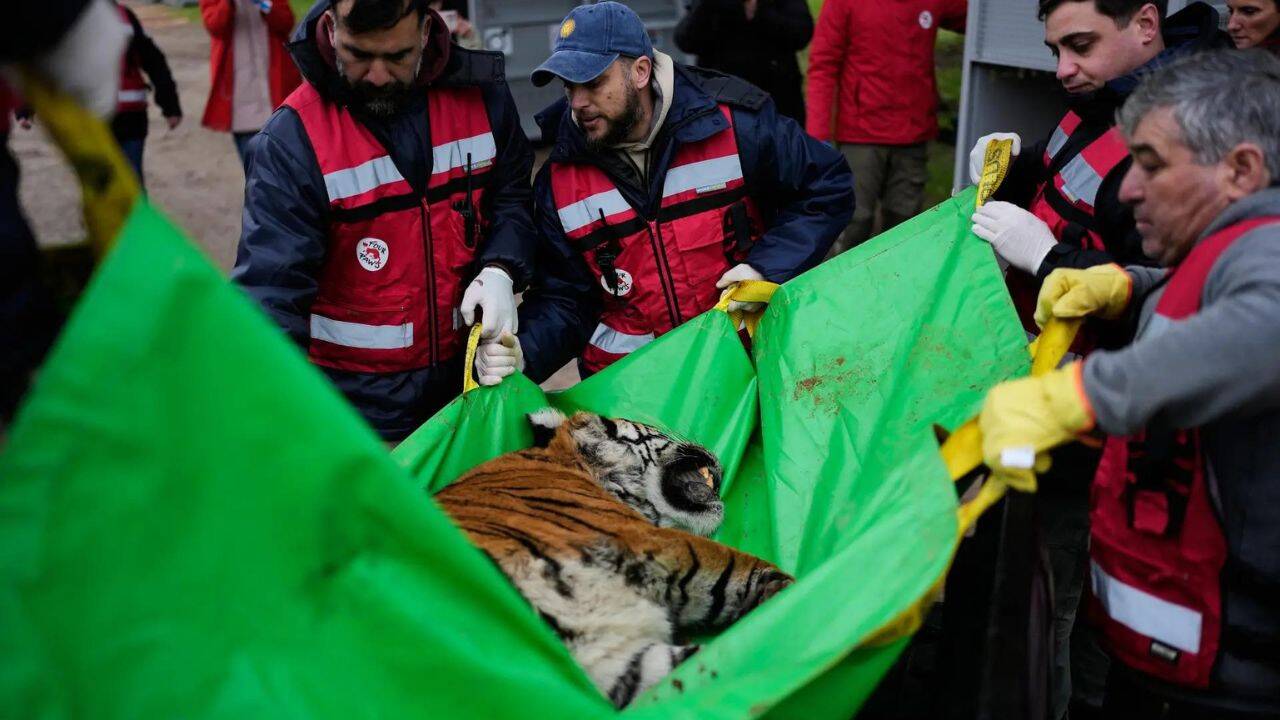
The physical transfer of thirty lions and tigers from a deteriorating private facility in Argentina to accredited sanctuaries in South Africa exposes the core inefficiencies inherent in sub-standard captive wildlife management. When municipal legislation, private capital constraints, and biological imperatives collide, the resulting operational vacuum creates a systemic crisis of animal welfare and public safety. Managing large felids in captivity requires a high-capital expenditure model focused on nutritional throughput, behavioral enrichment, and perimeter containment. Private enterprises operating without institutional endowments invariably experience capital decay, leading to compromised structural integrity, nutritional deficits, and regulatory failures.
Understanding this operational breakdown requires analyzing the mechanics of transfer logistics, the financial constraints of private zoos, and the biological costs borne by apex predators in suboptimal environments.
The Economic Model of Private Captive Facilities
Private zoological operations in emerging economies frequently rely on ticket-sales revenue and low-cost feed acquisition to maintain baseline cash flow. This creates an inverse relationship between financial health and animal welfare standards. As gate receipts decline or maintenance costs escalate, operators resort to deferred capital expenditure.
Revenue Decline -> Deferred Maintenance -> Perimeter Decay -> Regulatory Pressure -> Operational Collapse
Perimeter fences degrade, veterinary oversight becomes irregular, and caloric intake is reduced through cheaper, less nutrient-dense meat sources. Large felids such as Panthera leo and Panthera tigris have massive daily energetic requirements. Adult tigers consume an average of six to nine kilograms of meat daily, demanding a steady, high-cost supply chain. When feed acquisition costs rise or capital dries up, operators reduce rations, introducing nutritional deficiencies that manifest as skeletal weakness and neurological degradation.
The economic model lacks shock absorption. Unlike accredited institutions backed by endowments, municipal funding, or corporate sponsorship, private roadside zoos or makeshift animal parks operate paycheck-to-paycheck. When an acute financial shock occurs—such as a drop in tourism or increased utility costs—the facility immediately defaults on its core obligation: maintaining the biological security and metabolic needs of its inhabitants.
The Logistics of Intercontinental Wildlife Relocation
Moving thirty apex predators across continents is an exercise in high-stakes project management. The operation requires synchronization between veterinary teams, government regulatory bodies, cargo airlines, and receiving sanctuary personnel. The primary constraint is not distance, but biological stress mitigation.
Large felids do not tolerate prolonged sedation without significant physiological risk. Consequently, transfer protocols rely on conditioned crate training, where animals voluntarily enter reinforced transport containers weeks before departure. This minimizes the necessity for chemical immobilization, which compromises thermoregulation and respiratory function in big cats.
The transport pipeline breaks down into three distinct phases:
- Pre-Transport Conditioning: Veterinary clearance, blood panel analysis to screen for zoonotic diseases, and crate habituation to lower baseline cortisol levels.
- Chain of Custody Transfer: Road transit to an international cargo hub, tarmac loading under strict temperature-controlled conditions, and customs clearance protocols designed to minimize dwell time.
- Post-Arrival Decompression: Unloading into specialized quarantine facilities at the destination sanctuary, followed by a phased introduction to larger enclosures to prevent shock-induced self-harm.
Regulatory compliance presents a secondary bottleneck. The Convention on International Trade in Endangered Species of Wild Fauna and Flora mandates rigorous documentation to ensure specimens are not traded illegally. Securing permits across multiple jurisdictions introduces administrative latency. If a bureaucratic delay strands a crate at a port of entry, the animal's stress levels spike, increasing the risk of capture myopathy—a metabolic condition resulting from extreme muscular exertion and stress that frequently proves fatal.
Biological Costs of Sub-Optimal Confinement
Confining apex predators in substandard environments produces quantifiable psychological and physical pathologies. In the wild, lions and tigers range across extensive territories, patrolling boundaries, hunting, and engaging in complex spatial navigation. Concrete-floor enclosures with minimal vertical complexity induce chronic stereotypic behaviors, including pacing, head-bobbing, and self-mutilation.
Neurological health in captive felids correlates directly with spatial volume and environmental variability. Without novel stimuli, dopamine pathways degrade, leading to cognitive lethargy and immune system suppression through chronic cortisol elevation. Furthermore, hard flooring surfaces cause joint dysplasia and arthritis in animals weighing upwards of two hundred kilograms.
The transition from a barren concrete enclosure to a multi-acre sanctuary environment reverses some, but not all, of these pathologies. Upon release into expansive tracts of native vegetation, rehabilitated predators frequently exhibit initial disorientation, often referred to as agoraphobia in a wildlife context. Locomotion patterns change dramatically; animals that spent years pacing a ten-meter perimeter must re-learn how to navigate undulating terrain, tall grass, and natural obstacles.
Regulatory Lapses and Municipal Oversight
The emergence of substandard private zoos is symptomatic of regulatory arbitrage. Operators exploit jurisdictions with lax animal welfare laws, low land costs, and minimal inspection frequencies. When these facilities fail, the burden of remediation falls entirely upon the public sector or international non-governmental organizations.
Municipal authorities rarely possess the technical expertise or financial resources to manage apex predators temporarily seized during legal disputes. This creates a protracted interim period where animals remain in abandoned or bankrupt facilities, sustained only by emergency donations and volunteer labor. The legal framework governing animal confiscation prioritizes evidentiary preservation over immediate welfare interventions, leaving lions and tigers trapped in legal limbo while courts deliberate bankruptcy proceedings and ownership rights.
Effective systemic reform requires shifting the financial burden of animal custody onto the operators before a crisis manifests. Mandatory surety bonds, independent veterinary audits, and compulsory pre-funding of decommissioning costs would internalize the true expense of apex predator management, pricing out undercapitalized operators.
Sanctuary Capacity Constraints and the Global Pipeline
The successful relocation of thirty lions and tigers highlights a severe global supply shortage of accredited sanctuary space. True sanctuaries operate on a non-breeding, lifetime-care model. Once an enclosure is populated by a rescued big cat, that real estate is locked out for fifteen to twenty years.
Demand for sanctuary placement vastly outstrips available capacity. Scores of private facilities across Latin America, Eastern Europe, and Southeast Asia house hundreds of illegally traded or abandoned big cats. Facilities capable of handling thirty large felids simultaneously are exceedingly rare. They require massive perimeter fencing reinforced against digging and climbing, double-gate safety locks, dedicated water infrastructure, and on-site veterinary surgical suites.
Consequently, international rescues function as triage operations rather than systemic solutions. Each high-profile transfer requires months of fundraising and diplomatic coordination, while hundreds of other animals languish in undocumented breeding farms and roadside attractions.
Institutional Transition Protocols
When large felids arrive at a destination sanctuary, the integration strategy dictates long-term survivability. Facilities avoid immediate full-range release. Instead, they utilize a step-down enclosure model:
- Quarantine Hold: Initial thirty-day isolation to monitor for infectious pathogens and treat acute injuries sustained during transport.
- Acclimation Paddock: A one-to-two-acre enclosure allowing the animal to adjust to ambient temperatures, local prey vocalizations, and olfactory signatures of resident wildlife.
- Extended Range Release: Access to expansive natural enclosures equipped with automated feeding systems that simulate unpredictable foraging schedules, re-engaging dormant hunting instincts.
If an animal has spent its entire life in close human proximity without conspecific interaction, social housing is rarely attempted. Adult lions and tigers defend territories fiercely; forcing unfamiliar rescued cats together often results in fatal aggression. Spatial management at sanctuaries must therefore prioritize individual holding capacity over herd integration.
Capital Allocation for Long-Term Mitigation
To eliminate the cycle of emergency wildlife extractions, capital must be redirected upstream toward preventative regulatory enforcement. Funding should subsidize the retirement of breeding stock rather than post-crisis rescue operations.
Preventative Audits -> Breeding Stoppage -> Phased Retirement -> Sanctuary Integration
Without structural intervention at the source—specifically the prohibition of private ownership and commercial breeding of large felids—the global pipeline of distressed captive wildlife will continue to outpace sanctuary expansion. The successful transport of these thirty animals marks a tactical victory for animal welfare, but strategically, it represents a single data point in an unmitigated structural surplus of captive apex predators.
Establish an immediate international task force to audit private zoological inventories, freezing all transfer permits for facilities failing to maintain a minimum three-year operational endowment. Simultaneously, redirect emergency response funds toward constructing modular acclimation modules at certified sanctuaries to double regional intake velocity by the end of the fiscal year.