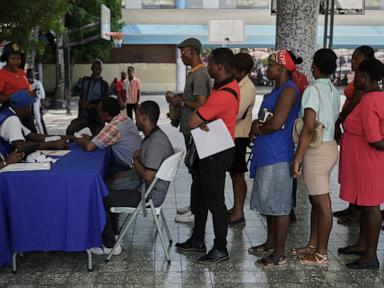
Reconstructing a functional electoral mechanism in a state where territorial control is heavily fragmented requires examining resource allocation against baseline operational friction. The recent tripartite financial arrangement involving the government of Japan, the Organization of American States, and the administration in Port-au-Prince provides a precise case study. By deploying a three million dollar capital injection targeted specifically at voter registration logistics and identification credentialing, the initiative attempts to bypass systemic administrative paralysis. Understanding the viability of this intervention demands breaking down the underlying cost functions, territorial constraints, and infrastructural bottlenecks that dictate whether capital converts into legitimate political participation.
The Operational Mechanics of the Three Million Dollar Allocation
Financial capital directed toward post-conflict or crisis-ridden electoral administration rarely translates directly into ballot collection. Instead, funds must be mapped against specific logistical choke points. The primary constraint in the current Haitian electoral cycle is not the absence of a theoretical voting populace, but the complete degradation of identity infrastructure.
The financial deployment targets two distinct operational variables:
- The procurement of three hundred and fifty thousand blank identification cards to clear existing administrative backlogs.
- The decentralization and hardware reinforcement of regional registration nodes, specifically targeting power stability and internet connectivity.
In environments where historical governance structures have collapsed, identity documents function as the foundational layer of the electoral stack. Without physical identification, the voter registry cannot be audited, deduplicated, or validated. The capital injection acts as a fixed-cost subsidy for credential manufacturing, shifting the baseline capacity of the state to issue verifiable proof of citizenship. However, the marginal utility of each dollar diminishes rapidly when confronted with external security variables.
Territorial Control Friction and the Security Cost Function
The primary impediment to executing general elections for the first time in over a decade is the inversion of traditional state sovereignty. With armed groups exercising territorial dominance across an estimated seventy percent of Port-au-Prince, the cost function of establishing secure registration centers escalates exponentially.
Traditional electoral theory assumes a baseline of public safety wherein citizens can freely transit to designated administrative offices. In the current operational environment, that assumption is invalid. The displacement of a record one and a half million individuals creates a moving demographic target. When populations flee active conflict zones, they routinely abandon physical documentation, transforming displaced persons into administrative ghosts.
The three million dollar intervention attempts to solve the hardware side of this equation by supplying blank cards, but it leaves the security variable unhedged. Deploying registration units into high-risk urban sectors or attempting to scale rural outreach without armed stabilization creates a stark resource vulnerability. Registration centers become physical targets, and prospective voters face direct physical deterrence simply by attempting to access state infrastructure. Consequently, financial inputs destined for administrative software and hardware risk immobilization if the security perimeter cannot be held by competent security forces.
The Timeline Compression Dilemma
The scheduled electoral calendar introduces a severe temporal constraint. Operating under a compressed timeline forces administrative bodies to choose between procedural thoroughness and calendar adherence.
Updating voter registries across a fractured demographic landscape requires rigorous field enumeration. When registration processes launch in active urban conflict zones under territorial fragmentation, data collection is inherently partial. Decentralized offices suffering from intermittent power and bandwidth constraints cannot reliably synchronize real-time databases with central servers. This introduces duplicate entries, omission errors, and verification lag.
The structural tension between maintaining an open-ended timeline to ensure high inclusion rates and adhering to a fixed electoral date creates systemic risk. If the administrative apparatus rushes the identification backlog to meet the target date, the resulting voter roll will inevitably exhibit high variance in accuracy. Conversely, delaying the vote to ensure data integrity risks further political instability in a nation that has lacked a functioning presidency since the assassination of Jovenel Moïse.
Strategic Allocation Priority
To maximize the efficacy of foreign financial assistance in deeply fractured administrative zones, future capital deployments must couple hardware procurement directly with localized security guarantees. Funding credential manufacturing without securing the physical nodes of distribution merely shifts the administrative bottleneck into a security crisis. International donors and domestic administrative bodies must prioritize mobile, armored registration units capable of operating within contested perimeters, paired with localized cryptographic verification that does not rely on permanent, fixed-location grid infrastructure.