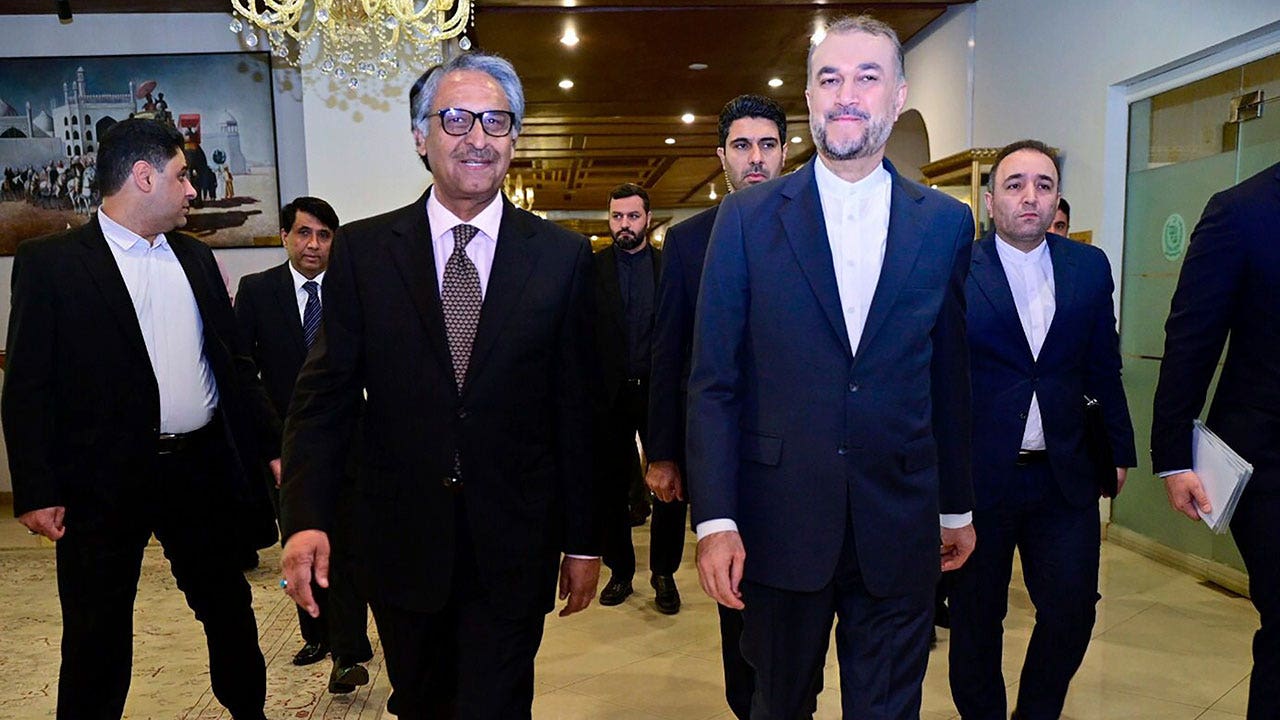
The deployment of a high-level United States delegation to Pakistan regarding Iranian regional activity represents a shift from passive containment toward active strategic compellence. This maneuver attempts to solve a multi-vector security equation: how to utilize Pakistan’s unique geographic and religious proximity to Iran to neutralize asymmetric threats while maintaining a credible kinetic deterrent. The efficacy of this strategy depends on three variables: the credibility of the US strike threat, the internal stability of the Pakistani government, and the economic elasticity of Iran under renewed pressure.
The Triad of Regional Influence Pakistan as a Geopolitical Lever
Washington’s decision to route Iranian negotiations through Islamabad is not a diplomatic courtesy but a calculated utilization of regional friction. Pakistan maintains a complex, often strained bilateral relationship with Iran, characterized by border security challenges in the Balochistan region and competing energy interests. By involving Pakistan, the US aims to create a "pincer effect" on Iranian strategic planning. Don't forget to check out our recent article on this related article.
The utility of Pakistan in this context operates on three distinct levels:
- Intelligence Synthesis: Pakistan’s Inter-Services Intelligence (ISI) possesses granular data on cross-border movements that Western agencies often lack. Accessing this data is critical for identifying the logistics chains of Iranian-backed proxies.
- Diplomatic Backchanneling: Islamabad serves as a rare neutral ground where messages can be delivered without the performative hostility of direct US-Iran engagement.
- Border Management: If Pakistan can be incentivized to tighten its western border, the kinetic and economic "leakage" that currently allows Iran to bypass certain sanctions is significantly reduced.
The Mechanics of Credible Deterrence
The simultaneous threat of "new strikes" serves as the kinetic anchor for the diplomatic mission. In game theory, a threat only alters the opponent's behavior if the cost of the threat being carried out exceeds the benefit of the current course of action, and the probability of execution is perceived as high. To read more about the context here, USA Today offers an in-depth breakdown.
The US military posture currently employs a Distributed Lethality framework. This involves spreading offensive capabilities across a wider array of platforms (sea, air, and cyber) to ensure that a strike can be launched with minimal lead time. The logical chain of this deterrence follows a specific sequence:
- Target Identification: High-value Iranian infrastructure or proxy command centers are pre-selected.
- Signaling: The public nature of the Pakistan delegation acts as the final "soft" warning.
- Escalation Dominance: The US demonstrates it has more rungs on the ladder of violence than Iran can effectively counter, forcing Tehran into a defensive crouch.
Economic Pressure and the Cost Function of Conflict
The threat of strikes is inextricably linked to the economic degradation of the Iranian state. Iran’s ability to project power via the Islamic Revolutionary Guard Corps (IRGC) is a function of available liquid capital. When the US delegation discusses Iran with Pakistani officials, the underlying currency of the conversation is often the Financial Action Task Force (FATF) compliance and energy transit.
Pakistan’s own economic fragility makes it susceptible to US influence. The International Monetary Fund (IMF) dependencies of Islamabad provide Washington with the necessary leverage to ensure Pakistan does not offer Iran a financial lifeline. This creates a bottleneck in Iran's "Resistance Economy," where the costs of maintaining regional proxies begin to cannibalize the domestic budget required for regime survival.
The Balochistan Variable and Asymmetric Risks
A significant blind spot in standard reporting is the role of the Balochistan province. This region, spanning both sides of the Iran-Pakistan border, is a hotbed for insurgent activity. Any US-led initiative that pressures Pakistan to take a harder line against Iran risks destabilizing this delicate ecosystem.
If the US delegation demands that Pakistan actively disrupt Iranian supply lines, they risk triggering a retaliatory response from Iran via specialized "gray zone" tactics. These include:
- Cyber Interruption: Targeting Pakistani or US-allied digital infrastructure.
- Proxy Activation: Increasing the frequency of skirmishes along the border to tie down Pakistani resources.
- Energy Sabotage: Disrupting the nascent energy pipelines that Pakistan desperately needs to fuel its industrial base.
Quantifying the Strike Probability Matrix
To evaluate the likelihood of the threatened strikes becoming a reality, we must look at the Expected Utility of the US administration. The strike probability increases when the "Diplomatic Yield" (the concessions gained from the Pakistan mission) remains low while the "Provocation Index" (Iranian-backed attacks on US assets) stays high.
Mathematically, the decision to strike can be modeled as:
$$S = (P \times V) - (C + R)$$
Where:
- $S$ is the Strategic Decision to strike.
- $P$ is the probability of a successful mission.
- $V$ is the political and security value of the target.
- $C$ is the immediate operational cost.
- $R$ is the risk of a wider regional conflagration.
The current administration has signaled that $V$ is increasing due to the need to project strength domestically and internationally. If the Pakistan delegation returns without a commitment from Islamabad to curb Iranian transit, the value of $R$ (risk) is likely to be discounted in favor of immediate kinetic action.
Structural Constraints of the US-Pakistan-Iran Triangle
The primary limitation of this strategy is the historical inconsistency of the US-Pakistan alliance. Pakistan has mastered the art of "Strategic Ambiguity," often appearing to comply with US demands while maintaining deep-seated ties with regional actors for its own long-term survival.
The second limitation is the internal political pressure within Iran. Hardline factions within the IRGC often view US strikes not as a deterrent, but as a catalyst for nationalistic fervor, which can solidify their domestic power base. This creates a paradox where kinetic action, intended to weaken the regime, might inadvertently provide it with the social cohesion necessary to withstand further sanctions.
Operational Logistics of the US Delegation
The composition of the delegation provides clues to the specific pressure points being applied. A delegation heavy on Treasury officials suggests a focus on cutting off illicit financial flows. A delegation heavy on Department of Defense personnel indicates a focus on tactical cooperation and "Red Line" definitions.
The structural prose of these negotiations focuses on three pillars:
- Direct Communication: Establishing a clear understanding of what actions will trigger an immediate US military response.
- Intelligence Reciprocity: Offering Pakistan high-level surveillance data in exchange for physical interdiction of Iranian shipments.
- Sanctions Alignment: Ensuring that Pakistan does not become a hub for Iranian oil "re-flagging" or other methods used to circumvent global trade restrictions.
The Geopolitical Repercussions of Kinetic Escalation
Should the delegation fail and the US move to execute the threatened strikes, the regional architecture will undergo an immediate stress test. The response from Beijing and Moscow will be critical. China, as a major investor in Pakistan’s infrastructure (CPEC), has a vested interest in preventing a hot war on Pakistan's borders.
The US must balance its strike objectives with the need to avoid a total rupture in its relationship with Islamabad. A strike that is perceived as violating Pakistani sovereignty could force the Pakistani government to pivot even more sharply toward the China-Russia-Iran axis, effectively ending the US's ability to influence South Asian security dynamics for a generation.
Strategic Implementation and Execution
The current diplomatic-military hybrid approach requires precise execution to avoid a catastrophic miscalculation. The following operational steps define the roadmap for the coming weeks:
- Establishment of the "Hotline": Formalizing a direct link between US command in the region and the Pakistani military to prevent accidental engagements during any strike operations.
- Verification Mechanisms: Implementing satellite and ground-based monitoring to ensure Pakistan is adhering to the agreed-upon interdiction protocols.
- Target Calibration: Ensuring that any "new strikes" are surgical and strictly limited to Iranian operational capabilities, avoiding civilian infrastructure to minimize the political fallout for the Pakistani government.
The primary objective is to force Iran into a strategic retreat by demonstrating that their traditional "strategic depth" in Pakistan is no longer guaranteed. This requires the US to offer Pakistan a security package that outweighs the benefits of their current cooperative stance with Tehran.
The strategic play is to move from a posture of reactive defense to one of proactive containment. The delegation's success will be measured by whether they can secure a "Neutrality Agreement" from Pakistan—one where Islamabad agrees to look the other way if the US chooses to engage Iranian targets near the border. If this is achieved, the Iranian regime loses its most valuable geographical shield, significantly altering the balance of power in the Middle East.