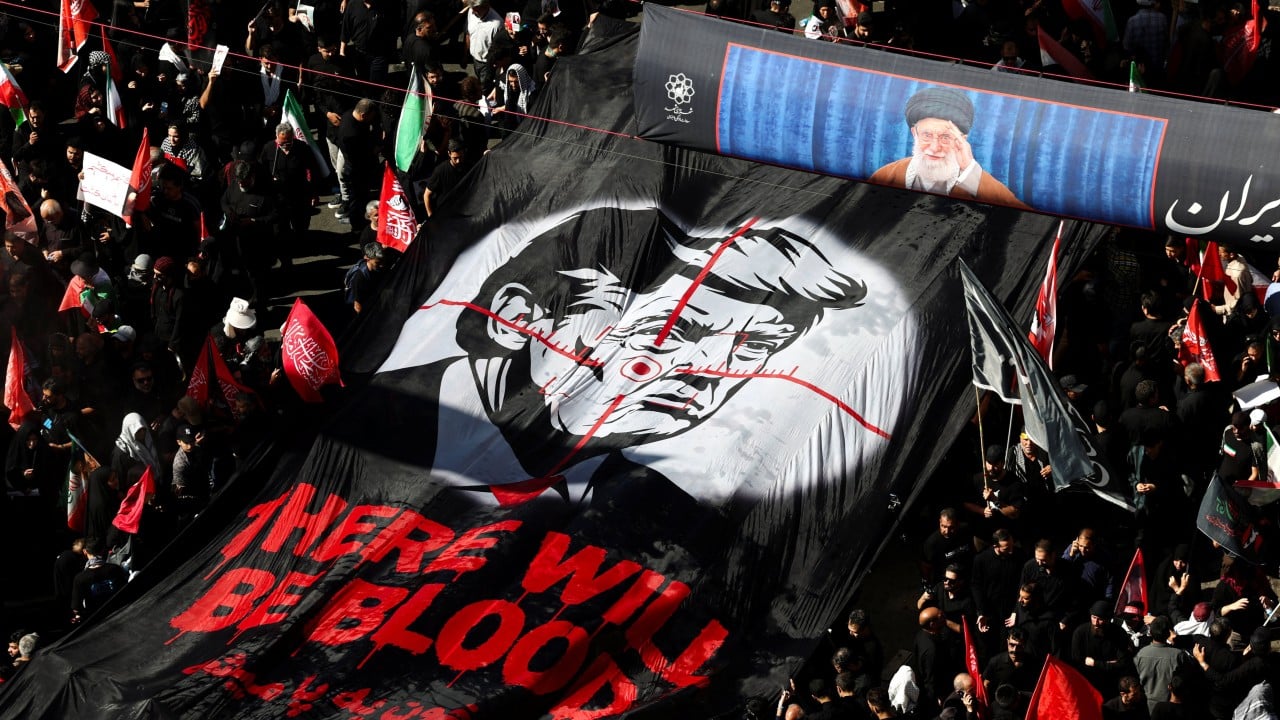
The convergence of active warfare and decapitation strategies has fundamentally altered the geopolitical conflict framework between the United States and the Islamic Republic of Iran. The structural shift from traditional state-versus-state military containment to a prolonged campaign of targeted leadership attrition has transformed the escalatory matrix. This analytical breakdown evaluates the operational mechanisms, strategic feedback loops, and cost functions governing the current conflict termination phase, specifically focusing on how high-value target (HVT) elimination disrupts command stability and complicates the parameters of a stable ceasefire.
The Mechanics of Asymmetric Deterrence Degradation
Geopolitical strategy historically relies on predictable retaliatory thresholds to maintain equilibrium. The introduction of persistent tactical decapitation protocols disrupts this predictability. Within the context of the current conflict, the operational execution of strikes targeting senior Iranian state actors creates a structural asymmetry in deterrence modeling.
Traditional deterrence functions on a state-level cost-benefit analysis where national infrastructure, economic assets, and conventional military forces serve as the primary variables of vulnerability. Leadership attrition protocols shift the vulnerability variable directly to the decision-making apparatus itself. This alteration modifies the adversary's risk calculation in three distinct phases:
- Information Asymmetry Accrual: The demonstration of precise kinetic capabilities against highly secured state figures signals complete intelligence penetration. This forces the adversary to reallocate significant operational resources away from offensive planning and toward internal counterintelligence and defensive security optimization.
- Command Chain Friction: The elimination of seasoned command personnel introduces immediate friction within the proxy command architecture. Subordinate commanders, operating under heightened survival constraints, display diminished risk tolerance and reduced coordination efficiency.
- Escalatory Ambiguity: When the state-level deterrent framework is replaced by personalized threat vectors, conventional red lines become obsolete. The adversary is left unable to accurately model which actions will trigger a kinetic response, leading to tactical paralysis or highly volatile, uncoordinated counter-escalation.
The structural breakdown of this deterrent matrix is visible in the operational tension defining the current theater. Rather than forcing a conventional diplomatic retreat, the systemic elimination of key institutional figures has compressed the time horizons of Iranian strategic planners, incentivizing asymmetric, non-attributable retaliation vectors over long-term conventional consolidation.
The Cost Function of High-Value Target Attrition
To systematically evaluate the efficacy of leadership attrition within the Iranian state apparatus, the structural design of the Islamic Revolutionary Guard Corps (IRGC) must be analyzed as an institutional network. The architecture of the IRGC and its external operating arms is built on a hybrid model combining bureaucratic institutionalism with highly personalized networks of informal allegiance.
When a high-value commander is neutralized, the operational cost to the organization is not merely the loss of a singular tactical decision-maker. The true cost function comprises the destruction of relational capital, transaction channels, and regional security arrangements built over decades.
Institutional Cost = [Relational Disruption] + [Intelligence Compromise Factor] + [Succession Friction Time]
Relational disruption measures the immediate severing of informal cross-border ties between the central command in Tehran and local proxy factions across the Levant and the Arabian Peninsula. These relationships are heavily dependent on personal trust, shared historical operational experience, and direct financial distribution channels. A new commander cannot rapidly replicate these informal governance mechanisms via bureaucratic decree.
The second component of the cost function involves the intelligence compromise factor. The successful execution of a high-value strike confirms the compromise of localized communication networks, physical movement protocols, and operational security architectures. The targeted organization must assume that all contiguous nodes within the deceased individual's immediate network are compromised, necessitating an immediate, sweeping teardown of active operational cells. This forced organizational restructuring induces an extended operational pause, degrading the adversary’s ability to project power efficiently during critical negotiation windows.
Succession Friction and Tactical Decentralization
The primary systemic vulnerability of a leadership attrition strategy is the unintended generation of tactical decentralization. While the removal of top-tier strategic coordinators reduces the probability of large-scale, highly synchronized multi-theater offensives, it simultaneously lowers the barrier to entry for localized, rogue actions.
In a highly centralized command framework, regional proxy nodes operate within strictly defined parameters established by the center. As the center undergoes successive leadership transitions, the enforcement mechanisms governing these parameters erode. The resultant organizational environment exhibits specific structural changes:
- Fragmented Command Authority: Middle-tier operational commanders assume greater autonomy over localized kinetic deployments, increasing the probability of unauthorized escalatory events that bypass diplomatic channels.
- Ideological Radicalization of Successors: The vacancy created by leadership elimination is frequently filled by younger, more ideologically rigid officers who seek to establish operational legitimacy through aggressive kinetic posture rather than calculated strategic restraint.
- Information Siloing: To mitigate the ongoing threat of intelligence penetration, the surviving command structure restricts information flow, inadvertently hampering their own internal logistical efficiency and strategic alignment.
This decentralization creates a profound bottleneck for conflict termination. Diplomatic envoys seeking to establish a durable ceasefire are confronted with an adversary that lacks a cohesive, unified command capable of enforcing compliance across its entire network of proxy forces. Consequently, localized breaches of truce conditions become structural constants rather than exceptional anomalies.
The Asymmetric Retaliation Loop and Command Vulnerability
The integration of targeted killings into state doctrine creates an enduring structural feedback loop characterized by reciprocal asymmetric threats. For the United States and its regional allies, the tactical execution of these strikes generates a secondary security liability: the personalization of state retaliation.
The Iranian security apparatus, facing conventional military inferiority, responds by shifting its strategic focus toward symmetric threats against high-level Western political and military figures. This operational posturing manifests as prolonged covert intelligence operations, cyber reconnaissance targeting command personnel, and the deployment of non-attributable transnational operational cells. The persistence of these plots, even during active ceasefire negotiations, indicates that leadership attrition strategies generate long-term security externalities that outlive the active phases of kinetic warfare.
This dynamic introduces a severe destabilizing variable into the war endgame. A political leadership operating under direct personal threat is structurally disincentivized to offer standard diplomatic concessions, as any relaxation of military posture could be interpreted as strategic weakness or vulnerability to pending personal retaliation. The conflict ceases to be managed purely through the cold calculation of state interests and becomes entangled with the immediate survivability and security requirements of individual decision-makers.
Strategic Realignment for Conflict Closure
Transitioning from a state of continuous tactical attritional dominance to structural conflict closure requires a rigorous re-engineering of current operational priorities. The continuation of targeted strikes past the point of maximum organizational disruption yields diminishing marginal returns and actively prevents the stabilization of a post-conflict equilibrium.
To achieve a durable resolution, military and diplomatic architectures must pivot toward institutional stabilization frameworks that isolate remaining radical nodes while providing explicit, verifiable de-escalation pathways for the central command. The structural preservation of a coherent, authoritative adversary capable of enforcing treaty obligations remains an absolute prerequisite for permanent war termination. Continued adherence to uncoordinated decapitation protocols will otherwise guarantee an amorphous, multi-theater conflict characterized by permanent asymmetric attrition and the complete absence of an enforceable political settlement.