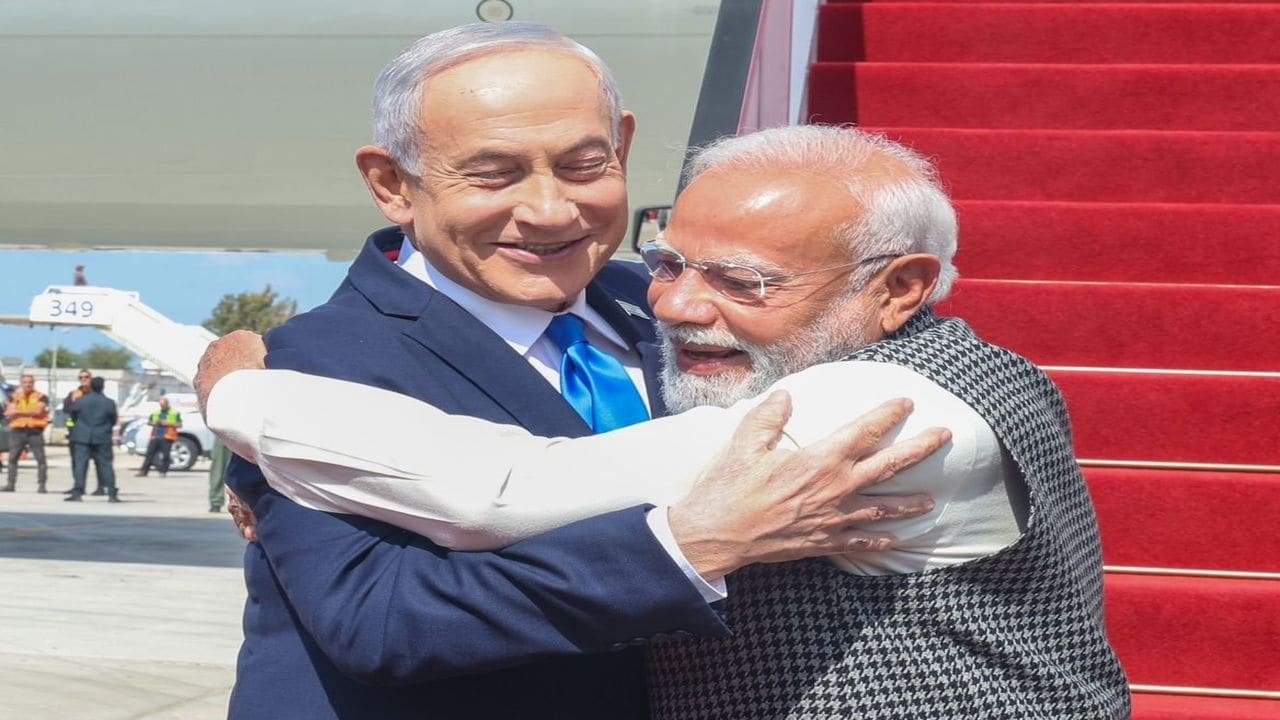
The congratulatory message from Israeli Prime Minister Benjamin Netanyahu to Indian Prime Minister Narendra Modi upon surpassing Jawaharlal Nehru’s record of 4,398 consecutive days in office marks more than a personal milestone. It signaling a fundamental shift in how democratic longevity alters bilateral leverage. In international relations, executive continuity functions as a form of strategic capital. When a state transitions from cyclical political volatility to predictable, multi-decade leadership, its diplomatic counterparties must reindex their long-term risk models.
The transaction between India and Israel provides a clear case study of this mechanism. Historically, India’s foreign policy operated under an equilibrium dictated by domestic electoral sensitivities, particularly regarding the Middle East. By securing consecutive democratic mandates, the current Indian administration has decoupled its geopolitical alignment from short-term electoral vulnerability. This structural stability alters the cost-benefit matrix for foreign allies, transforming transactional relationships into institutionalized strategic axes.
The Friction of Democratic Turnover in Strategic Alliances
To understand the value of executive continuity, one must analyze the structural limitations inherent in high-turnover democratic systems. In classical foreign policy modeling, states are frequently treated as rational, unitary actors. In practice, domestic political cycles introduce a recurring discount factor to international agreements.
Democratic Horizon Discount = f(Time to Election, Opposition Polarization, Institutional Safeguards)
When a prime minister or president face an imminent, highly contested election, the credibility of their long-term commitments diminishes. Foreign states hesitate to invest capital in joint infrastructure, defense co-development, or deep intelligence integration if a change in administration could cancel those initiatives.
The post-independence foreign policy of India illustrates this friction. For decades, the nation maintained a posture of non-alignment, balancing its relationships via institutional ambiguity. While this strategy minimized immediate geopolitical risk, it created a structural bottleneck for deep bilateral partnerships. Israel, which established full diplomatic relations with India only in 1992, remained a secondary consideration restricted by Delhi's necessity to balance regional partnerships.
The accumulation of uninterrupted executive tenure removes this structural discount. When an administration crosses the decade threshold with a stable parliamentary majority, the perceived probability of policy reversal approaches zero. For a strategic partner like Israel, this reliability alters the valuation of technology transfers and intelligence-sharing frameworks. The counterparty is no longer pricing its risk over a five-year electoral horizon; instead, it optimizes for a multi-decade security architecture.
The Three Pillars of Contemporary India-Israel Alignment
The transformation of the India-Israel relationship from an understated defense-procurement arrangement into an explicit strategic partnership rests on three independent operational axes. Each axis has been systematically insulated from domestic political shocks through long-term executive signaling.
Co-Development and Technology Transfer
The defense pillar has shifted from a buyer-seller dynamic to a deep technological dependency. Historically, India imported finished military hardware, leaving its domestic industrial base exposed to supply-chain disruptions. Under the current strategic framework, the focus has pivoted to joint development, exemplified by the Barak 8 surface-to-air missile system.
This model requires an unprecedented level of intellectual property sharing and joint industrial integration between Israel Aerospace Industries and India's Defence Research and Development Organisation. Such deep corporate and military integration is structurally unfeasible without the explicit, multi-year backing of stable executive leadership.
Agricultural and Water Infrastructure Integration
Beyond defense, the partnership utilizes asymmetric technological competencies to address structural resource deficits. Israel’s mastery of arid-land agriculture and desalination technology matches India’s long-term food security requirements.
By establishing dozens of Centers of Excellence across multiple Indian states, the bilateral relationship bypasses the federal-state frictions that frequently paralyze foreign-funded initiatives in India. The durability of the central government provides the institutional air cover required to implement these localized agricultural adaptations over a multi-year horizon.
Geopolitical De-risking in Multilateral Forums
The third pillar is diplomatic reciprocity, which operates through a clear transactional logic. India has historically voted against Israeli interests in United Nations resolutions to maintain alignment with the Global South and Arab partners.
While India has not entirely abandoned its traditional positions, its voting patterns have increasingly shifted toward abstention on critical resolutions. This shift reflects a calculated trade-off: India secures advanced defense tech and counter-terrorism intelligence, while Israel gains diplomatic legitimacy from the world's most populous democracy.
Institutional Path Dependency and the Post-Nehru Era
The historical comparison between the current administration and the tenure of Jawaharlal Nehru reveals a critical structural divergence in how political longevity translates into institutional change.
| Metric | The Nehru Era (1947–1964) | The Modi Era (2014–Present) |
|---|---|---|
| Primary Ideological Anchor | State-Led Socialism & Non-Alignment | Market-Driven Nationalism & Strategic Autonomy |
| Geopolitical Vector | Post-Colonial Solidarity (Global South) | Multi-Alignment & Minilateralism (Quad, I2U2) |
| Institutional Mechanism | Centralized Bureaucratic Planning | Digitized Welfare & Public Infrastructure Scaling |
Nehru’s 16-year, 286-day tenure was foundational, establishing the constitutional and civic architecture of post-independence India. However, his foreign policy was deeply rooted in personal prestige and ideological commitment to the Non-Aligned Movement. When the structural assumptions of that policy were challenged by the 1962 Sino-Indian War, the institutional framework struggled to adapt, revealing the vulnerability of a policy reliant on personal prestige.
By contrast, the current era uses political longevity to build an institutional path dependency that outlasts individual tenures. By embedding foreign policy choices within concrete domestic economic agendas—such as manufacturing initiatives and national security supply chains—the current administration ensures that future governments face prohibitively high exit costs.
A subsequent administration could not easily untangle India's defense architecture from Israeli sub-components without incurring a severe, multi-year drop in operational readiness. Consequently, the strategic alignment becomes a structural reality rather than an ideological choice.
The Limits and Strategic Vulnerabilities of Continuity
A data-driven strategy assessment requires mapping the structural vulnerabilities inherent in long-term executive dominance. Continuity provides predictability, but it also creates specific systemic risks that foreign planners must quantify.
- Institutional Over-Centralization: When foreign policy decisions are concentrated within a tight executive core over a decade, traditional bureaucratic channels like the Ministry of External Affairs can see reduced agency. If decision-making structures become overly centralized, the state's capacity to manage simultaneous, multi-theater diplomatic crises can degrade.
- The Single-Point-of-Failure Risk: Alliances built on strong personal relationships between leaders face sudden valuation adjustments when a leadership transition eventually occurs. Netanyahu's reference to a personal bond highlights this vulnerability: the strategic alignment is partially priced on personal chemistry, creating a premium that may not transfer to a successor.
- Asymmetric Geopolitical Pressures: India’s multi-alignment strategy requires balancing its partnership with Israel against its critical energy dependencies in the Middle East and its evolving relationship with Iran. A severe escalation in Middle Eastern regional conflict tests the limits of this balancing act, forcing India to choose between tangible defense dependencies and broader energy security.
The Strategic Path for Global Capital and Defense Planners
For multinational corporations, sovereign wealth funds, and defense contractors, the milestone of executive longevity in India demands a recalibration of risk models. The empirical evidence indicates that India has crossed a threshold where its core geopolitical and macroeconomic trajectories are locked in, irrespective of future electoral fluctuations.
The strategic play here is to shift from short-term transactional models to deep institutional integration. Entities operating in the defense, technology, and infrastructure sectors should structure joint ventures under the assumption that the current regulatory and geopolitical framework enjoys long-term stability. The risk of sudden, ideological policy reversals is at an all-time low.
Capital should be deployed into co-development frameworks that tie Western and Middle Eastern supply chains directly into India's domestic production ecosystem. The state has demonstrated the political capacity to maintain its strategic alignments under immense global pressure, making it an anchor of predictability in an otherwise volatile global landscape.