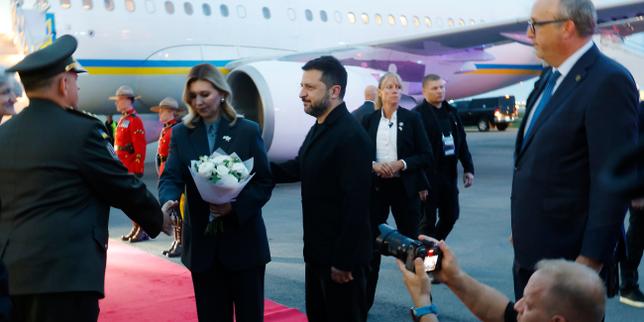
Bilateral state visits during active armed conflict operate as high-leverage signaling mechanisms rather than routine diplomatic exchanges. When a head of state travels to a secondary donor nation, the underlying transaction involves aligning domestic industrial capacity with external military demand under severe time constraints. The diplomatic architecture connecting Ottawa and Kyiv reveals a specific economic and political feedback loop where domestic resource allocation meets international deterrence theory.
Evaluating this relationship requires stripping away conventional diplomatic rhetoric to examine three structural components: the domestic political economy of donor mobilization, the fiscal capacity for military procurement, and the logistical constraints of transatlantic supply chains.
The Domestic Political Economy of Donor Mobilization
Middle-power nations with significant expatriate diasporas experience a unique intersection of domestic voter alignment and foreign policy execution. Canada hosts one of the largest Ukrainian diasporas globally, creating an electoral constituency that directly influences legislative momentum for defense appropriations. This dynamic alters the standard cost-benefit analysis for governing coalitions. Rather than weighing foreign aid purely against domestic fiscal priorities, political leadership must account for the immediate opportunity cost of inaction among concentrated voting blocks.
This political incentive structure translates directly into legislative output, yet it collides with institutional defense procurement timelines. Public diplomacy emphasizes immediate solidarity, but the underlying mechanisms of state support rely on multi-year defense contracts, industrial baseline expansions, and specialized manufacturing orders. When political leaders negotiate direct assistance packages during official visits, they are frequently front-loading future production capacity rather than transferring immediate surplus inventory, as existing stockpiles within middle-power militaries are structurally constrained.
The Fiscal and Material Capacity Constraints
The limits of bilateral aid emerge clearly when examining the fiscal mechanics of defense contributions from non-superpower economies. Canada operates under specific defense spending baselines that historically hover below major alliance thresholds, creating immediate friction between political commitments and physical inventory availability.
- Inventory Depletion Thresholds: Donating active military hardware degrades domestic operational readiness unless paired with concurrent procurement contracts to backfill national stockpiles.
- Specialized Maintenance Pipelines: Advanced weapon platforms require specialized technical support, spare parts inventory, and training infrastructures that cannot be rapidly transferred without civilian contractor support.
- Industrial Baseline Lags: Defense manufacturing lines for heavy artillery and armored vehicles operate on long lead times, meaning financial pledges made during state visits take quarters or years to materialize as physical assets on the ground.
These constraints dictate that financial transfers and humanitarian aid serve as the primary short-term vectors of assistance, while lethal military aid represents a secondary, longer-term capital investment constrained by domestic manufacturing capacity.
Transatlantic Logistics and the Friction of Delivery
Pledging material support and executing delivery across an oceanic supply chain introduce severe operational friction. The logistical pathway from North American defense plants to Central European staging areas requires coordinated multi-modal transport involving strategic airlift, maritime shipping, and rail networks managed by coalition partners.
Each transition point in this supply chain introduces latency and vulnerability. When political delegations meet to announce new aid packages, operational planners must immediately account for transit security through congested European logistics hubs. Consequently, the public announcement of aid often lags weeks behind the actual initiation of logistics staging, or conversely, precedes actual delivery by months while manufacturing orders are processed.
Strategic Realignment and Resource Allocation
Sustained interstate conflict forces secondary donors to transition from ad-hoc inventory donations to systematic industrial integration. For Ottawa, this shift requires recalibrating federal budgets to sustain multi-year funding streams for Ukrainian state operations, military procurement, and infrastructure reconstruction. The long-term trajectory of this alliance depends less on symbolic summit diplomacy and more on the sustained capacity of domestic industrial sectors to absorb increased defense orders without triggering inflationary pressures or severe supply bottlenecks.
Policymakers must institutionalize these funding mechanisms within regular defense reviews to prevent donor fatigue from eroding strategic commitments during protracted attritional warfare. Future security architectures will rely on integrated joint-production agreements where donor nations fund manufacturing directly inside secure zones or partner states, bypassing the prohibitive logistics of transatlantic shipping for heavy combat systems.