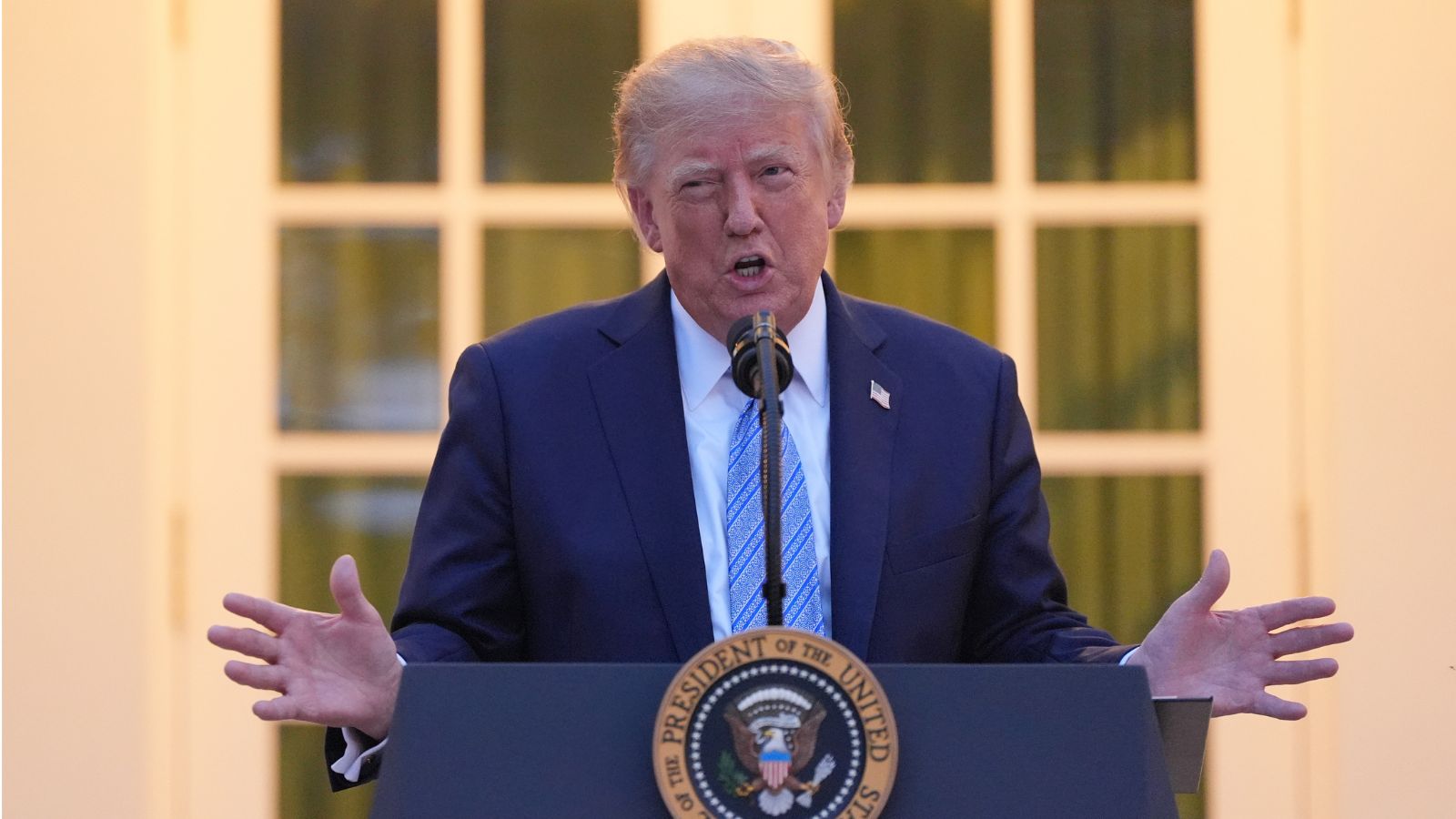
When an American president announces he is in "deciding mode" regarding Iran, he is not merely describing a psychological state or an administrative pause. He is deploying a calculated instrument of coercive diplomacy known as strategic ambiguity. By withholding the exact threshold that triggers kinetic or economic retaliation, the executive branch forces an adversary to price in the maximum possible cost of escalation while denying that adversary the data required to calibrate a safe provocation.
Standard news coverage treats executive deliberation as a waiting game—a vacuum between rhetoric and action. That framing misunderstands how deterrence operates at the highest levels of statecraft. In international relations, the period of active decision-making is often the primary phase of leverage. The public declaration of deliberation alters the payoff matrix for Tehran, regional proxies, energy markets, and allied capitals simultaneously. Understanding the mechanics of this posture requires breaking down the four structural variables governing the White House decision calculus, the economic transmission belts that react to executive signaling, and the operational limits of keeping an adversary in a state of suspended uncertainty. Learn more on a related subject: this related article.
The Architecture of Coercive Deliberation
In classic deterrence theory, pioneered by Thomas Schelling, a threat is only as effective as its credibility and the adversary's perception of resolve. However, absolute clarity carries a severe operational liability: if a leader draws a bright red line and the adversary crosses it incrementally, the leader is trapped between initiating an unwanted war or suffering a catastrophic loss of credibility.
Stating that the administration is in "deciding mode" solves this commitment trap. It signals that the intelligence assessment is complete, the military and economic options are sitting on the resolute desk, and the probability of action has shifted from theoretical to imminent. Further analysis by NPR delves into comparable perspectives on this issue.
The Three Functions of the Deliberation Signal
- Cost Internalization by the Adversary: When Tehran observes an open-ended decision window in Washington, Iranian military planners must disperse assets, heighten air defense readiness, and suspend overt operations to avoid handing the White House a convenient pretext. The threat of action imposes immediate operational friction and financial burn on the Iranian apparatus before a single munition is fired or a new sanction is signed.
- Allied and Coalition Conditioning: Unilateral action in the Middle East carries steep diplomatic and logistical costs, particularly regarding basing rights, overflight permissions, and intelligence sharing with Gulf Cooperation Council states and European partners. A publicized decision phase acts as a forcing function for diplomatic alignment. It pressures regional allies to either extract concessions from Tehran quietly or prepare their own domestic defenses for spillover effects.
- Domestic Political Insulation: Modern executive statecraft operates under intense legislative and public scrutiny. Signaling a methodical evaluation process preempts accusations of impulsiveness from congressional critics while satisfying domestic hawks that the status quo is no longer acceptable. It establishes a public record of exhaustion of alternatives, which becomes vital if the ultimate decision involves military force.
The Four Variables in the White House Decision Matrix
Any executive decision regarding Iran is constrained by four interlocking variables. Unlike simplistic media narratives that reduce foreign policy to personality traits, an institutional analysis reveals that the White House must optimize across competing national security and macroeconomic imperatives.
Variable 1 The Nuclear Breakout Timeline
The primary technical driver of any Iran decision is the status of its nuclear enrichment program. Intelligence communities measure this not in political rhetoric, but in breakout time—the duration required to produce enough weapons-grade fissile material for a single nuclear device, coupled with the weaponization timeline required to mate that material to a delivery vehicle.
When enriched uranium stockpiles reach 60 percent purity, the technical distance to 90 percent weapons-grade material shrinks exponentially due to the physics of centrifuge cascades. If intelligence indicates that Tehran is shortening its breakout window or restricting International Atomic Energy Agency (IAEA) monitoring beyond established thresholds, the White House faces a binary choice: accept a latent nuclear threshold state or execute a kinetic strike to set the physical infrastructure back by years. The deliberation phase is frequently used to verify whether covert sabotage or diplomatic backchannels can achieve what overt military strikes would accomplish at a higher escalation cost.
Variable 2 Regional Proxy Escalation and Asymmetric Reach
Iran rarely confronts conventional military powers symmetrically. Instead, it relies on a distributed network of regional proxies—including Hezbollah in Lebanon, the Houthis in Yemen, and various militias in Iraq and Syria—to impose costs on U.S. assets and international shipping lanes.
The White House decision calculus must weigh the direct target against the inevitable second-order retaliation. A strike on Iranian soil or high-value Islamic Revolutionary Guard Corps (IRGC) assets triggers predictable responses across multiple theaters:
- Disruption of maritime commerce through the Strait of Hormuz or the Bab el-Mandeb Strait.
- Ballistic missile and drone salvos targeting U.S. bases in the Levant and Persian Gulf.
- Escalation along Israel's northern border, risking a full-scale regional war that draws in American air and naval power.
Evaluating these cascades requires positioning defensive assets—such as carrier strike groups, THAAD batteries, and Patriot systems—into the theater before announcing a final decision. Often, "deciding mode" is the public cover for the logistical deployment of defensive interceptors.
Variable 3 The Macroeconomic and Energy Transmission Belt
Foreign policy decisions do not occur in a vacuum; they collide directly with domestic economic stability. The Persian Gulf remains the central artery of global hydrocarbon supply, with roughly one-fifth of the world's petroleum liquids passing through the Strait of Hormuz.
When the White House signals imminent deliberation over Iran, commodities markets immediately price in a geopolitical risk premium. Even without a physical blockade, heightened tension spikes maritime insurance rates, diverts tanker traffic, and pushes Brent crude futures upward. For an American administration, a sustained spike in crude prices translates directly into higher retail gasoline prices, reigniting inflationary pressures and tightening financial conditions.
The executive branch must therefore calculate whether global spare oil production capacity—primarily held by Saudi Arabia and the United Arab Emirates—is sufficient to offset any Iranian supply disruption, or whether the Strategic Petroleum Reserve can buffer a short-term price shock. If energy markets are tight, the administration's bias shifts heavily toward non-kinetic options, such as targeted financial sanctions or cyber operations, rather than physical strikes on energy infrastructure.
Variable 4 Sanctions Enforcement and Financial Chokepoints
Between doing nothing and launching cruise missiles lies a vast spectrum of economic warfare. The U.S. Treasury Department maintains extensive secondary sanctions regimes designed to isolate the Iranian financial system and choke off illicit oil revenues, particularly exports flowing to independent refineries in Asia.
However, sanctions suffer from diminishing marginal returns over time. Adversaries build parallel financial architectures, utilize ship-to-ship oil transfers with transponders disabled, and barter commodities to bypass the U.S. dollar. When the president enters a high-profile decision phase, one primary option under review is a shift from statutory sanctions (adding new names to a blacklist) to enforcement escalation—seizing tankers, sanctioning major foreign financial institutions facilitating Iranian trade, or disrupting the logistical networks moving dual-use drone and missile components.
The Structural Limits of Strategic Ambiguity
While public deliberation generates short-term leverage, it is a depreciating asset. Operating in a prolonged state of "deciding mode" introduces three severe operational risks that can degrade the administration's strategic position.
The Credibility Decay Curve
Deterrence relies on the believability of follow-through. If an executive repeatedly announces that all options are on the table and that a decision is imminent, yet fails to execute a visible shift in policy within a reasonable timeframe, the adversary adjusts its baseline assumptions. Tehran will conclude that the deliberation is a bluff designed for domestic consumption or diplomatic posturing. Once an adversary discounts the threat of action, the coercive value of ambiguity drops to zero, forcing the executive into a position where only a massive, disproportionate use of force can restore deterrence.
Escalation Dominance by the Adversary
Leaving a decision open-ended surrenders the initiative to the opponent. During a prolonged American deliberation window, Iran is not passive. Tehran can alter facts on the ground—accelerating centrifuge installation in hardened underground facilities like Fordow, moving high-value personnel out of targeted zones, or instructing proxies to launch low-level attacks that stay just below the threshold of a major war. By seizing the operational tempo, the adversary forces the White House to constantly recalibrate its intelligence picture, creating an infinite loop of re-evaluation that paralyzes execution.
Market Fatigue and Allied Hedging
Allies and global markets cannot remain on a war footing indefinitely. If Washington signals impending action without clarity, regional partners begin hedging their bets. Gulf states, acutely vulnerable to Iranian drone and missile retaliation, will initiate bilateral de-escalation talks with Tehran to insulate their own oil facilities and desalination plants from crossfire. Simultaneously, European allies may distance themselves from American posture to protect their own diplomatic channels. Prolonged ambiguity fractures the very coalition required to sustain economic or military pressure.
Operational Execution The Tactical Blueprint for Decision Closure
To convert strategic ambiguity into tangible geopolitical leverage without succumbing to credibility decay, an administration must transition from open-ended deliberation to structured execution. Based on the mechanics of coercive diplomacy, closing the decision loop requires a strict sequence of calibrated moves rather than a single dramatic announcement.
- Establish Private Red Lines with Public Ambiguity: Maintain public silence on exact military targets while communicating specific, non-negotiable thresholds to Tehran via established intermediaries (such as Oman, Qatar, or Swiss diplomatic channels). The adversary must know precisely which actions guarantee a kinetic response, even if the public does not.
- Synchronize Force Posture with Diplomatic Deadlines: Tie the deliberation window to hard operational milestones—such as an upcoming IAEA Board of Governors meeting or the expiration of a specific sanctions waiver. Force deployments into the Central Command (CENTCOM) area of responsibility must align with these dates so that the capability to execute matches the expiration of the diplomatic clock.
- Prioritize Asymmetric Disruption Over Broad Escalation: If kinetic or overt action is selected, target the specific nodes that enable Iranian power projection—such as drone manufacturing supply chains, naval logistics vessels, or financial clearinghouses—rather than broad infrastructure that guarantees an existential, regime-survival response from Tehran.
- Lock In Energy Buffers Prior to Announcement: Coordinate quietly with major non-OPEC and Gulf producers to ensure spare capacity is ready to hit the market the moment an executive decision is made public, neutralizing Iran's primary economic weapon—oil price volatility—before it can inflict domestic political damage.
The true measure of an executive's "deciding mode" is not found in press briefings or televised remarks, but in the quiet movement of naval assets, Treasury enforcement directives, and diplomatic cables. When the decision finally emerges, its success will depend entirely on whether the administration used its deliberation window to lock in escalation dominance—or merely allowed the adversary time to prepare for the storm.