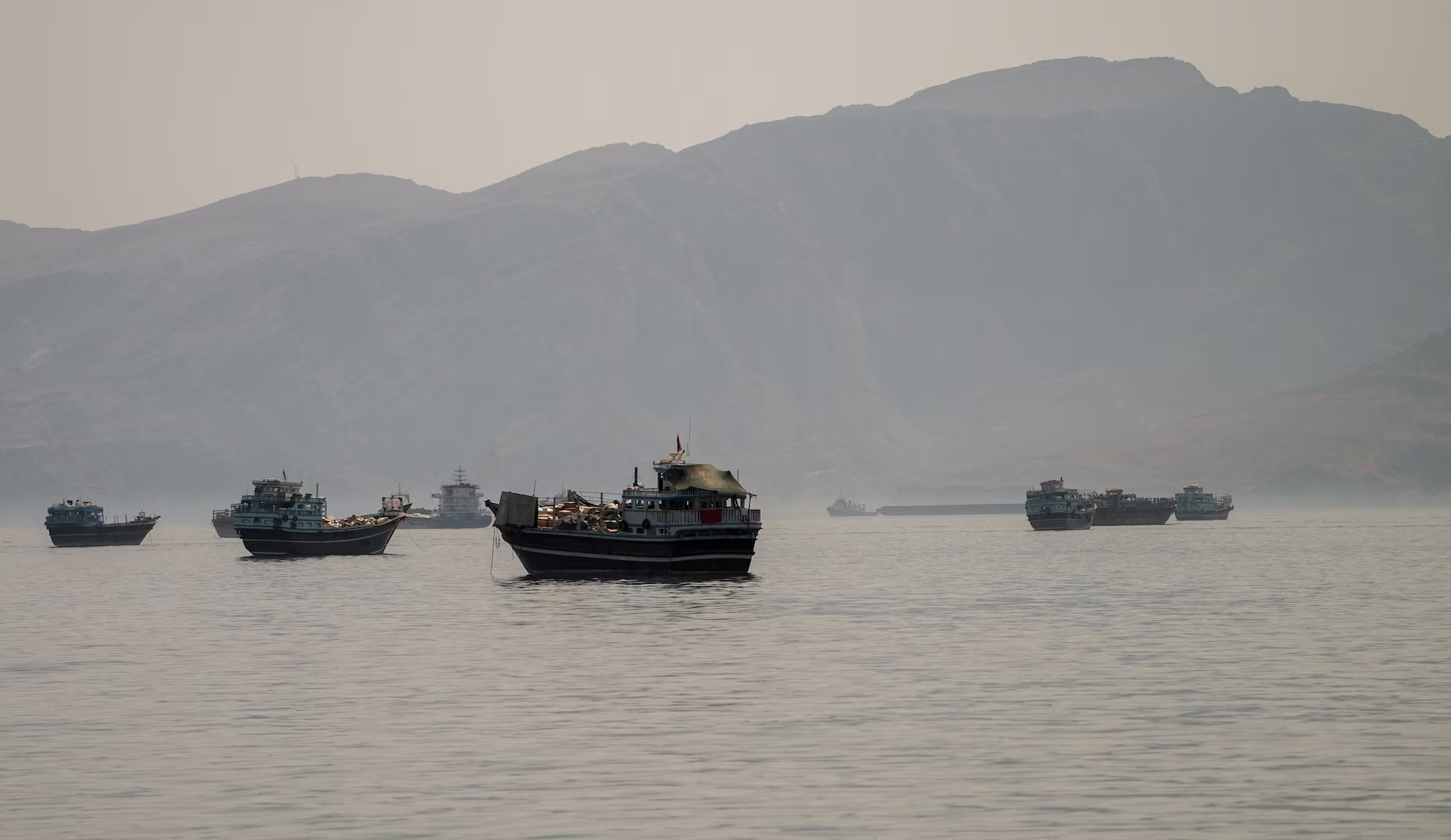
The financial press is currently obsessing over a slow-moving parade of ships.
Mainstream analysts are looking at tracking data from the Strait of Hormuz, watching stranded tankers slowly resume their journeys, and breathing a collective sigh of relief. The consensus narrative is already set: the "trickle" of stalled crude is returning to the global market, supply constraints are easing, and downward pressure on energy prices is imminent. Expanding on this topic, you can find more in: The Anatomy of Social First Media Scaling Economics and Algorithmic Arbitrage.
It is a comforting bedtime story for commodities traders. It is also completely wrong.
The belief that a temporary bottleneck clearing in the Persian Gulf will meaningfully fix global supply dynamics misses the fundamental mechanics of modern energy logistics. This is not a supply triumph. It is a lagging indicator of structural friction. If you are pricing your assets based on the assumption that these clearing tankers represent a bearish wave of oil, you are setting your capital on fire. Experts at Harvard Business Review have shared their thoughts on this trend.
The Illusion of the "New" Barrel
Here is the first foundational error the consensus makes: treating delayed oil as new oil.
When a tanker is delayed in transit due to geopolitical tension, insurance disputes, or localized security threats, that crude does not magically multiply. It was already bought, paid for, and factored into the global supply-demand balance weeks, if not months, ago.
I have spent nearly two decades analyzing energy supply chains. I have watched trading desks panic over canal closures and throw parties when the gates reopen. The reality on the ground is always far less dramatic. A backlog of ships clearing a choke point is not a sudden influx of production; it is merely a correction of a scheduling error.
Consider the math. If a refinery in South Korea or Western Europe expects 2 million barrels of crude on the first of the month, but security threats delay the vessel by twelve days, that refinery is forced to draw down its localized inventories or buy expensive, prompt-delivery wet cargoes on the spot market. When the delayed tanker finally arrives on the 14th, it does not create a surplus. It merely tops up a depleted tank.
The market has already absorbed the shock of the delay. The resolution of the delay simply returns the system to baseline zero. It does not push it into a surplus.
The Phantom Liquidity of Floating Storage
Mainstream reporting loves to throw around the phrase "floating storage" as if it represents a hidden reserve of liquidity ready to flood the market.
Let's clear up a massive misunderstanding: nobody stores oil on a Very Large Crude Carrier (VLCC) by choice unless they are completely desperate or executing a highly specific contango play.
Normal Transit: Efficient, pre-sold, high-velocity movement.
vs.
Stranded/Floating Storage: Daily demurrage costs, soaring insurance premiums, degradation risks.
When tankers idle near the Strait of Hormuz, the ownership costs skyrocket. Demurrage rates—the penalty fees paid for delaying a ship beyond its allotted time—can easily breach $50,000 to $100,000 per day depending on the charter market. Combine that with war-risk insurance premiums that spike by 400% the moment a hull sits too long in a contested zone, and that "cheap" crude suddenly becomes the most expensive oil on the planet.
When these ships finally move, the operators are not looking to undercut the market to move volume. They are looking to dump the cargo as fast as humanly possible to stop the bleeding on operational costs. This oil is heavily penalized by logistics costs. It cannot act as a dampener on global prices because its break-even threshold has been artificially inflated during its time in limbo.
The Broken Premium: Why Regional Risk Outlasts the Bottleneck
The "lazy consensus" argues that once the ships move, the risk premium evaporates. This ignores how maritime insurance and credit facilities actually operate.
When the Strait of Hormuz experiences even a temporary slowdown, Lloyds of London Joint War Committee does not just shrug and reset their risk maps the moment traffic ticks upward. The risk premium is sticky. It stays embedded in the cost of freight for months after the physical disruption has cleared.
- Higher Hull Insurance: Shippers pay a lasting tax just for routing through the region.
- Altered Routing Strategies: Major fleets choose the long way around Africa, permanently removing shipping capacity from the global pool.
- Financing Constraints: Banks require higher collateral to issue letters of credit for cargoes passing through volatile corridors.
The physical presence of the oil moving through the strait is irrelevant if the cost of moving that oil has structurally shifted higher. You are looking at a nominal increase in localized volume while ignoring a structural increase in total landed cost.
Dismantling the Premise of "Evolving Logistics"
If you look at typical retail investor forums or talking-head interviews, the questions being asked are fundamentally flawed.
Flawed Question: "How many days will it take for the Strait of Hormuz backlog to clear and lower gas prices?"
This question assumes a direct, frictionless pipeline from a VLCC in the Gulf to a pump in Ohio. It completely ignores refining constraints. The global refining system is not a flexible sponge; it is a rigid, highly tuned machine. The crude currently trickling out of the Persian Gulf is predominantly medium-heavy, sour crude.
If European refineries, which have spent the last few years reconfiguring their systems away from heavy sour grades toward lighter, sweeter alternatives, receive an uneven burst of delayed Middle Eastern crude, they cannot simply process it overnight. It creates secondary bottlenecks at the discharge ports. Ships queue up at the destination instead of the origin. The bottleneck isn’t eliminated; it is merely exported to a different geography.
The Uncomfortable Truth About Global Spare Capacity
The real reason the mainstream media focuses so heavily on a few stranded tankers is because they are terrified to look at the actual structural issue: global spare production capacity is razor-thin.
We are living in an era of chronic underinvestment in upstream oil and gas development. It is far easier for an analyst to write a 500-word piece about satellite tracking data showing ships moving through a strait than it is to admit that OPEC+ is fighting a losing battle against natural field decline, or that US shale growth has plateaued into a mature, capital-disciplined model.
The trickle of oil through Hormuz is a distraction. It is security theater for energy traders. A truly robust global energy market would not care about a dozen delayed tankers because a supply buffer would exist elsewhere in the system. Today, that buffer does not exist. Every single barrel is spoken for. Every delay creates a permanent scar in the inventory data.
The Operational Reality
If you are running an industrial operation or managing a macro portfolio, stop watching the daily ship counts in the Persian Gulf. It is noise.
Instead, look at the spread between prompt-month futures and the second-month contracts (the structure of the futures curve). If the market were truly being flooded by "saved" supply from clearing straits, we would see a rapid shift toward deep contango—where future prices are higher than spot prices, signaling oversupply.
We aren't seeing that. The front of the curve remains stubbornly tight because physical buyers know what the media does not: the oil moving through the strait is already late, already expensive, and already gone.
Stop treating logistics corrections as supply growth. The tankers are moving again, but the energy crisis hasn't changed its trajectory by a single inch. If you bet on cheap oil based on the clearing of a temporary maritime traffic jam, you are going to get run over.