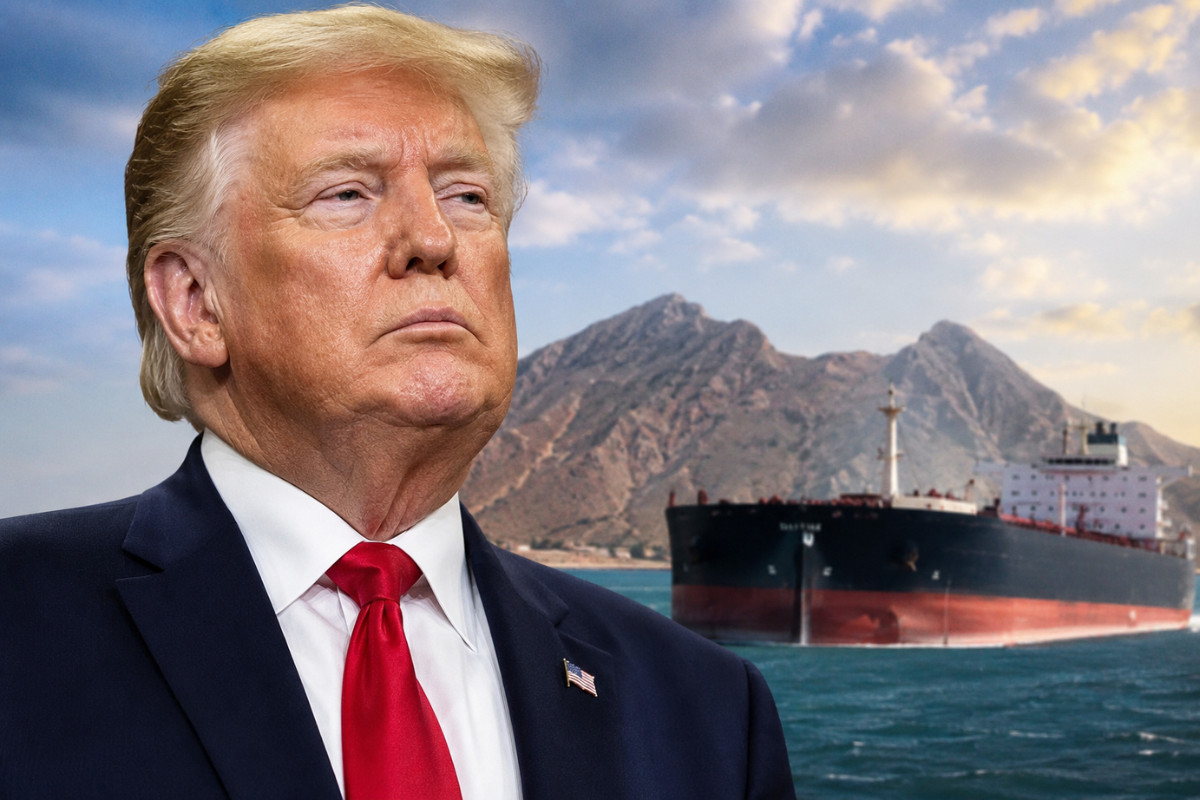
The collapse of the June 17, 2026 Versailles Memorandum of Understanding (MoU) between the United States and Iran marks a structural shift in global maritime trade: the transition from a freedom-of-navigation model to a competitive extraction model. When Iran declared the Strait of Hormuz closed "until further notice" following tactical disputes over shipping corridors, the immediate response from Washington was not merely military retaliation, but an unprecedented economic declaration. The announcement of a unilateral 20 percent tariff on all commercial cargo transiting the waterway, coupled with the reinstatement of the U.S. naval blockade on Iranian energy exports, transforms the world’s most critical maritime choke point from a shared international highway into a high-friction toll zone. Understanding the operational realities of this escalation requires moving past political rhetoric and examining the specific mechanics of maritime routing, tariff economics, and tactical military limitations.
The fundamental flaw in standard assessments of the crisis is the assumption that the Strait of Hormuz is either entirely open or entirely closed. Data from maritime intelligence firms like Kpler reveals a more complex reality. On July 12, 2026, immediately following Iran’s declaration of closure, 14 vessels transited the strait. While this represents a catastrophic decline from pre-war averages—where approximately 25 percent of global seaborne oil and 20 percent of liquefied natural gas (LNG) passed through the channel daily—it demonstrates that traffic has not ground to an absolute halt. Crucially, half of those 14 transits were Iranian-flagged vessels, revealing that the true operational objective of the Islamic Revolutionary Guard Corps (IRGC) is not a blanket denial of access, but the enforcement of absolute sovereign jurisdiction over the shipping lanes.
This enforcement mechanism relies on a geographic bifurcation of the strait. The conflict centers on two competing transit corridors:
- The Northern Lane: This route hugs the Iranian coastline and passes directly through territorial waters managed by the newly formed Persian Gulf Strait Authority. Tehran demands that all commercial vessels utilize this lane, submit manifests for prior authorization, and coordinate explicitly with Iranian naval units.
- The Southern Lane: This route runs parallel to the coast of Oman, passing through the Musandam Governorate's waters. The U.S. military and its regional allies have attempted to establish this as an alternative corridor outside direct Iranian physical control, utilizing escorted convoys under initiatives like Operation Project Freedom.
The immediate catalyst for the current breakdown was the kinetic targeting of two commercial tankers, the Mombasa and the Al Bahiyah, within the southern shipping lane near the Omani coast. By utilizing cruise missiles and one-way attack drones to disable these vessels, Iran demonstrated the tactical invalidity of the southern route without requiring a permanent physical presence there. Merchant shipping lines operate on strict insurance risk matrices. When the United Kingdom Maritime Trade Operations (UKMTO) designated the threat level in the strait as "severe," the practical effect was a near-total withdrawal of commercial hulls from the Omani corridor, irrespective of U.S. Central Command (CENTCOM) statements asserting that the waterway remains legally open.
The introduction of a proposed 20 percent U.S. tariff on transit cargo introduces a destabilizing economic variable into maritime law. Under long-standing international frameworks, specifically the United Nations Convention on the Law of the Sea (UNCLOS) and governing principles monitored by the International Maritime Organization (IMO), international straits used for international navigation are subject to the regime of transit passage. This regime explicitly forbids coastal states or outside powers from suspending passage or levying mandatory tolls simply for transiting the waterway. The U.S. proposal to collect a 20 percent fee to offset the cost of naval protection alters this legal landscape.
Iranian Foreign Minister Abbas Araghchi capitalized on this policy shift by noting that Washington’s endorsement of a toll system effectively legitimizes the concept of charging for maritime security. The strategic calculation from Tehran is clear: if the United States establishes a precedent for monetizing choke point security, Iran can claim the identical right as the primary coastal state. Araghchi’s public statements indicating that Iran would "be fair" in setting its own alternative user fees indicates that both nations are moving toward a framework where shipping lines must account for institutionalized extortion as a baseline cost of operation.
To quantify the financial friction of a 20 percent cargo tariff, consider the cost structure of a modern Very Large Crude Carrier (VLCC). Carrying roughly two million barrels of crude oil, a VLCC transiting the strait with oil priced at eighty dollars per barrel represents a total cargo value of 160 million dollars. A 20 percent tariff imposes a 32 million dollar fee on a single transit. For containerized cargo, bulk minerals, and specialized chemical shipments, such a margin eliminates the profitability of the trade route. This tariff structure forces a reassessment of global supply chains, pushing alternative logistics routes from marginal ideas to economic necessities.
The structural alternatives to the Strait of Hormuz, however, face acute capacity bottlenecks:
- The East-West Pipeline (Saudi Arabia): Stretching from the Eastern Province to the Red Sea port of Yanbu, this pipeline has a nominal capacity of roughly 5 million barrels per day. Prior utilization and domestic refining needs leave less than 3 million barrels per day of excess capacity for export diversion.
- The Abu Dhabi Crude Oil Pipeline (UAE): Connecting the Habshan fields to Fujairah on the Gulf of Oman, this system bypasses the strait entirely but is capped at a maximum throughput of 1.5 million barrels per day.
- The Iraq-Turkey Pipeline: This northern route remains subject to chronic geopolitical disruptions and structural maintenance deficits, limiting its reliability as a major relief valve.
Combining all functional regional bypass pipelines yields a maximum diversion capacity of fewer than 5.5 million barrels per day. This leaves over 15 million barrels per day of regional oil production completely dependent on the physical passage through the strait. Consequently, any prolonged disruption or cost inflation within the channel immediately manifests as a structural deficit in the global energy market, directly driving up the prices of refined products, agricultural fertilizers, and maritime freight rates globally.
On the military axis, the current escalation exposes the limitations of airpower against asymmetric, deeply fortified adversaries. CENTCOM reported striking 140 Iranian military targets within a 48-hour window, focusing heavily on coastal missile batteries, drone launch facilities, and port infrastructure in southern cities like Bandar Abbas and Kish Island. These strikes degrade immediate launch capabilities but fail to alter the strategic calculus. The threat of U.S. strikes against highly fortified subterranean installations, such as Mount Kolang Gaz La (Pickaxe Mountain) near the Natanz complex, underscores the limits of conventional deterrence. Strategic analysts recognize that the deeply buried tunnel complexes at these locations are virtually impervious to conventional ordnance. Threatening these assets signals political urgency but does not provide a functional solution to the immediate problem of low-cost drone and sea-mine proliferation in the maritime corridor.
The tactical reality is that Iran retains the capacity to disrupt shipping using low-signature assets that are highly resistant to traditional air interdiction. The deployment of bottom-bound sea mines, small-boat swarms operated by the IRGC Navy, and mobile, truck-mounted anti-ship cruise missiles hidden within rugged coastal topography allows Tehran to maintain a persistent threat envelope. A U.S. naval blockade targeting Iranian ports—scheduled to resume systematically at 4:00 p.m. Eastern Time on July 14, 2026—can successfully starve the Iranian regime of official seaborne oil revenues, but it does not disarm these coastal denial systems. This creates a continuous feedback loop: U.S. blockades increase Iranian economic desperation, which drives further Iranian kinetic interventions against neutral shipping to force international pressure on Washington.
For global shipping entities and state energy procurement agencies, navigating this environment requires abandoning reliance on a rapid diplomatic resolution. The Versailles MoU demonstrated that short-term ceasefires are structurally unstable when the underlying issue of territorial and financial control over the strait remains unresolved. The strategic play for global energy consumers involves three immediate tactical adjustments.
First, shipping consortia must restructure charter party agreements to include explicit clauses for choke point tariffs, allocating the legal and financial responsibility for the proposed 20 percent fees between cargo owners and ship operators before vessels enter the Gulf of Oman. Second, sovereign importers must transition from just-in-time inventory management to strategic stockpile accumulation, treating the current reduction in transit volume as a permanent baseline change rather than a temporary anomaly. Third, international maritime syndicates must prepare for a multi-jurisdictional toll environment, developing compliance frameworks that can handle competing payment demands from both U.S. and Iranian authorities for the identical transit. The era of unhindered, cost-free passage through the global maritime commons has ended; survival in the new trade reality requires pricing the cost of geopolitical enforcement directly into the commodity itself.