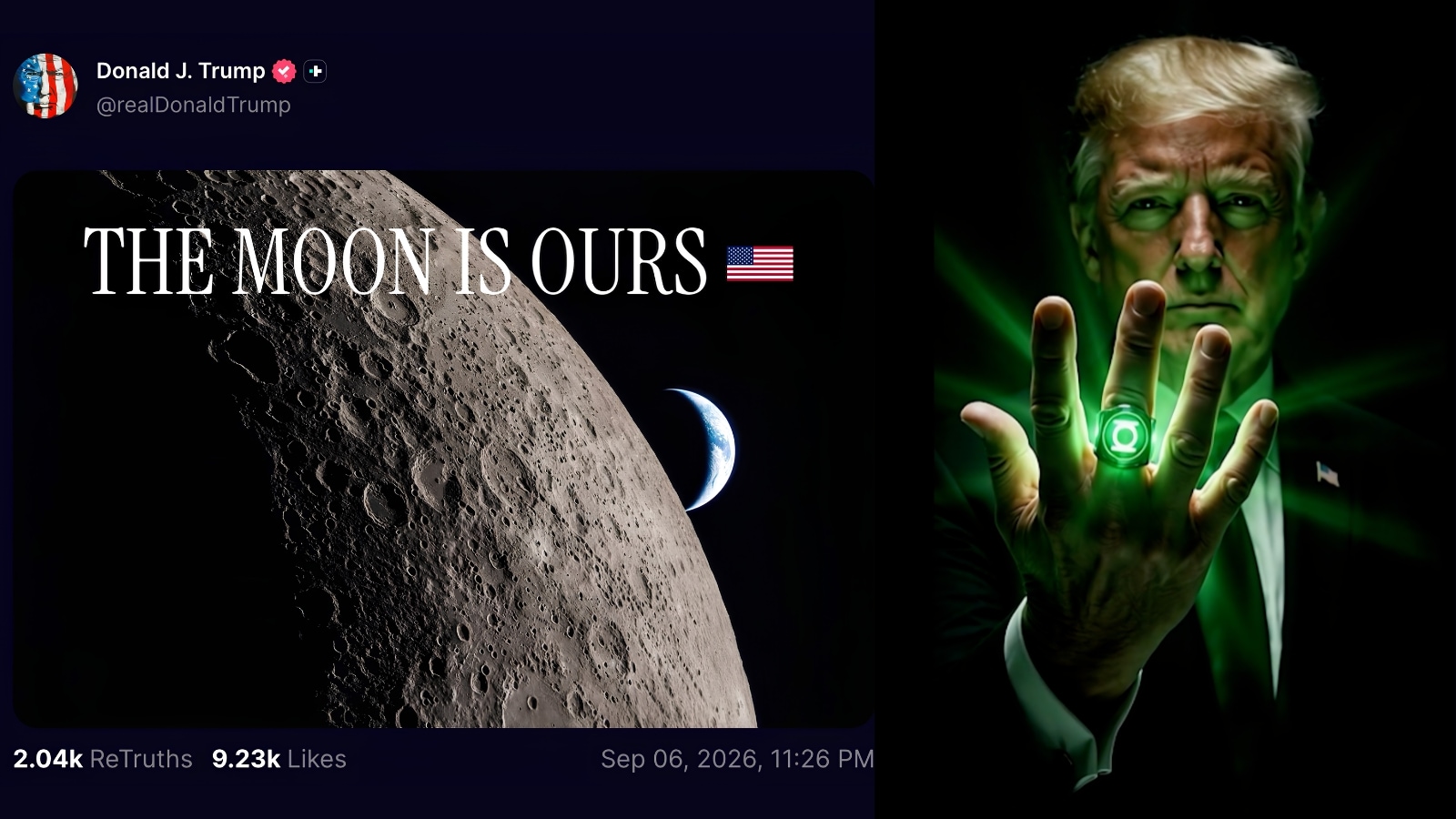
The media machine broke its collective neck trying to unpack a digital artifact. Donald Trump drops a post on Truth Social implying lunar real estate acquisition, and the chattering classes sprint to their microphones. Washington flacks spin it into caped-crusader myth-making. Pundits on cable news furrow their brows and debate outer space treaties, international law, and the Outer Space Treaty of 1967.
They are all getting played by a masterclass in distraction.
Everyone treats these digital outbursts as policy proposals or literal claims of sovereignty. That is lazy analysis. It is worse than that; it is falling for a basic magic trick. While you are staring at the glittering distraction of celestial declarations, the real operational mechanics of power are moving entirely elsewhere.
The Absurdity of the Literal Interpretation
Let us clear up the legal reality right out of the gate. The Outer Space Treaty of 1967 explicitly bans sovereign claims over celestial bodies by any nation-state. Article II states that outer space, including the Moon and other celestial bodies, is not subject to national appropriation by claim of sovereignty, by means of use or occupation, or by any other means.
Trump knows this. His lawyers know this. The interns writing press releases in the West Wing know this.
Treating a social media dispatch as a formal territorial claim is like treating a viral tweet about buying the Atlantic Ocean as a maritime annexation. Yet, elite media outlets draft breathless reports analyzing the geopolitical fallout of a crater-sized PR stunt. They conflate performance art with statecraft.
When a politician launches a grenade into the public square via digital broadcast, the media's job is not to catch it and inspect the pin. The job is to ask who benefits from the smoke.
The Superhero Spin and the Trap of Authenticity
The White House counter-narrative is equally predictable. They rush to cast him as a modern-day pioneer pushing past bureaucratic boundaries, a cosmic entrepreneur thumbing his nose at globalist red tape.
This is the opposite of the truth. It is not boundary-pushing; it is defensive anchoring.
I have watched political communication strategies for two decades, and the rulebook never changes. When domestic economic indicators pinch or policy fights stall, you elevate the conversation to a plane where facts do not exist. You cannot audit the Moon. You cannot inspect the ledger of celestial assets. By shifting the discourse to a theater where accountability is physically impossible, you starve your critics of measurable data.
The superhero branding is designed to insulate him from mundane competence. If you judge a leader by inflation rates, legislative passage, or administrative execution, you are playing a game with scoreboards. If you judge a leader by whether he is bold enough to conquer the cosmos in 280 characters or less, the scoreboard dissolves. You have traded empirical results for vibes.
Why the Opposition Falls for It Every Single Time
The opposition party dives headfirst into the trap. They draft earnest, multi-page policy papers explaining why lunar colonization requires international multilateral frameworks. They trot out astrophysicists and treaty negotiators to patiently explain that property deeds issued on the Sea of Tranquility carry no legal weight.
It is excruciating to watch.
You cannot fact-check a joke or a troll with a peer-reviewed journal article. Every minute spent explaining why the Moon is not up for grabs is a minute not spent talking about things that actually affect the electorate's bottom line. The strategy relies on oxygen depletion. By flooding the zone with absurdities, the baseline of political discourse drops until nobody can breathe.
Imagine a scenario where a corporation CEO tweets that they now own the weather. Wall Street does not halt trading. Competitors do not panic. They ignore it because they understand market capitalization, supply chains, and regulatory compliance. Political journalism should adopt the same cold, transactional cynicism.
The Real Game is Attention Monopolization
Attention is the only currency left that matters. Traditional political capital used to be measured in legislative majorities, donor networks, and institutional trust. Those assets are depreciating. Today, political capital is measured purely in eyeballs captured and held.
A post about lunar ownership costs zero dollars to produce and yields millions of impressions. It crowds out investigative reporting on judicial appointments, infrastructure spending, or regulatory rollbacks. It is algorithmic judo.
We need to stop analyzing these moments through the lens of political science or international law. Analyze them through the lens of attention economics. The product being sold is not lunar property. The product is your focus.
The Antidote to Digital Circus Acts
If you want to break the cycle, the prescription is brutal and simple: starve the beast.
Treat non-substantive digital noise with the profound silence it deserves. When a public figure throws a flare into the sky, look down at what they are trying to step over.
The next time a headline blares about space claims, executive bravado, or digital manifest destiny, remember that power does not reside in the absurd. Power resides in the boring, grinding machinery of budgets, courts, and logistics. Everything else is just stardust and mirrors.
Stop looking at the Moon. Look at your wallet. Look at the contracts being signed in the dark.