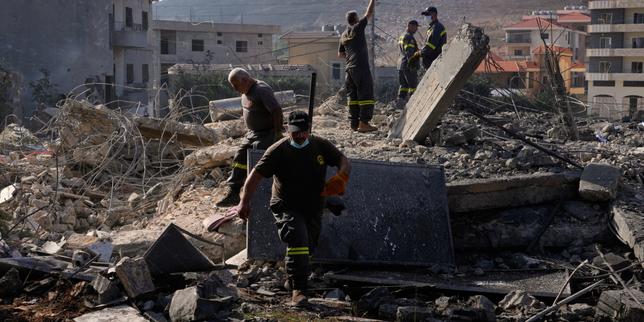
Every major news desk is currently clutching its pearls over the latest violation reports coming out of southern Lebanon. Headlines shriek about eleven dead, including two infants, wringing hands over why a parchment document signed in a sterile diplomatic room failed to stop bombs in the dark. The lazy consensus across international media treats these violations as anomalies—glitches in an otherwise functioning diplomatic machinery. They act surprised when a kinetic military machine continues to grind after a ceasefire is declared.
Stop being naive. A ceasefire that lacks structural enforcement mechanisms and leaves a heavily armed, deeply entrenched non-state actor integrated into civilian neighborhoods is not a peace deal. It is a strategic pause designed to lock in territorial gains and set the parameters for the next phase of escalation.
I have watched analysts burn millions of words and countless hours dissecting the minutiae of these broken truces, treating diplomatic communiqués like sacred scripture while ignoring raw operational reality. Clausewitz taught us that war is the continuation of politics by other means. A signature on a diplomatic pact does not rewrite the calculus of commanders on the ground who view complete tactical dominance as their only security guarantee.
Let us look past the superficial outrage and examine the mechanics of how modern asymmetric border zones actually function.
The Anatomy of a Dead-on-Arrival Truce
When a government or military force agrees to a cessation of hostilities under international pressure, they rarely abandon their core strategic objectives. They shift metrics. In the current theater, military planners operate on a doctrine of preventive attrition. If an adversary retains the capacity to reconstitute rocket launch sites or move heavy munitions through civilian conduits, the logic of total security dictates preemptive kinetic action, regardless of what the ink on the treaty says.
To understand why these tragedies keep repeating, look at the geography of human shielding and urban integration. Modern military analysts often talk about "cleared zones" as if they are empty chess boards. They are not. They are densely populated civilian sectors where combatants, infrastructure, and non-combatants live stacked on top of one another. When an air strike levels a residential building in places like Kafr Rouman, the mainstream press focuses exclusively on the horrific human toll—which is real, devastating, and undeniable—while completely ignoring the systemic structural failure that places civilians in the crosshairs of an active, unresolved war zone.
Imagine a scenario where a criminal syndicate stores automatic weapons inside a kindergarten. If law enforcement conducts a raid that ends in disaster, blaming the concept of policing misses the foundational pathology: the deliberate weaponization of civilian density. Yet, international reporting routinely sanitizes this dynamic, treating every strike in a populated zone as an unprovoked violation rather than a brutal symptom of asymmetric warfare design.
Why Diplomatic Theater Fails Every Single Time
Diplomats love ambiguous wording because ambiguity allows everyone to claim victory at the signing ceremony. But ambiguity is fatal on a live battlefield. When a cessation agreement fails to define explicit, verifiable enforcement triggers, it invites escalation.
Consider the standard operational response cycle:
- An intelligence cell detects movement or asset transfer in a restricted zone.
- Commanders calculate a threat window.
- A strike is authorized because the cost of inaction is perceived as higher than the diplomatic fallout.
- The agreement fractures further.
The media treats each iteration of this cycle as a shocking betrayal. It is not a betrayal; it is the predictable output of a broken system. Security architectures that rely on good faith between bitter enemies sharing a razor-thin border are bound to collapse. Good faith does not exist in a zero-sum security dilemma.
If you want to understand why eleven people die in a night raid, stop looking at the ceasefire document. Look at the failure of the state to monopolize violence within its own borders. Look at the operational doctrine that permits parallel military states to operate inside sovereign territory. Until those structural root causes are addressed, calling an active combat zone "pacified" because of a political photo-op is worse than useless—it is a lethal delusion that lulls civilians into staying in places where survival is mathematically impossible.
Stop demanding better behavior from a military machine executing its core doctrine. Demand honesty from the analysts who pretend that words on paper can suspend the laws of strategic survival.