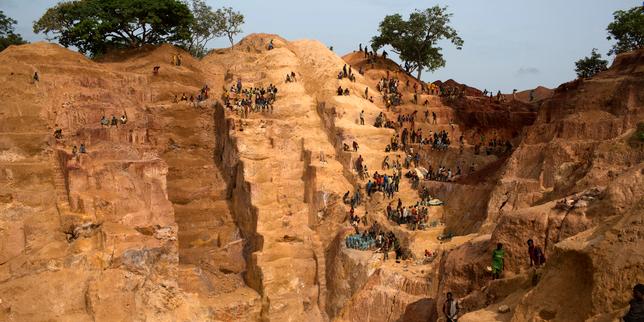
The headlines are churning, breathless and predictable. Another collapse in Zamboyé, another hundred souls buried beneath the red earth of the Central African Republic, and another round of finger-wagging from international observers who wouldn't know a pickaxe from a fountain pen. You are being fed a narrative of "preventable tragedy" and "lack of regulation." It is a comfortable, lazy lie designed to shield you from the ugly, structural reality of the global gold market.
The consensus is clear: the state failed to enforce safety, the miners were reckless, and the international community should provide more oversight. This is a fairy tale. It assumes a state that actually functions—or even desires to function—in the peripheral zones where gold is pulled from the ground. When you call for "stricter regulation" in a lawless border zone like Nana-Mambéré, you aren't calling for safety. You are calling for a bureaucratic tax that ensures the gold flows into more "legitimate" hands rather than the pockets of the workers.
Let’s dismantle the stupidity.
The Myth of the Regulated Mine
Observers love to lament the "informal" or "illegal" status of these sites. They treat informality as a bug in the system. It is the feature.
I’ve walked the perimeters of sites like these. They aren't "unregulated" because the government forgot to visit. They are unregulated because the state in the Central African Republic has zero incentive to formalize labor that essentially functions as an off-the-books survival mechanism for tens of thousands of people. If the state "regulated" Zamboyé, it would have to acknowledge the miners, provide infrastructure, and handle the tax burden. It is far easier to let them die in silence and offer a pro-forma "condolence" statement to the international press.
Imagine a scenario where a foreign NGO arrives with "safety gear" and "training protocols." What happens? The cost of production spikes. The margins for the artisanal miner—who is already working on razor-thin survival wages—evaporate. The mine shuts down, or it moves three kilometers further into the bush where it is even more dangerous, even less visible, and even more desperate. Your intervention creates a higher mortality rate in the shadows than the status quo does in the light.
The Real Cost of Your Gold
The indignation you see on your screen is performative. If you truly wanted to stop the "tragedy," you wouldn't be reading about it; you would be boycotting the global supply chain that effectively treats artisanal gold as a fungible commodity.
The gold leaving Zamboyé doesn't stay in the village. It enters a pipeline that cleanses it of its blood-stained origins. Once it passes through a few intermediaries, it is refined, melted, and stamped with a "clean" origin. Your jewelry, your electronics, your central bank reserves—they are the end users. Every time you demand a "cleaner" supply chain, you aren't saving lives; you are simply forcing the illicit trade to hide behind more complex layers of shell companies and smuggling routes.
Expertise Versus Sentiment
Let’s be precise. A "mine collapse" in this context isn't a failure of engineering. It’s a failure of desperation. When you are starving, you do not perform a geotechnical survey on the soil stability of your pit. You dig. The physics of these accidents is simple: vertical shafts, no shoring, saturated ground. The local authorities know this. They have seen the same death tolls in Bé-Mbari and Bonéwela. They choose not to act because their authority is limited to the pavement in Bangui.
The "People Also Ask" crowd wants to know: Who is responsible?
The answer is brutal: We all are.
We created a global market that demands the commodity but refuses to acknowledge the human cost of the extraction. We want the gold to be "ethical" while simultaneously wanting it to be cheap. You cannot have both. When you push for higher standards without providing massive capital infusion for structural stabilization, you are voting for the extinction of the artisanal miner’s livelihood.
What Actually Works
If you want to move beyond the shallow outrage of the press release, look at the only mechanism that has ever actually shifted the needle: direct, localized capital. Not grants to governments. Not international task forces. Not "oversight committees."
Direct investment in simple, low-cost mechanical support systems for artisanal cooperatives—tools that allow them to extract gold without digging their own graves—is the only path that doesn't involve crushing the poor under the weight of "compliance." But this requires risk. It requires working with the people on the ground rather than the bureaucrats in comfortable offices.
The tragedy in Zamboyé is not that the ground gave way. It is that the world has built a system where the ground is the only thing a man has left to bet his life on. Stop asking for more regulations. Start questioning why you need the gold so badly that you’re willing to keep the system exactly as it is.
The shovels are still hitting the dirt in Zamboyé. They aren't waiting for your pity. They are looking for the next vein. And the people who buy their gold are waiting for the next shipment, conveniently scrubbed of the dirt, the blood, and the truth.


