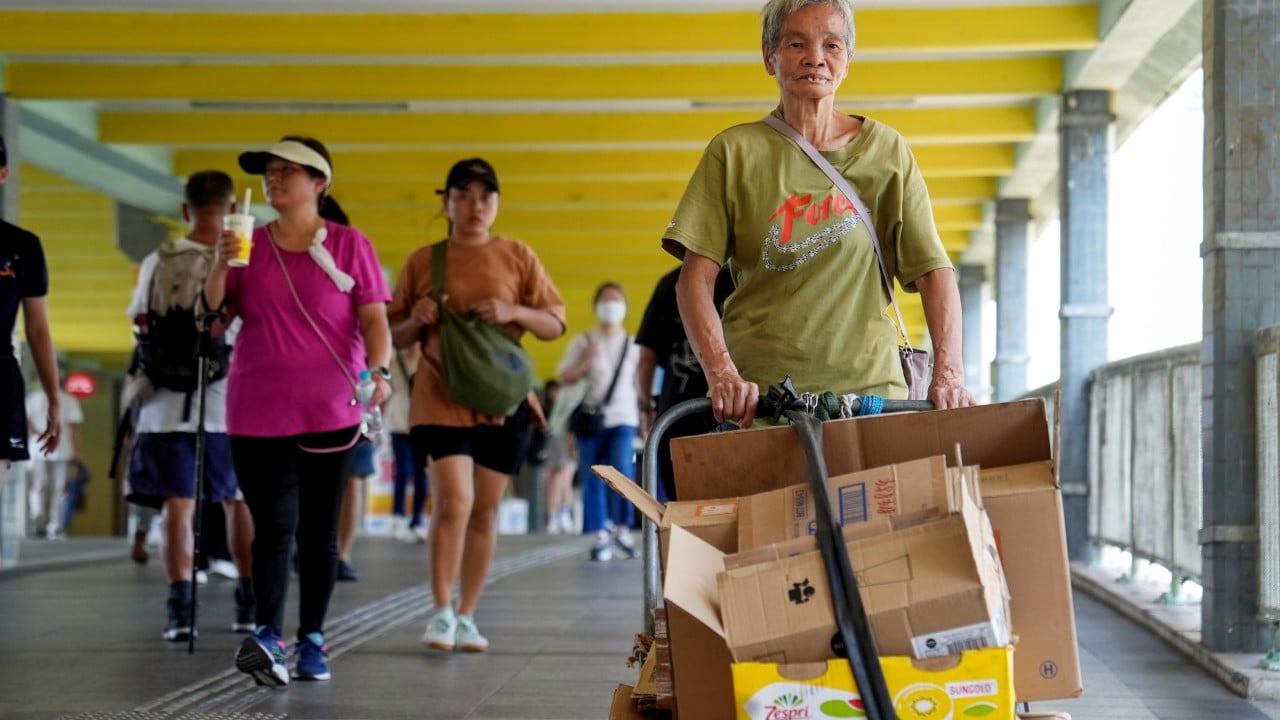
Every time cardboard prices crash in Hong Kong, the exact same tear-jerking op-ed gets published. You know the script. A journalist walks down a humid alleyway in Sham Shui Po, snaps a high-contrast black-and-white photo of an octogenarian pushing a rusted trolley piled six feet high with flattened boxes, and asks how these vulnerable seniors will survive now that scrap dealers have slashed payout rates by half.
It is emotional. It is poetic. And it is completely missing the point. If you enjoyed this post, you should check out: this related article.
By framing falling cardboard prices as an existential crisis for Hong Kong’s elderly scavengers, mainstream media accidentally defends an informal labor market that relies on destitute seniors to subsidize the city’s broken waste management infrastructure. When you cry over the falling price of corrugated fiberboard, you are arguing for the preservation of a system where an eighty-year-old woman has to haul fifty kilograms of wet trash through rush-hour traffic just to afford a bowl of congee.
The real story is not how these seniors will survive a drop in scrap prices. The real story is why the wealthiest financial hub in Asia still uses its oldest, frailest citizens as unpaid municipal sanitation workers—and why a crash in cardboard value might actually be the best thing that ever happened to them. For another look on this event, check out the recent update from Reuters Business.
The Myth of the Noble Scavenger
Let’s dismantle the romanticism first. Media coverage of Hong Kong’s "cardboard grannies" (zi pei po po) almost always leans into a narrative of rugged self-reliance. Pundits talk about how collecting waste gives isolated seniors a sense of purpose, keeps them active, and provides supplemental pocket money.
Ask anyone who has actually spent time tracking municipal waste supply chains in East Asia, and they will tell you that this narrative is pure PR cover for systemic policy failure.
Nobody pushes a metal cart up a fifteen-degree incline in thirty-two-degree heat with ninety percent humidity for "exercise." They do it because Hong Kong’s retirement safety net has massive, gaping holes. For decades, the city operated without a universal pension scheme, relying instead on the Mandatory Provident Fund (MPF)—a defined-contribution system launched in 2000 that came too late for anyone currently over the age of seventy-five. Even for younger cohorts, high management fees and low contribution caps mean the MPF rarely yields enough to cover basic rent in one of the world’s most expensive real estate markets.
When the Hong Kong government implements new waste policies—whether it is shifting subsidies for recyclers, tightening cross-border scrap import quotas with mainland China, or introducing municipal solid waste charging schemes—scrap buyers immediately pass the financial shock down the chain. Because cardboard collectors are classified as independent scavengers rather than employees, they have zero labor protections, zero minimum wage guarantees, and zero bargaining power.
When a recycler drops the payout from HK$0.80 per kilogram to HK$0.40 per kilogram, the granny does not get to unionize. She just has to push twice as much weight to make the same twenty dollars.
How the Scrap Supply Chain Actually Works
To understand why price drops happen—and why trying to artificially prop up scrap prices is a fool’s errand—you have to look at the economics of secondary commodities.
Cardboard is not magic. It is a global commodity traded on thin margins. Historically, Hong Kong’s recycling sector functioned entirely as a collection and baling hub for mainland Chinese paper mills. Street collectors gathered the boxes from retail shops, sold them to local street-corner middlemen, who then trucked them to massive recovery yards in the New Territories before shipping them across the border to Guangdong.
Then came China’s National Sword policy in 2018, followed by subsequent bans on foreign solid waste imports. Suddenly, the primary buyer for Hong Kong’s low-grade, contaminated street cardboard vanished overnight.
In response, the Hong Kong Environmental Protection Department (EPD) stepped in with subsidized recycling schemes, setting floor prices for licensed recyclers to keep the domestic collection network from collapsing completely. Whenever those subsidy parameters shift, or whenever global pulp prices dip due to manufacturing slowdowns, local street buyers slash their buying rates immediately to protect their own razor-thin margins.
Here is the brutal economic reality that human-interest journalists ignore: A system that requires elderly people to perform backbreaking manual labor for pennies per pound is structurally broken regardless of whether the price is high or low.
If you lobby the government to subsidize scrap dealers so that cardboard prices stay high, you are not helping the elderly. You are pouring public tax dollars into an inefficient, hazardous, informal gray market. You are literally paying to keep eighty-year-olds on the streets dodging delivery vans.
The Questions Everyone Gets Wrong
Whenever this topic trends on social media, the exact same misguided questions pop up in the comments. Let’s tear apart the flawed premises behind them.
"Should the government set a minimum price for collected cardboard?"
No. Setting a statutory price floor on street scrap is an economic disaster waiting to happen. First, it creates massive arbitrage opportunities where commercial waste haulers and retail chains stop paying for private waste disposal and instead dump their commercial cardboard onto the streets—or into the hands of proxy collectors—to capture the subsidized rate. Second, it cements street scavenging as an official career path for the elderly. You do not fix poverty by making dangerous, sub-minimum-wage labor slightly more lucrative. You fix poverty by decoupling basic human survival from trash collection.
"Don't many of these seniors actually have savings and just choose to work?"
This is the favorite talking point of fiscal conservatives in Hong Kong who want to justify low public welfare spending. Yes, surveys conducted by local NGOs like Waste No Mall and various university social work departments have found that a fraction of street collectors own public housing units or hold modest savings.
So what? In a city where a single medical emergency in the private sector can wipe out a lifetime of savings, and public hospital wait times stretch into years, hoarding cash out of sheer terror is a rational survival mechanism. Even among those who collect cardboard to stave off loneliness, the fact that the only accessible community activity available to a working-class senior in Kowloon is sorting through commercial garbage is an indictment of urban planning, not a heartwarming anecdote.
"What happens to Hong Kong's recycling rate if the grannies stop collecting?"
This is the quiet part that municipal planners never want to say out loud. According to official EPD waste statistics, Hong Kong’s overall municipal solid waste recovery rate has hovered around thirty percent for years—a dismal figure compared to neighbors like Taipei or Seoul, which routinely hit over fifty or sixty percent.
Within that thirty percent, paper and cardboard make up the lion's share, and informal street collectors account for a massive percentage of the commercial cardboard recovered from dense urban districts. Without those thousands of elderly workers acting as unpaid sorting machines, Hong Kong’s landfills—which are already nearing capacity—would be completely overwhelmed.
The city has been free-riding on geriatric poverty to hit its environmental targets.
The Contrarian Fix That Actually Works
If we stop asking how to help cardboard grannies survive lower scrap prices, we can finally ask the right question: How do we eliminate the street-scavenging economy entirely without starving the people currently trapped in it?
It requires attacking the problem from two completely different angles simultaneously—municipal waste logistics and targeted income replacement—while refusing to mix the two together.
1. Force Commercial Producers to Pay for Their Own Trash
The overwhelming majority of cardboard collected by Hong Kong’s elderly does not come from residential apartments. It comes from supermarkets, pharmacies, convenience stores, and logistics hubs that dump their empty shipping boxes directly onto public sidewalks every evening.
Right now, these multi-billion-dollar retail conglomerates enjoy free waste removal because street collectors clean up their mess before municipal street sweepers arrive at dawn.
The fix is simple: strict, aggressive Extended Producer Responsibility (EPR) laws backed by heavy fines. Retail chains and commercial buildings must be legally required to bale and transport their own corrugated waste directly to licensed recycling facilities. No dumping on public pavements. No relying on informal scavengers to clear the loading docks. When corporations have to internalize the true cost of their packaging waste, the supply of "free" street cardboard dries up, and professional logistics operators take over the heavy hauling using forklifts and trucks—not eighty-year-old backs.
2. Replace Scrap Subsidies with Direct Geriatric Cash Transfers
Every dollar the government spends trying to stabilize scrap paper markets or funding convoluted recycling middlemen should be redirected straight into the Old Age Living Allowance (OALA).
Critics always scream about moral hazard and budget deficits whenever direct cash transfers are mentioned. Yet Hong Kong sits on hundreds of billions of Hong Kong dollars in fiscal reserves. More importantly, paying a senior a guaranteed, inflation-adjusted monthly stipend is vastly cheaper for the taxpayer than paying for the orthopedic surgeries, heatstroke hospitalizations, and traffic accident trauma care that inevitably result from seniors working in active roadways.
When a senior receives an unconditional cash floor that comfortably covers food, utilities, and medical copays, the economic coercion disappears. If they still want to stay active, they can join community centers, tend urban gardens, or take on light, insured part-time roles in neighborhood recycling stations.
3. Formalize Neighborhood Collection Hubs with Real Employment
Look at what happened when NGOs and social enterprises began opening clean, air-conditioned community recycling stores (like the GREEN@COMMUNITY network) across Hong Kong's eighteen districts. Initially, these hubs were designed to encourage middle-class residents to drop off plastics and glass.
The smartest evolution of this model is turning these neighborhood hubs into formal employers for the exact demographic currently pushing carts. Instead of forcing seniors to compete with each other on the street for volatile per-kilogram payouts, municipal contractors should hire them on hourly, insured shifts to manage sorting stations, weigh incoming materials, and educate residents.
You get cleaner, uncontaminated recyclables—which command higher prices on the global market—and the worker gets a predictable paycheck, air conditioning, and worker’s compensation insurance.
The Uncomfortable Truth About Disrupting the Status Quo
Let’s be brutally honest about the downsides of tearing down the informal scrap economy. If you aggressively formalize cardboard collection and ban commercial sidewalk dumping overnight, there will be immediate, painful friction.
First, small independent scrap-shop operators in older districts like Wan Chai and Mong Kok will go out of business. Many of these middlemen are themselves working-class families operating on razor-thin margins, paying exorbitant commercial rents to store bales of paper in tiny ground-floor units. Transitioning to a corporate EPR model wipes out their livelihood just as quickly as it removes the street collectors.
Second, a small subset of fiercely independent seniors will actively resist formalization. Having worked outside rigid schedules for decades, some elderly collectors genuinely prefer the autonomy of setting their own hours, keeping cash in hand daily, and avoiding bureaucratic paperwork. Taking away the street supply of cardboard removes an informal safety valve for people who deeply distrust government institutions and social workers.
Third, waste-to-landfill rates will almost certainly spike in the short term. Commercial retailers will drag their feet on compliance, illegal fly-tipping in rural New Territories will increase, and municipal collection costs will rise before the new corporate logistics networks stabilize.
Politicians hate short-term spikes in visible trash, and journalists love easy stories about plucky underdogs surviving against the odds. That is why both groups prefer to keep the current system limping along, offering thoughts, prayers, and minor policy tweaks whenever scrap prices tumble.
Stop Mournfully Watching the Carts Roll By
The next time a new waste policy triggers a drop in cardboard prices, resist the urge to share a viral photo of an elderly collector looking exhausted beside a pile of flattened boxes. That outrage is performative, and it protects the very machinery keeping her poor.
A thriving, world-class metropolis does not measure its compassion by how well its elderly citizens adapt to falling trash prices. It measures its compassion by ensuring no senior ever has to care what a kilogram of wet cardboard is worth in the first place. Let the street scrap market crash—and let it stay dead.