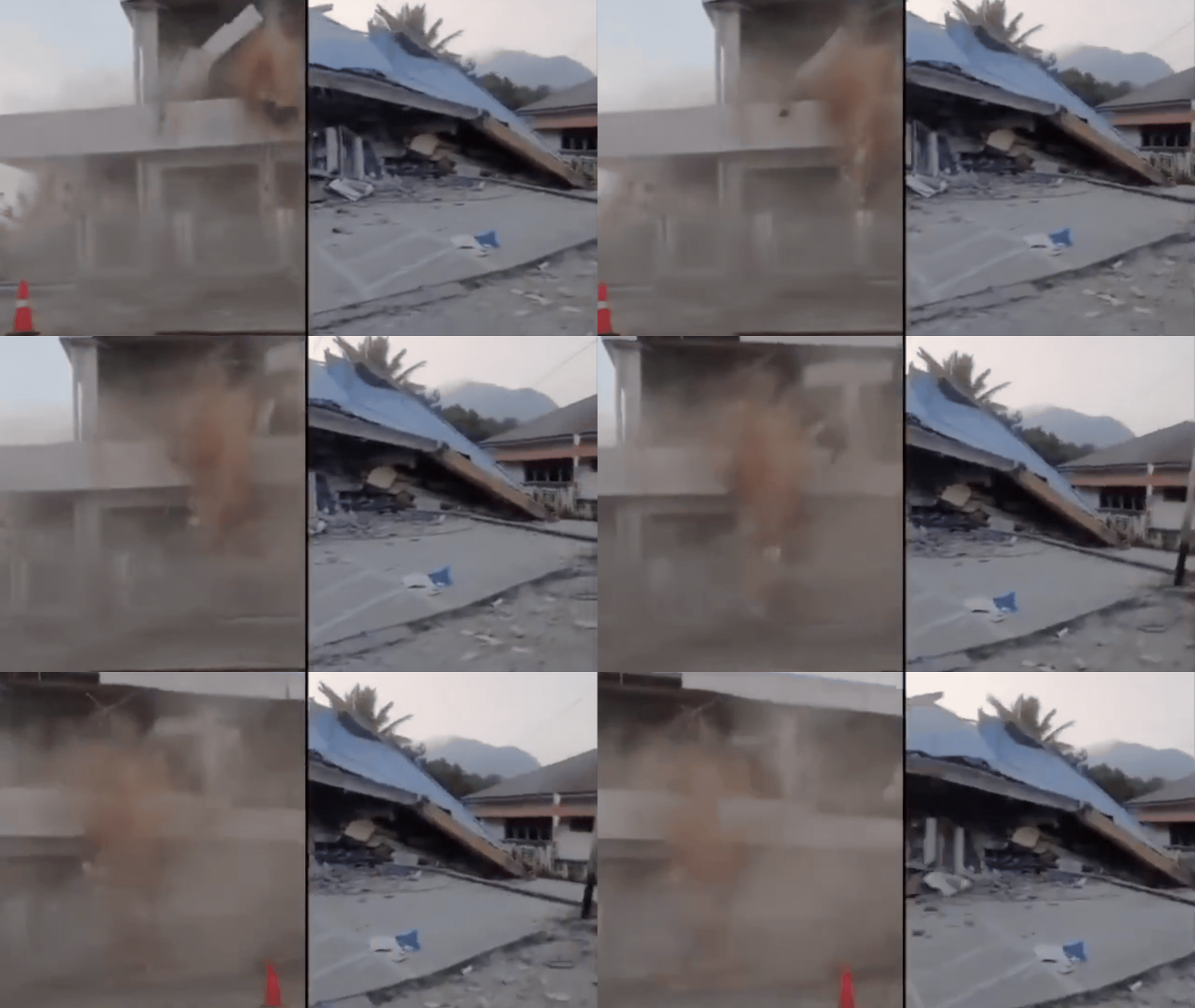
Another day, another breathless news cycle about Indonesia getting hammered by a cluster of major earthquakes and hundreds of aftershocks. The headlines read like an apocalyptic thriller. Three massive tremors in twenty-four hours. Over two hundred aftershocks shaking the earth raw. Panic in the streets. Evacuations in full swing.
The lazy consensus screams that Indonesia is cursed by geography, an endless victim of tectonic cruelty sitting squarely on the Pacific Ring of Fire.
That narrative is intellectually lazy, dangerously incomplete, and it lets human incompetence off the hook.
Nature does not murder people. Bad engineering does.
The Tectonic Red Herring
Every time the ground moves in the Banda Sea or off the coast of Java, seismologists rush to publish magnitude numbers, and media outlets treat the death toll as an act of angry gods. This framing completely misses the mechanics of disaster management.
Let us look at the actual physics. Tectonic subduction zones release unimaginable amounts of energy. You cannot stop plates from moving. You cannot negotiate with the Indo-Australian plate sliding beneath the Eurasian plate. The fault lines are immutable facts of our planet's crust.
Yet, treating the earthquake itself as the primary enemy is like blaming gravity for plane crashes.
I have spent years consulting on infrastructure resilience across Southeast Asia. I have walked through post-disaster zones where concrete crumbles into grey dust because contractors skimped on rebar, and municipal officials looked the other way during safety inspections. When a magnitude 7.0 quake hits and buildings pancake into rubble, the catastrophe is not natural. It is manufactured by corruption, poor zoning, and substandard construction materials.
Japan sits on the same fiery ring. They routinely absorb massive shocks that would level entire cities elsewhere without a single skyscraper blinking. Why? Because their structural philosophy treats seismic energy as an engineering puzzle to be solved, not a tragedy to be mourned.
Dismantling the Panic Economy
The 24-hour news cycle thrives on terror. A flurry of 230 aftershocks sounds terrifying to someone sitting in a high-rise in Manhattan or London. To a structural engineer or an experienced disaster response veteran, a swarm of aftershocks is simply the earth redistributing stress. It is a normal mechanical adjustment.
Yet, the media treats every rattle as a sign of impending doom, driving panic buying, crippling local tourism economies, and misallocating psychological resources. People lock themselves in fear while ignoring the actual variable they can control: the roof over their heads.
If you are asking why Indonesia keeps experiencing these massive clusters of seismic activity, you are asking the wrong question. The geographic reality is a constant. The real question is why capital allocation for retrofitting vulnerable masonry buildings lags decades behind economic growth.
Consider the economics of vulnerability. Retrofitting an older structure costs real money. Ignoring seismic codes until disaster strikes costs human lives and billions in emergency relief. Politicians love breaking ground on flashy new megacities while ignoring the crumbling brick masonry holding up neighborhood commercial districts in secondary cities.
The Uncomfortable Truth About Disaster Relief
When the dust settles and the international aid agencies swoop in with photo opportunities, a quiet cycle of complacency begins. Money flows in, temporary shelters go up, and everyone forgets until the next big shake triggers another round of performative empathy.
This approach is broken. Emergency response without structural enforcement is just a revolving door of tragedy.
Imagine a scenario where international funding blocks are tied strictly to mandatory structural audits rather than post-disaster charity. Imagine local governments enforcing zero-tolerance policies on substandard concrete mixtures instead of issuing retroactive building permits after bribes change hands. The resistance to this approach is fierce because it disrupts the status quo of cheap, fast, unregulated development.
Developers want margins. Municipalities want tax revenue from rapid expansion. The earthquake simply exposes the shortcuts they took five years prior.
What You Should Do Instead of Watching the Feed
Stop refreshing the earthquake tracker every ten minutes. The numbers do not change the ground reality. If you operate supply chains, invest capital, or live in high-risk seismic zones across the archipelago, your operational framework needs a total rewrite.
- Audit the Skeleton: If your building uses unreinforced masonry, no amount of emergency preparedness kits will save you when the shear waves hit. Upgrade the core load-bearing columns.
- Decentralize Logistics: Stop relying on central government warehouses that get cut off the moment a bridge buckles. Neighborhood-level cache systems save lives in the first critical six hours.
- Ignore Magnitude Hysteria: Focus on peak ground acceleration and soil liquefaction mapping instead of raw Richter scale numbers. A shallow magnitude 6.0 can devastate an area faster than a deep magnitude 7.5.
The earth is going to keep shifting. The plates will not stop moving because we wrote an editorial about it. The only variable that matters is whether we continue to build houses of cards on top of geological fault lines while pretending we had no way of knowing better.
Stop blaming the Ring of Fire. Start inspecting the concrete.