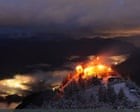
Every time someone strikes a match near a Third Reich relic, the international press loses its collective mind.
Look at the standard media coverage surrounding the arrest of a suspect over the fire at the Kehlsteinhaus—widely known by its Allied nickname, the "Eagle’s Nest"—in Berchtesgaden, Bavaria. The lazy consensus writes itself before the smoke even clears. Journalists treat the site as a sacred, fragile historical artifact that must be shielded from vandals at all costs, framing any physical threat to the building as an attack on historical memory itself. They clutch their pearls over property damage to a mountain chalet while completely ignoring the grotesque commercial machine that keeps the place running.
Here is the truth nobody in the Bavarian tourism board or the heritage preservation industry wants to say out loud. By treating the Kehlsteinhaus as an indispensable monument that requires endless protection and tourist foot traffic, we are actively subsidizing a sanitized, profitable theme park built on the back of mass murder.
I have spent over fifteen years advising cultural heritage boards, museum curators, and municipal tourism directors across Europe on how to manage contested sites. I have sat in boardrooms where officials agonize over paint scratches on fascist architecture while quietly celebrating the ticket revenue those exact buildings generate. The obsession with preserving every square inch of Nazi-era stone under the guise of "education" is one of the biggest intellectual frauds in modern travel and journalism.
The Myth of the "Hitler Retreat"
To dismantle the media’s hysteria over this fire, you first have to dismantle the foundational lie baked into almost every headline about the Kehlsteinhaus.
The press loves calling it "Hitler’s Eagle’s Nest retreat." That phrasing is pure clickbait. It conjures images of the dictator pacing the floorboards, plotting the invasion of Poland while staring out at the Bavarian Alps.
The historical reality is far less dramatic. The Kehlsteinhaus was commissioned by Martin Bormann as a fiftieth birthday gift for Adolf Hitler, completed in 1938. Hitler hated the place. He suffered from vertigo, despised the thin mountain air, and was terrified that the brass elevator shaft—blasted 124 meters straight through solid rock—would be struck by lightning. According to historical records from the Institute for Contemporary History in Munich, Hitler visited the Kehlsteinhaus fewer than fifteen times, usually for less than an hour to entertain foreign diplomats. His actual mountain residence, the Berghof, sat lower down on the Obersalzberg mountain.
Why does this distinction matter when a fire breaks out? Because the Allies already bombed and bulldozed the Berghof in 1952 specifically to prevent it from becoming a neo-Nazi shrine. They left the Kehlsteinhaus standing only because it had negligible strategic or ideological significance to Hitler himself, and because its remote perch made demolition logistically annoying.
When modern news outlets frame a fire at the Kehlsteinhaus as a threat to a "major Nazi headquarters," they are doing the propaganda work Martin Bormann could only dream of. They are inflating the historical weight of a diplomatic teahouse to justify outrage over an arson suspect, feeding the exact mythos that draws hundreds of thousands of gawkers up the mountain every summer.
The Dark Tourism Industrial Complex
If you want to understand why authorities react with maximum alarm to any incident at Berchtesgaden, follow the money.
The Kehlsteinhaus is not a solemn memorial like Dachau or Auschwitz. It is a high-volume commercial restaurant and observation deck. Every year, roughly 300,000 tourists pay hefty fees to ride specialized buses up the steep mountain road, walk through the cold stone tunnel, and ascend in the original polished brass elevator. Once at the top, they buy beer, eat bratwurst, and snap selfies on the terrace where Eva Braun once sunbathed.
Let us be brutally honest about the mechanics of this operation. The Bavarian state owns the property, leases it out, and funnels the proceeds into regional charities and maintenance. On paper, that sounds noble. In practice, it creates a perverse financial incentive. To keep the cash flowing, the site must remain attractive, accessible, and safe for casual vacationers.
I have watched European municipalities blow millions of euros on state-of-the-art security systems, fire suppression grids, and structural restorations for Third Reich buildings—money ripped directly from underfunded local schools, regional archives, and actual victims' memorials. When a fire happens at the Kehlsteinhaus, the panic is rarely about losing irreplaceable historical data. Every millimeter of that building has been photographed, laser-scanned, and documented ten times over. The panic is about losing a lucrative seasonal cash cow and facing the embarrassment of a security breach at a flagship tourist attraction.
Answering the Questions Tourists Are Too Afraid to Ask
When news of an arrest at a Nazi landmark hits the wire, search engines light up with predictable queries. People want to know if the site is safe, what was damaged, and why the building wasn't torn down decades ago. Let us strip away the polite tourist-brochure language and answer those questions directly.
Why didn't Germany destroy the Eagle's Nest after World War II?
Because the American military seized it in 1945, used it as an officers' club and recreational lookout, and handed it back to the Bavarian government in 1960. Unlike the Berghof, which the Bavarian authorities blew up to stop far-right pilgrimages, the Kehlsteinhaus was viewed as too stunning a piece of Alpine real estate to waste. Money and scenery beat ideological hygiene.
Is visiting the Kehlsteinhaus disrespectful to Holocaust victims?
That depends entirely on whether you go to the Dokumentation Obersalzberg down the hill first. If you skip the museum—which meticulously details the Nazi terror apparatus that operated from the mountain—and go straight to the summit to drink a lager and admire the view, you are not engaging with history. You are participating in voyeuristic leisure on a crime scene. Most visitors spend twenty minutes in the museum and three hours taking photos at the summit.
Does arresting arsonists actually protect historical memory?
It protects physical real estate and enforces the rule of law, which is the bare minimum any police force must do. Arson on a wooded mountain puts firefighters, hikers, and surrounding forests in lethal danger, and anyone setting fires in public spaces belongs in custody. However, equating the preservation of Bormann’s concrete and granite with the preservation of historical truth is a dangerous category error. History lives in rigorous scholarship, survivor testimony, and uncensored archives—not in a mountain restaurant's roof timbers.
The Architecture of "Täterorte" and the Preservation Trap
In German heritage studies, places like Obersalzberg are classified as Täterorte—sites of the perpetrators. Leading historians, including scholars like Norbert Frei and the team behind the Dokumentation Obersalzberg, have spent decades wrestling with a brutal dilemma: how do you explain Nazi architecture without accidentally glorifying it?
The consensus among mainstream heritage bureaucrats is "contextualization through preservation." Their theory goes like this: leave the building standing, slap a few informational plaques on the walls, and trust that the public will leave with a deep, sobering understanding of fascist megalomania.
That theory fails in the real world. Architecture is not a neutral textbook; it is a physical manipulation of human emotion. Albert Speer and Martin Bormann designed Third Reich structures to make individuals feel tiny, awestruck, and submissive to raw power. When you stand on the Kehlsteinhaus terrace looking out over the Königsee, you do not feel revulsion. You feel euphoria. The sheer beauty of the Alps hijacks your brain, washing away the blood price paid by the thousands of forced laborers who blasted that road out of the cliffside in thirteen months.
No metal plaque in the parking lot can out-argue a thousand-foot vertical drop and a sunny Alpine panorama. By keeping the building pristine, scrubbed of soot, and open for lunch service, the state allows the original Nazi aesthetic triumph to operate completely unchallenged.
The Hard Truth About Letting Things Rot
If I were advising the Bavarian authorities today—and putting my own career reputation on the line—I would tell them to stop treating the Kehlsteinhaus like a porcelain vase.
There is a radical alternative to both commercialized preservation and explosive demolition. Heritage theorists call it "controlled decay" or ruination. Imagine a scenario where, instead of pouring millions into restoring fire-damaged woodwork or polishing brass elevators to showroom shine, authorities shut down the restaurant, pull the commercial leases, and let the mountain slowly reclaim the structure.
Think about what happens when a fascist monument is allowed to weather, crack, and oxidize behind a secure perimeter.
- The glamour dies instantly. Neo-Nazis and thrill-seekers do not make pilgrimages to leaking, rusted, overgrown concrete bunkers that look like industrial failures. They make pilgrimages to pristine temples of power.
- The financial hypocrisy ends. The state stops profiting from the sale of postcards and sausages at a site built by slave labor.
- The focus shifts to the victims. Visitors are forced to engage with the actual history at the Obersalzberg documentation center at the base of the mountain, rather than using history as an excuse for a scenic gondola-style joyride.
Now, let us be completely transparent about the downsides of this approach, because pretending a contrarian strategy has zero flaws is amateurish. Letting a high-altitude structure decay creates real physical hazards. Falling masonry, unstable rock faces, and rusted infrastructure pose severe liability risks in an Alpine environment where hikers constantly trespass off-trail. Furthermore, shutting down a major tourist draw would deal an immediate economic blow to Berchtesgaden’s local hospitality sector—hoteliers, bus drivers, and guides who rely on summer traffic to survive the winter.
Those are legitimate administrative headaches. They are not excuses for pretending that a fire at a commercial mountain restaurant is a cultural tragedy on par with the burning of the Library of Alexandria.
Stop Confusing Real Estate With Remembrance
Every time a headline screams about a suspect arrested for a fire at the Eagle's Nest, look closely at what is actually being defended. Police are rightly enforcing arson laws to protect lives and public property. Media outlets are harvesting easy clicks by slapping Hitler’s name into a breaking news alert. And heritage officials are rushing to reassure the public that the monument will be repaired and reopened right on schedule.
Nobody is asking why we are so desperate to keep Hitler's birthday present in mint condition nearly a century after the fall of the Reich.
True historical literacy does not require an elevator ride to a mountaintop beer garden. It requires confronting the uncomfortable reality that turning the sites of perpetrators into manicured tourist attractions does not educate the public—it anesthetizes them. Let the police prosecute the arsonist, let the firefighters secure the mountain, and stop pretending that charred timber on a Bavarian peak is a wound to human history.