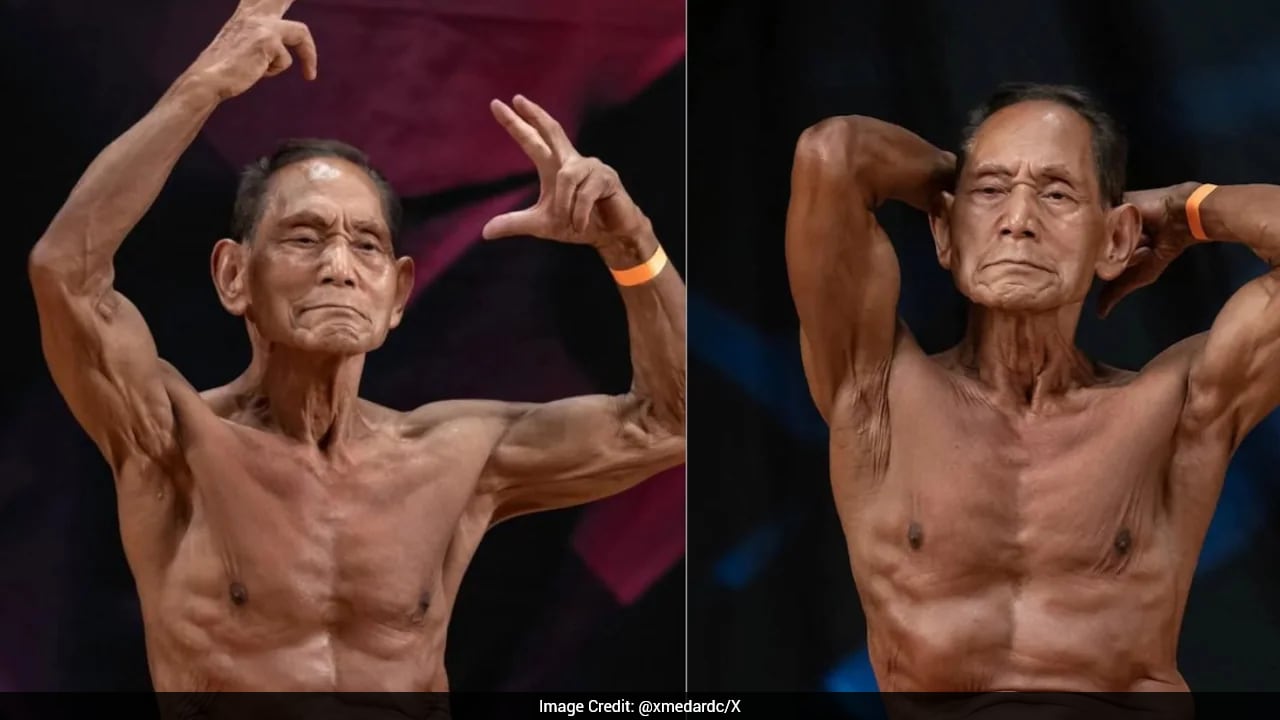
Every few months, a viral photo of Toshisuke Kanazawa makes the rounds on your social media feed. You know the one. A lean, tanned, ninety-year-old Japanese man hitting a double biceps pose on a bodybuilding stage, looking more shredded than guys a third his age.
And right below the photo, the fitness-industrial complex goes into overdrive. Comment sections fill up with cheap motivational slogans. "Age is just a number." "No excuses." "What is stopping you?" Mainstream health blogs churn out lazy, surface-level profiles celebrating his grit, his plant-based diet, and his daily training regimen as the ultimate blueprint for longevity. In similar news, read about: What Happens When Hospitals Treat Stillbirth Like a Routine Appointment.
They are lying to you by omission.
Worshipping Toshisuke Kanazawa as a fitness role model is like looking at a lottery winner and quitting your job to buy scratch-off tickets. It is a textbook case of survivorship bias dressed up as health journalism. If you are forty, fifty, or sixty years old and you try to copy the lifestyle that put Kanazawa on a stage at ninety, you will not end up looking like him. You will end up in an orthopedic surgeon's waiting room with torn rotator cuffs, degenerated lumbar discs, and systemic burnout. WebMD has provided coverage on this important topic in great detail.
Let us dismantle the fairy tale and look at the actual physiology behind the viral photos.
The Survivorship Bias Trap in Senior Bodybuilding
When mainstream outlets write about Toshisuke Kanazawa, they focus entirely on the highlight reel. They tell you he won the All-Japan Championship in his twenties, retired at thirty-four, let his body go, and then returned to the iron at age fifty because his wife was frequently sick and he wanted to make her happy. They gush over the fact that he competes in the Japan Bodybuilding & Fitness Federation (JBBF) well into his late eighties and nineties.
Here is what they leave out. Kanazawa is a genetic anomaly operating on a foundation of elite, championship-level muscle memory.
In exercise physiology, myonuclei are the control centers inside your muscle fibers. When you build massive amounts of muscle in your twenties—especially to the point of winning national titles, as Kanazawa did in the 1960s—your muscle fibers recruit and permanently retain extra myonuclei. Even if you stop lifting for sixteen years, eat poorly, smoke, and drink, those myonuclei do not disappear. They sit dormant. The moment you pick up a barbell again at fifty, your body skips the grueling, years-long process of cellular construction and simply re-inflates the existing architecture.
You do not have national-champion myonuclei sitting in your biceps.
I have watched dozens of middle-aged executives and weekend warriors fall for this exact trap. They see an outlier like Kanazawa or Ernestine Shepherd, decide they are going to train like competitive bodybuilders in their fifties, and immediately destroy their connective tissue. Muscle tissue has a rich blood supply and adapts quickly to mechanical tension. Tendons, ligaments, and joint cartilage are largely avascular—they have terrible blood flow and adapt at a glacial pace. When an average fifty-year-old pushes bodybuilding-style volume without decades of structural conditioning, the muscles get strong enough to rip the tendons right off the bone.
Why His Famous Diet Will Starve Your Muscles
The second piece of lazy consensus surrounding Kanazawa is his nutrition. Articles love to highlight that he eats a primarily plant-based, low-protein diet consisting of brown rice, natto (fermented soybeans), miso soup, vegetables, and fruit, with almost no meat or fish. Wellness writers hold this up as proof that you do not need animal protein to build and maintain muscle in old age.
This is dangerously bad nutritional advice for the general population.
As you age, your body develops anabolic resistance. Think of it as insulin resistance, except instead of ignoring blood sugar, your muscle cells ignore dietary protein. A twenty-year-old can trigger maximal muscle protein synthesis (MPS) with 20 grams of protein. A seventy-year-old needs closer to 40 or 50 grams of high-leucine protein in a single sitting just to flip that same genetic switch.
Dr. Stuart Phillips, one of the leading protein researchers in the world, has spent decades proving that older adults require significantly more protein, not less, to fight off sarcopenia (age-related muscle wasting). Plant proteins are notorious for having lower bioavailability and lower concentrations of leucine—the specific amino acid required to stimulate the mTOR pathway and initiate muscle repair.
Kanazawa gets away with eating brown rice and natto because of two factors you likely do not share:
- Caloric and metabolic efficiency forged over seventy years of athletic adaptation.
- A 5-foot-tall frame. Kanazawa stands roughly 152 centimeters (around 5 feet) tall and weighs around 50 kilograms (110 pounds) on stage. His absolute daily protein requirement is tiny compared to a 5-foot-10, 185-pound man.
If a standard-sized 65-year-old man adopts Kanazawa’s low-protein, plant-heavy bodybuilding diet while lifting weights daily, he will rapidly lose lean muscle mass, tank his testosterone levels, and compromise his bone mineral density. You cannot out-discipline basic biochemistry.
The Hidden Cost of Stage Conditioning at Ninety
Let us talk about the physique itself. Look closely at photos of Kanazawa on stage. Yes, his skin is tight, his veins are visible, and his abdominal separation is remarkable for a nonagenarian.
In the bodybuilding world, we call that "stage lean." In the medical world, we call it severe physiological stress.
Getting body fat down to single digits requires a prolonged, aggressive caloric deficit. In young men, dieting down to contest shape crashes natural testosterone to hypogonadal levels, tanks thyroid function (specifically T3), elevates cortisol, and weakens the immune system. In a ninety-year-old body, the margin for error is microscopic.
| Metric | Longevity & Healthspan Focus | Competitive Bodybuilding Focus |
|---|---|---|
| Body Fat Percentage | 12% – 18% (Men) / 20% – 26% (Women) | 4% – 7% (Men) / 10% – 14% (Women) |
| Training Volume | 3–4 days/week, submaximal effort | 5–7 days/week, high systemic fatigue |
| Joint Stress | Controlled, joint-friendly ranges of motion | Repetitive overuse for aesthetic symmetry |
| Hormonal Profile | Optimized, stable endocrine function | Suppressed via chronic caloric restriction |
| Primary Goal | Functional independence & fall prevention | Subjective visual judging on a stage |
Notice the massive divide between looking good under stage lights and actually being healthy. Subcutaneous fat is not just dead weight; it is an active endocrine organ that buffers your immune system, cushions your joints, and regulates hormones. When elderly individuals carry zero reserve energy, a single bout of influenza or a minor fall becomes a life-threatening event.
Kanazawa himself has admitted in Japanese interviews that he no longer trains with heavy weights because his joints cannot take it, shifting instead to lighter weights, longer rest periods, and focusing purely on the mind-muscle connection. Yet the clickbait articles conveniently gloss over this, letting readers assume he is still throwing around heavy iron like a twenty-year-old.
What People Also Ask About Senior Bodybuilding
When people search for Toshisuke Kanazawa, they usually end up down a rabbit hole of related questions. Most of those questions are built on flawed assumptions. Let us set the record straight.
Can you really build muscle at 90 years old?
Yes, but temper your expectations. Studies—including the landmark 1990 Fiatarone study published in JAMA—prove that even frail nursing home residents in their nineties can increase muscle strength and size through resistance training. However, the hypertrophy you achieve at ninety is functional, not cosmetic. You can improve your ability to stand up from a chair without using your hands, which might save your life. You are not going to pack on ten pounds of dense contractile tissue and win a trophy unless you built that frame half a century ago.
Is bodybuilding good for longevity?
No. Resistance training is arguably the single best intervention for longevity. Competitive bodybuilding is the exact opposite. Resistance training builds bone density, improves insulin sensitivity, and protects cardiovascular health. Bodybuilding demands extreme dehydration, chronic starvation cycles, obsessive psychological fixation on body image, and pushing joints past their structural limits for symmetry. Confusing the two is like confusing a daily jog with running an ultramarathon on broken ankles.
What is Toshisuke Kanazawa's exact workout routine?
According to profiles in Japanese fitness media, Kanazawa trains almost every day, often spending hours at the gym, though much of that time is spent socializing, resting, and doing light, high-repetition isolation movements. He avoids heavy compound lifts that compress the spine or shear the knees. If you copy his frequency without copying his ultra-low intensity and massive recovery windows, you will fry your central nervous system within three weeks.
How to Actually Train for Your Nineties
If your goal is to be independent, strong, and pain-free at ninety—rather than starving yourself for a plastic trophy—you need to throw out the bodybuilding playbook entirely.
1. Prioritize Eccentric Control Over Heavy Loads
You do not need massive weights to stimulate muscle growth, especially as you age. Research on blood flow restriction (BFR) and low-load training to near-failure shows that lifting 30% to 40% of your one-rep max yields virtually identical hypertrophy to lifting 80%, with a fraction of the joint shear. Slow down the lowering (eccentric) phase of every lift to three or four seconds. You will create massive mechanical tension on the muscle belly while sparing your tendons.
2. Train for Power, Not Just Slow Strength
Bodybuilders move weights slowly and methodically to maximize time under tension. That is terrible for aging. As we get older, we lose Type II (fast-twitch) muscle fibers twice as fast as slow-twitch fibers. Fast-twitch fibers are what catch you when you trip on a curb. If you only train slow, you lose the ability to react quickly. Dedicate the first ten minutes of every workout to explosive, low-impact movements: medicine ball slams, fast kettlebell swings, or rapid box step-ups.
3. Eat Like an Athlete, Not a Monk
Forget the brown rice and natto minimalism unless you are a 110-pound genetic outlier. Anchor every single meal around 35 to 45 grams of complete, bioavailable protein. Eggs, Greek yogurt, whey isolate, wild-caught fish, and lean meats are your best friends here. If you insist on staying plant-based, you must supplement with pure L-leucine or use concentrated pea-and-rice protein isolates to overcome anabolic resistance.
4. Measure VO2 Max and Grip Strength, Not Bicep Circumference
Vanity metrics do not keep you out of an assisted living facility. Two biomarkers predict all-cause mortality better than almost anything else in medicine: VO2 max (your cardiovascular ceiling) and grip strength (a direct proxy for total-body neuromuscular integrity). Include heavy farmer's carries in your routine twice a week, and do at least 150 minutes of Zone 2 cardio alongside one brutal, high-intensity interval session per week.
The Real Lesson of Toshisuke Kanazawa
Toshisuke Kanazawa is an extraordinary human being. His discipline, devotion to his late wife, and sheer refusal to fade quietly into old age deserve genuine respect.
Just stop using him as an instructional manual.
Admire the painting, appreciate the artist, and then go build a training program designed for your actual biology. When you are ninety, nobody is going to care how clearly they can see your abs under fluorescent lights. They are going to care whether you can carry your own groceries up a flight of stairs without breaking a hip.