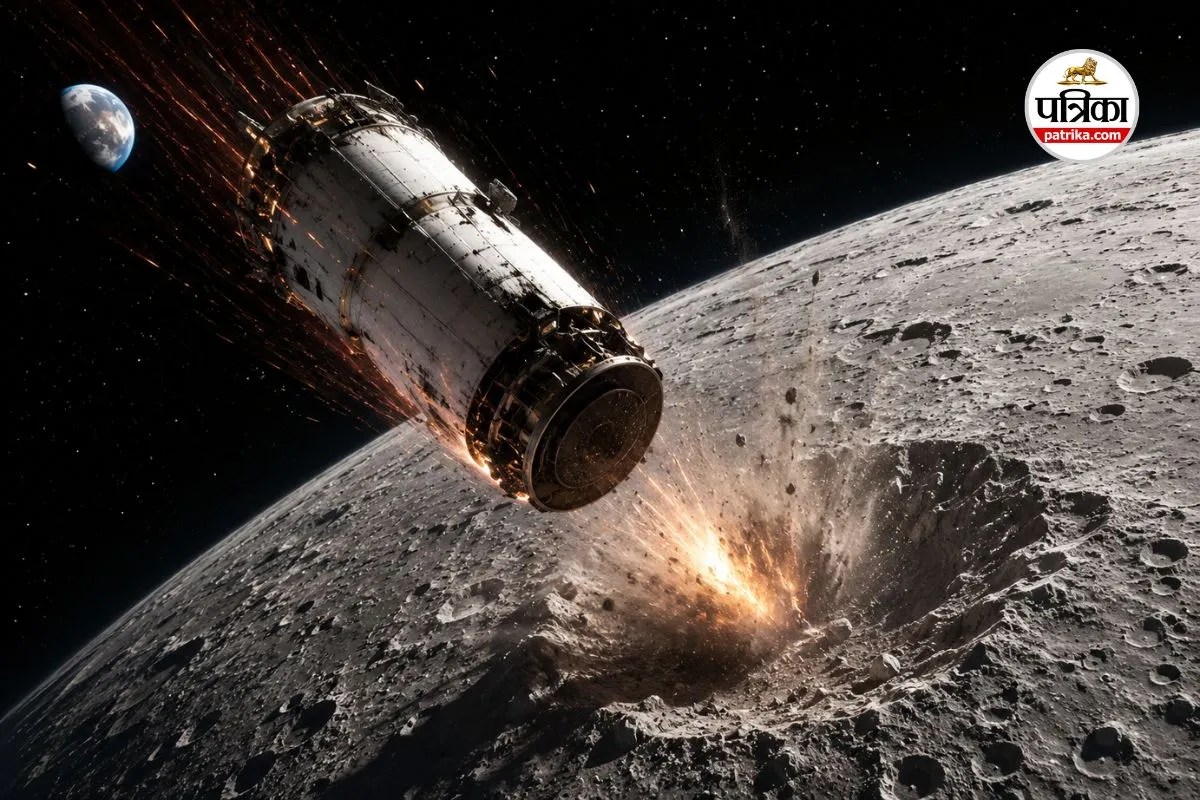
Every few years, the internet collectively loses its mind over orbital debris. The narrative writes itself. A rogue piece of industrial hardware, discarded years ago, tumbles through the vacuum of space before smashing into a celestial body. Mainstream outlets run breathless headlines about school-bus-sized boosters leaving craters, painting a picture of corporate recklessness painting the heavens with trash.
It is high-drama theater built on a foundation of scientific illiteracy. Building on this topic, you can also read: Raytheon Autonomous Launcher Field Test Performance and System Economics.
I have watched aerospace programs chew through billions of dollars while armchair pundits hyperventilate over passive iron and aluminum chunks doing precisely what celestial mechanics dictates they must do. The panic over that stray SpaceX upper stage hitting the lunar surface back in 2022 is the ultimate monument to this manufactured outrage. People gasped at the impact coordinates as if humanity had desecrated a pristine museum.
Let us dismantle the hysteria. The Moon has been taking a beating for 4.5 billion years. A dead Falcon 9 booster crashing into a desolate basalt plain is not an ecological catastrophe. It is a rounding error on a cosmic scale. Experts at Engadget have also weighed in on this trend.
The Physics They Ignore
When critics scream about space junk defacing the solar system, they reveal a profound misunderstanding of both orbital mechanics and the actual state of the Moon.
Let us look at the numbers. The Moon gets hit by natural meteoroids every single day. Micro-meteoroids pound it constantly. Larger rocks, weighing tons, impact with enough frequency to continuously churn the lunar regolith. This process is called gardening. Over billions of years, asteroid impacts have pulverized the top few meters of the lunar surface into a fine, powdery dust.
Now enter the infamous booster. We are talking about roughly four metric tons of empty steel and aluminum alloy traveling at a few kilometers per second. It punched a shallow crater a dozen meters wide.
To put that in perspective, nature does that exact same thing to the lunar neighborhood with rocks on a regular basis. The kinetic energy of a spent rocket stage is puny compared to even a modest meteoroid impact. Yet, because the booster bore a corporate logo from an era of commercial spaceflight, pundits treated a minor dent in a dust-covered wasteland like an environmental oil spill.
I have spent decades watching engineers obsess over delta-v budgets, fuel residuals, and disposal orbits. The obsession with cleaning up every single piece of inert metal in deep space is a luxury belief held by people who have never had to balance the mass fraction of a trans-lunar injection.
The False Purity Myth
The underlying premise of the freak-out is that space is a sacred wilderness that we are ruining with our industrial footprint. This is romantic nonsense.
Space has never been pristine. It is a violent, radiation-soaked shooting gallery of high-speed debris, solar radiation, and cosmic shrapnel. Comets drop organic molecules and dirty ice everywhere. Asteroids shatter against planets and moons without asking for an environmental impact statement.
Pretending that leaving a spent casing on the Moon permanently ruins some untouchable scientific archive ignores how geology works. The lunar surface is constantly resurfaced by solar wind sputtering and impact gardening. In a few million years, thermal stress, micrometeoroid bombardment, and radiation will break down that aluminum shell into unrecognizable fragments, thoroughly mixed into the regolith.
The real danger in orbital management is not deep-space litter. It is low Earth orbit congestion, where thousands of active and dead satellites threaten operational assets in congested altitude bands. That is a tangible problem requiring strict orbital decay planning and active debris removal.
Hysteria over a dead stage hitting a dead rock a quarter-million miles away is a distraction from the real regulatory battles we need to fight. It trades rigorous engineering oversight for cheap emotional theater.
The Cost of Pristine Ideology
If we listened to the zero-impact purists, we would never leave the atmosphere. Every launch requires a trade-off. To push payloads out of Earth's gravity well, you must shed mass. You drop stages. You burn propellants. You accept that hardware will end up where gravity pulls it.
Demanding that every upper stage perform complex disposal maneuvers back toward Earth when it is already on an escape trajectory to heliocentric or lunar space requires massive mass penalties. You burn fuel to carry extra fuel just to alter the trajectory of a dead hunk of metal. That means smaller payloads, fewer science instruments, and inflated mission costs.
We trade actual human advancement and deep-space exploration for aesthetic sensibilities.
The engineers who designed that Falcon 9 mission did not fail. They executed a complex lunar flyby trajectory, deployed their primary payload, and left the remaining hardware to the laws of physics. The fact that it eventually intersected the Moon is a testament to the chaotic, intersecting pathways of interplanetary space.
What We Should Actually Measure
Instead of pearl-clutching over structural scrap on the Moon, let's look at metrics that matter.
- Orbital Density: Track active constellations in low Earth orbit where collision cascading is an actual threat to human spaceflight.
- Passivation Protocols: Ensure dead satellites and upper stages vent remaining propellants and battery reserves to prevent explosive fragmentation.
- Re-entry Safety: Manage the controlled de-orbit of massive platforms in Earth orbit to guarantee zero risk to populated ground zones.
Notice how none of these involve crying over a dent in the Sea of Fertility.
The next time an outlet tries to sell you a panic piece about space junk crashing into an interplanetary body, remember what you are looking at. You are looking at a species finally expanding off its home rock, interacting with a dynamic solar system that does not care about our delicate sensibilities.
Stop treating the universe like a glass museum. It is a construction site. Get used to the noise.